Sound power from surface vibration (ISO/TS 7849)
Standards: ISO/TS 7849Key references: Cremer et al. 2005
The airborne sound power a machine radiates through the structure-borne
vibration of its outer surface can be estimated from the surface vibratory
velocity and a radiation factor ε (the radiation efficiency), without an
acoustic measurement. The radiated power is (ISO/TS 7849-1, Formula 6)
with Z_c the characteristic impedance of air, ⟨v²⟩ the mean-square vibratory
velocity over the radiating area S. Expressed in levels (velocity level re
v₀ = 5·10⁻⁸ m/s), the A-weighted sound power level is (Formula 12 / 15)
where S₀ = 1 m², the normalized impedance Z_{c,n} = 411 N·s/m³ and the
reference Z_{c,0} = 400 N·s/m³ give the fixed 10 lg(411/400) = 0.118 dB
term. This module feeds the structure-borne source and building prediction
standards (ISO 9611, EN 15657, EN 12354-5).
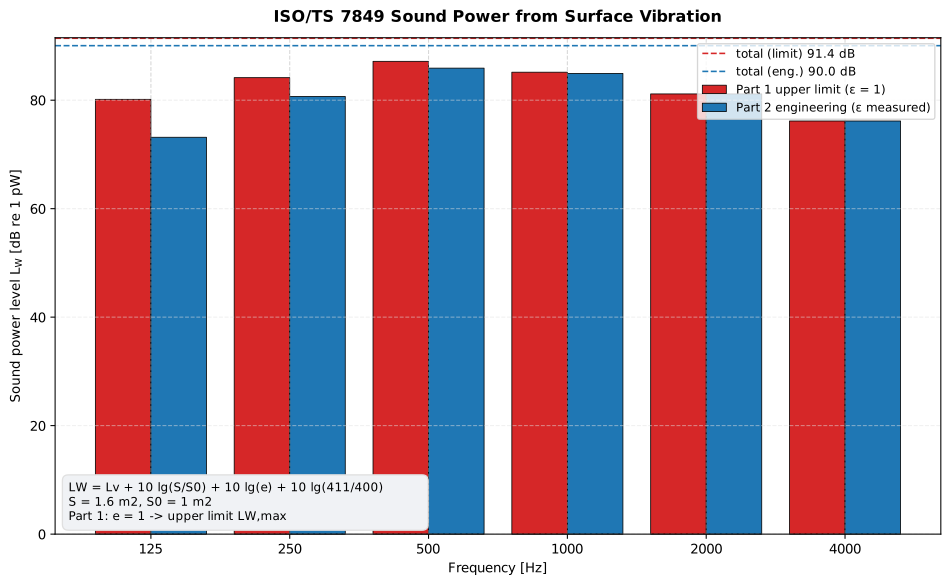
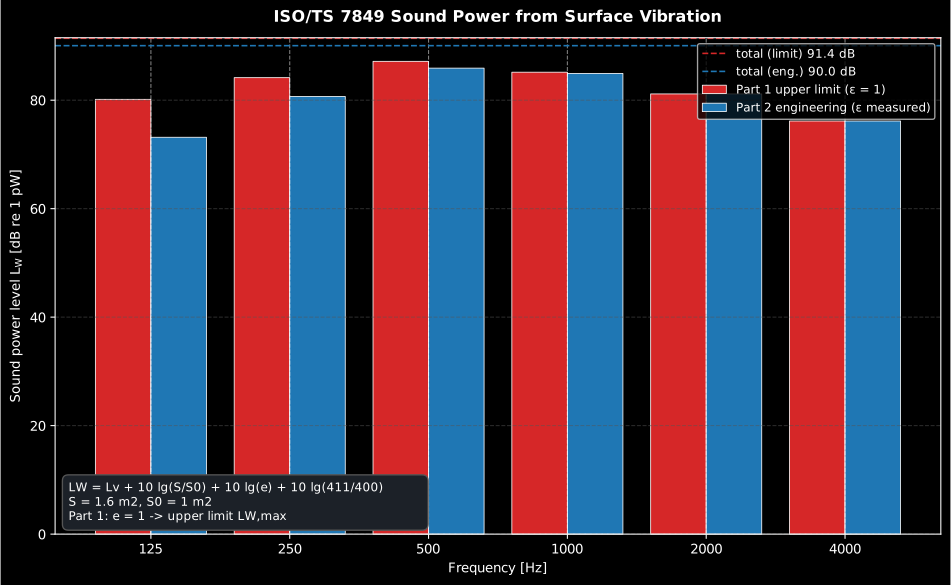
Show the code for this figure
import matplotlib.pyplot as pltimport numpy as npfrom phonometry import emission
# Surface velocity levels and a measured radiation factor per octave band.bands = np.array([125.0, 250.0, 500.0, 1000.0, 2000.0, 4000.0])lv = np.array([78.0, 82.0, 85.0, 83.0, 79.0, 74.0])eps = np.array([0.20, 0.45, 0.75, 0.95, 1.00, 1.00])
lw_max = emission.radiated_sound_power_level(lv, 1.6)  # Part 1, eps = 1lw_eng = emission.radiated_sound_power_level(lv, 1.6, radiation_factor=eps)  # Part 2
# One line — the LW(f) spectrum of one determination as a result object:res = emission.sound_power_from_vibration(lv, area=1.6, radiation_factor=eps,                                          frequencies=bands)res.plot()plt.show()
# By hand, comparing the two parts:x = np.arange(bands.size)fig, ax = plt.subplots()ax.bar(x - 0.2, lw_max, width=0.4, label="Part 1 upper limit ($\\varepsilon$ = 1)")ax.bar(x + 0.2, lw_eng, width=0.4, label="Part 2 engineering ($\\varepsilon$ measured)")ax.set_xticks(x, [f"{b:g}" for b in bands])ax.set(xlabel="Frequency [Hz]", ylabel="Sound power level $L_W$ [dB re 1 pW]")ax.legend()plt.show()
1. The two parts
Section titled “1. The two parts”The two parts differ only in the radiation factor. Part 1 (survey) assumes
ε = 1 and yields the upper limit L_W,max, needing only the velocity level
and the area. Part 2 (engineering) applies a frequency-band radiation factor
εⱼ determined (per ISO 9614) as εⱼ = Pⱼ/(Z_{c,n}·⟨vⱼ²⟩·S).
import numpy as npfrom phonometry import emission
bands = np.array([250.0, 500.0, 1000.0, 2000.0])lv = np.array([82.0, 85.0, 83.0, 79.0])          # mean velocity level per band [dB]
# Part 1 upper limit (epsilon = 1):upper = emission.sound_power_from_vibration(lv, area=1.6, frequencies=bands)print(round(upper.total_level, 1))               # e.g. 89.4  dB re 1 pW
# Part 2 engineering value with a measured radiation factor:eps = np.array([0.45, 0.75, 0.95, 1.00])eng = emission.sound_power_from_vibration(lv, area=1.6, radiation_factor=eps, frequencies=bands)print(np.round(eng.sound_power_level, 1))        # per-band L_W
eng.plot()   # the LW(f) spectrum, as in the figure above (needs matplotlib)
2. Velocity level, calibration and the radiation factor
Section titled “2. Velocity level, calibration and the radiation factor”The velocity level is L_v = 20·lg(v/v₀) (Formula 3); a sinusoidal calibration
acceleration converts as L_v = 20·lg(â/(2πf·v₀·√2)) (Formula 8). The radiation
factor comes from an independently measured power:
from phonometry import emission
# The standard's worked calibration EXAMPLE: 9.81 m/s^2 at 100 Hz.print(round(float(emission.velocity_level_from_acceleration(9.81, 100.0)), 1))   # 106.9 dB
# Radiation factor from a measured power (ISO 9614): eps = P / (Zc <v^2> S).eps = emission.radiation_factor(3.0e-4, area=2.0, mean_square_velocity=(1e-3)**2)print(round(float(eps), 3))                                                # 0.365
Surface velocity levels from several positions are combined with the energetic
mean mean_velocity_level (Formula 10) or its area-weighted form (Formula 11),
and the correction extraneous_velocity_correction removes extraneous
vibration per Table 2.
3. When the radiation-factor assumption breaks
Section titled “3. When the radiation-factor assumption breaks”The whole method stands on one substitution: replacing the acoustic
measurement by ε. The Part 1 value ε = 1 is close to the true radiation
factor only above the critical (coincidence) frequency of plate-like
parts, where bending waves travel faster than sound and the surface radiates
like a piston. Below coincidence, adjacent zones of the
plate move in antiphase and their radiation largely cancels: ε drops far
below one and falls quickly with decreasing frequency, so the survey method
can overstate the low-frequency bands of a large thin casing by 10 dB and
more. The same cancellation makes small sources radiate poorly (the acoustic
short circuit around an unbaffled panel). Two further assumptions are easy
to violate in the field:
- The measured vibration must be the machine’s own. Vibration fed in
from neighbouring machinery inflates
⟨v²⟩; Table 2 prescribes the source-off check andextraneous_velocity_correctionapplies it. - The surface must be the dominant radiator. Airborne sound from openings, intakes or internal sources that bypasses the measured casing is invisible to a velocity survey; the method characterises the structure-borne part only.
Part 2 exists exactly for the radiation-factor problem: it replaces the
fixed ε = 1
with a band-by-band εⱼ determined from one reference measurement of the
radiated power (ISO 9614 intensity), after which the velocity survey can be
repeated cheaply on nominally identical machines.
4. The measurement report (.report())
Section titled “4. The measurement report (.report())”A determination ends as a document. The VibrationSoundPowerResult exposes a
.report() method that writes a one-page PDF fiche laid out like a sound-power
test sheet: the standard-basis line naming the applied method (the ISO/TS
7849-1 survey method with a fixed radiation factor ε = 1, or the ISO/TS
7849-2 engineering method with a determined radiation factor), an optional
metadata header (client, machine/source, test environment, instrumentation,
climate, date), a per-band table (nominal octave/one-third-octave frequency,
the surface vibratory velocity level and the band sound-power level
), the sound-power spectrum with a nominal band axis, and a boxed
A-weighted sound power level (dB re 1 pW) with the total , the
radiating area and the applied method alongside.
The metadata is supplied through a ReportMetadata, whose applicable fields
here are the machine/source description (specimen), the test
environment (test_room), the client, the instrumentation, the
temperature, relative humidity and ambient pressure, the date of
test (test_date) and the footer identity (laboratory, operator,
report_id, notes); the radiating area comes from the result itself and
is printed in the result box, together with the sound-power relation
in the
basis strip. Supplying requirement adds a PASS/FAIL verdict against a declared
A-weighted sound-power limit (a sound-power emission is a quantity where less is
better, so the source passes at or below the limit). verbose=True adds the
radiation factor column to the table. language="es" renders the
Spanish fiche with comma decimals.
import numpy as npfrom phonometry import ReportMetadata, emission
freqs = np.array([125, 250, 500, 1000, 2000, 4000], float)lv = np.array([78.0, 82, 85, 83, 79, 74])          # surface velocity level [dB]eps = np.array([0.20, 0.45, 0.75, 0.95, 1.00, 1.00])  # measured radiation factorres = emission.sound_power_from_vibration(    lv, area=1.6, radiation_factor=eps, frequencies=freqs,)
res.report(    "vibration_sound_power.pdf",    metadata=ReportMetadata(        client="Example manufacturing plant",        specimen="Gearbox casing (steel panel)",        test_room="Machine hall (source vibration survey)",        instrumentation="Piezoelectric accelerometer (ISO 16063-21 calibration), s/n 0042",        laboratory="Phonometry reference example",        report_id="EXAMPLE-7849",        requirement=90.0,    ),)   # LWA = 88.7 dB(A) re 1 pW -> declared limit 90 dB(A): PASS
The example fiche is regenerated with make reports and kept rendered in the
repository; click the preview to open the PDF.
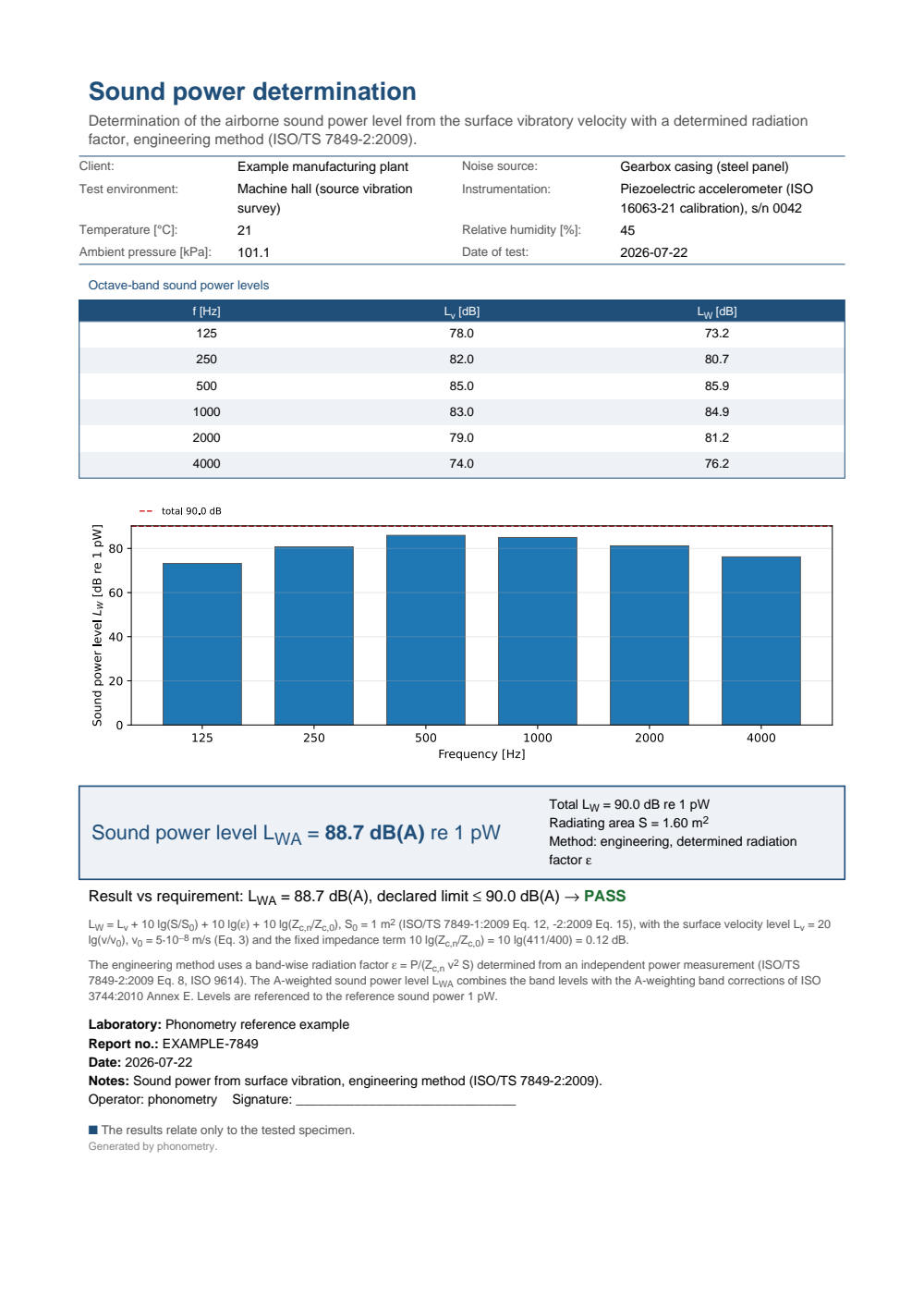
One-page ISO/TS 7849-2 sound-power-from-vibration determination fiche: a header with the client, the machine/source, the machine-hall test environment and the accelerometer and climate, the octave-band table (125 Hz to 4 kHz) of surface vibratory velocity levels Lv and radiated band sound-power levels LW, the sound-power spectrum LW(f) with a nominal band axis, the boxed A-weighted sound power level LWA = 88.7 dB(A) re 1 pW with the total LW = 90.0 dB, the radiating area S = 1.60 m2 and the engineering method, and a PASS verdict against the declared 90 dB(A) limit, closed by a basis strip stating the LW = Lv + 10 lg(S/S0) + 10 lg(epsilon) + 10 lg(411/400) relation with its fixed impedance term and the radiation-factor model.
What this guide covers
Section titled “What this guide covers”Covered. ISO/TS 7849-1:2009 and ISO/TS 7849-2:2009 as far as they define
the calculation of sound power from vibration: the radiated power
P = Z_c⟨v²⟩Sε (Formula 6), the velocity level and its calibration
conversion (Formulae 3, 8) run by velocity_level and
velocity_level_from_acceleration, the surface mean (Formulae 10/11) run by
mean_velocity_level, the extraneous-vibration correction of Table 2 run by
extraneous_velocity_correction, and the sound power level with the fixed
impedance term (Formula 12, Part 1) or a measured per-band radiation factor
(Formula 15, Part 2) run by radiated_sound_power_level and
sound_power_from_vibration. radiation_factor implements Part 2’s
single-machine Formula 8, converting an independently measured sound power
into ε.
Not covered. The measurement clauses of both parts (instrumentation,
source installation, the number and mounting of measurement positions,
environmental conditions: clauses 5 to 7) and their measurement-uncertainty
clauses and informative annexes are not implemented: they are laboratory
practice this guide assumes. Part 2’s clause 8 also asks for the radiation
factor of a machine batch or family, averaging εⱼ over several machines and
its standard deviation (Formulae 9, 10); only the single-machine Formula 8 is
implemented, so pass an already-averaged ε for a family determination. The
sound power that feeds radiation_factor must come from an ISO 9614
intensity measurement, covered separately in the
sound intensity guide.
See also
Section titled “See also”- API reference:
emission.vibration_sound_power.
References
Section titled “References”- Cremer, L., Heckl, M., & Petersson, B. A. T. (2005). Structure-borne sound: Structural vibrations and sound radiation at audio frequencies (3rd ed.). Springer. https://doi.org/10.1007/b137728The radiation-efficiency treatment behind section 3: coincidence, the cancellation below the critical frequency and the radiation of finite plates. ISBN 978-3-540-22696-3.
- International Organization for Standardization. (2009). Acoustics — Determination of airborne sound power levels emitted by machinery using vibration measurement — Part 1: Survey method using a fixed radiation factor (ISO/TS 7849-1:2009). The upper-limit method with ε = 1: the radiated power P = Z_c⟨v²⟩Sε (Formula 6), the velocity level and its calibration (Formulae 3, 8), the mean over the surface (Formulae 10/11), the extraneous correction (Table 2) and the sound power level with the fixed impedance term (Formula 12). Conformance is anchored on the standard's own worked calibration example.
- International Organization for Standardization. (2009). Acoustics — Determination of airborne sound power levels emitted by machinery using vibration measurement — Part 2: Engineering method including determination of the adequate radiation factor (ISO/TS 7849-2:2009). The engineering method with a measured band-wise radiation factor (Formula 4/8) and its sound power level (Formula 15). Conformance includes the exact round-trip between the radiation factor and L_W = 10 lg(P/P₀).