Why phonometry
phonometry is a standards-based acoustic measurement toolkit. Its differentiator is not the list of features but how they are built: every metric is implemented from the governing standard’s text, and the standard’s own reference values and acceptance limits are transcribed into the test suite and enforced in CI. This page explains that approach with a concrete case study (time weighting under IEC 61672-1:2013) and summarizes what is conformance-tested today. The time-weighting analysis was originally published in issue #38.
Design philosophy: a case study in time weighting
Section titled “Design philosophy: a case study in time weighting”Standard time weighting is defined as a continuous function of time via the differential equation
which corresponds to a stable first-order low-pass filter with a pole in the left half-plane ().
| phonometry | python-acoustics | |
|---|---|---|
| Output | Continuous time-weighted envelope (one value per sample) | Stepped output (one value every τ seconds) |
| Input units | Raw sound pressure (Pa); squared internally | Energetic quantity (Pa²) expected as input |
| Filter | Stable exponential averaging (pole at ) | Theoretically unstable design (pole in the right half-plane) stabilized by resetting the filter state every τ seconds |
| Behavior | True IEC time weighting | Closer to a block integrator () |
A pole on the negative real axis corresponds to a decaying exponential impulse response (), exactly what “exponential time weighting” means: past events are forgotten exponentially. A pole on the positive real axis grows without bound; block-resetting hides this but changes the measurement’s nature.
Verification against IEC 61672-1 (tone bursts)
Section titled “Verification against IEC 61672-1 (tone bursts)”The rigorous test for time weighting is the Tone Burst Response (IEC 61672-1, Table 4), using a 4 kHz sine burst referenced to the steady-state level.
phonometry results (FAST):
| Burst duration | IEC target (dB) | phonometry (dB) | Error (dB) | Status |
|---|---|---|---|---|
| 200 ms | −1.0 | −0.98 | +0.02 | ✅ PASS |
| 50 ms | −4.8 | −4.82 | −0.02 | ✅ PASS |
| 10 ms | −11.1 | −11.14 | −0.04 | ✅ PASS |
| 1 ms | −20.9 | −20.99 | −0.09 | ✅ PASS |
python-acoustics results (FAST, squared signal passed as required by that library):
| Burst duration | IEC target (dB) | python-acoustics (dB) | Error (dB) | Status |
|---|---|---|---|---|
| 200 ms | −1.0 | −0.97 | +0.03 | ✅ PASS |
| 50 ms | −4.8 | −3.93 | +0.87 | ⚠️ FAIL |
| 10 ms | −11.1 | −10.90 | +0.20 | ✅ PASS |
| 1 ms | −20.9 | −20.90 | +0.00 | ✅ PASS |
phonometry maintains high precision across all test cases. The block-based approach deviates significantly (> 0.8 dB) for the 50 ms burst because 125 ms blocks cannot resolve short transient events accurately; the result depends on how the burst aligns with the block boundaries.
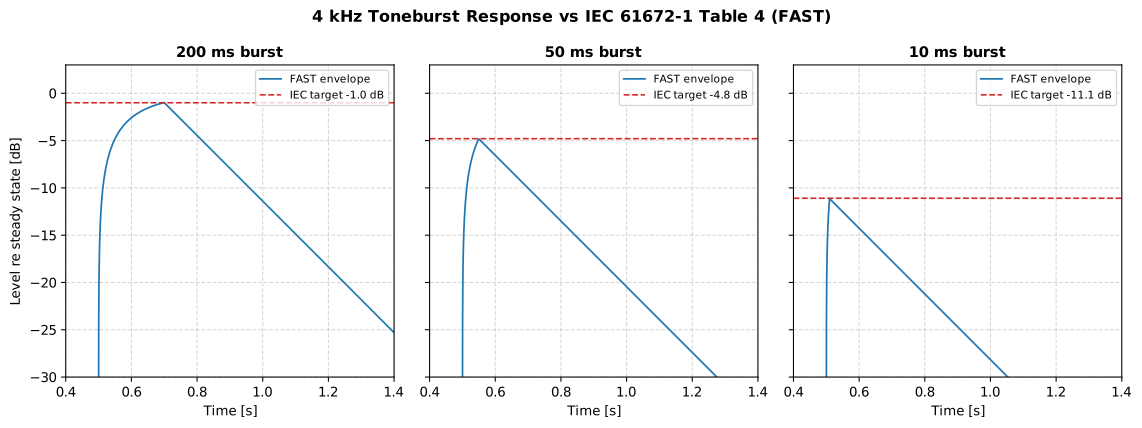
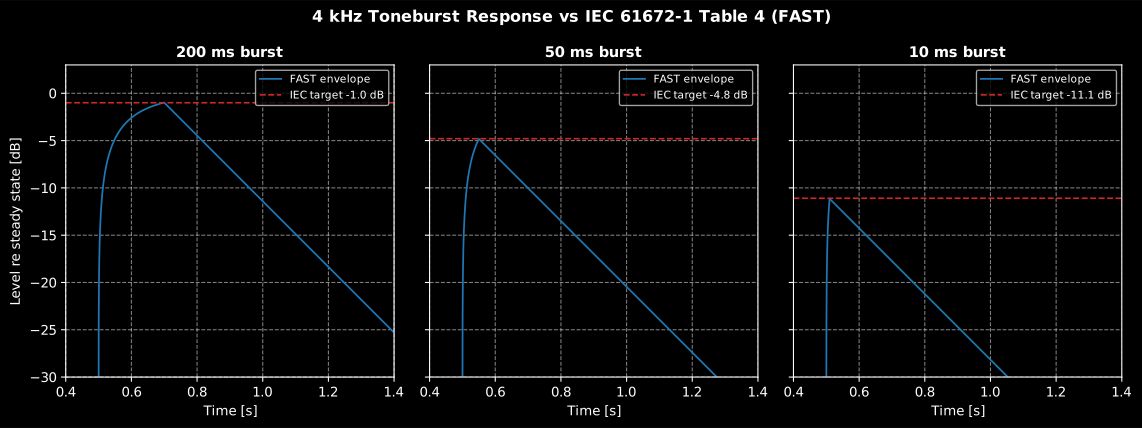
Measured Fast envelopes (blue) matching the Table 4 reference values (dashed) within 0.1 dB for 200/50/10 ms bursts.
What this means in practice
Section titled “What this means in practice”- If you need standard-compliant Fast/Slow/Impulse envelopes (sound level
meter behavior, one level per sample), use phonometry’s
time_weighting. - If you need block-averaged Leq per interval, that is a different, equally
valid metric; you can compute it with
leqover consecutive slices. - Both approaches are useful; they just answer different questions. The discrepancy reported in issue #38 comes from comparing a continuous envelope against a block integrator, not from an implementation error.
Conformance testing across the library
Section titled “Conformance testing across the library”The tone-burst case above is not an isolated check. For each standard the library implements, the reference values and acceptance limits are transcribed from the official text into the test suite, so any regression fails CI. A sample from the metrology core:
| Standard | What is verified | Test file |
|---|---|---|
| IEC 61672-1:2013 Table 3 | A/C/Z weighting at all 34 nominal frequencies, class 1 limits, at 48 and 96 kHz | tests/test_iec_weighting_table3.py |
| IEC 61672-1:2013 Table 4 | F/S tone-burst responses (1 s to 1 ms) and the LAE column for sel() | tests/test_iec_compliance.py |
| IEC 61672-1:2013 Table 5 | lc_peak() one-cycle/half-cycle peak responses, class 1 limits | tests/test_levels.py |
| IEC 61260-1:2014 Table 1 | Filter-bank class 1/2 acceptance limits via verify_filter_class() | tests/test_compliance.py |
| ISO 7196:1995 Table 2 | G weighting (infrasound) at every nominal response value, 0.25–315 Hz | tests/test_g_weighting.py |
| ISO 226:2023 Annex B | Equal-loudness contours, loudness levels and hearing threshold against the Annex B tables | tests/test_loudness_contours.py |
| ECMA-418-1:2024 | TNR/PR tone prominence: critical bandwidths, proximity spacing and prominence criteria against the worked examples in clauses 10–12 | tests/test_tonality.py |
| ISO 1996-1:2016 | lden(), ldn() and composite_rating_level() against hand-computed formula values | tests/test_environmental.py |
| IEC 60942:2017 Table 2 | Calibrator short-term stability limits (frequency-dependent, class 1) in sensitivity() | tests/test_calibration_validation.py |
The same discipline applies far beyond the metrology core: today the suite runs 427 numerical conformance checks across 53 domains and 278 standards, covering psychoacoustics, room and building acoustics, vibration, environmental, aircraft and underwater noise, electroacoustics and broadcast loudness. The full numerical report (the expected value and the value the library computes for every check, regenerated on every pull request) is published as the conformance report.
Beyond IEC 61252-style noise dose (sound_exposure(), lex_8h()), the same
standards-first mindset shows up in the numerics: filter banks place their
−3 dB points on the ANSI S1.11 / IEC 61260-1 band edges for every
architecture (including Chebyshev II and Bessel, where scipy’s raw
parametrization would not), and A/C weighting stays within class 1 tolerances
up to 16 kHz at common audio rates via internal oversampling (see
Frequency Weighting).
Where phonometry fits in the Python ecosystem
Section titled “Where phonometry fits in the Python ecosystem”- python-acoustics was archived in February 2024 and is no longer maintained. Its comparison above reflects the last released code.
- acoustic-toolbox, the community successor to python-acoustics, depends on phonometry for its weighted level computations rather than reimplementing them.
- MoSQITo focuses on psychoacoustic sound-quality metrics (loudness, sharpness, roughness). It complements rather than overlaps phonometry: it does not cover sound level metrology (weighting filters, ballistics, Leq/SEL/Lden, calibration) and does not claim conformance testing against the standards’ tolerance tables.
If your work needs numbers you can defend against a standard’s tolerance table, whether for measurement reports, environmental assessments or instrument cross-checks, that verification layer is what phonometry is for. The sources behind it are collected in the Bibliography, every entry with a verified DOI or official publisher link.