Wind-turbine noise: sound power and tonal audibility
Standards: IEC 61400IEC TS 61400ISO 1996
IEC 61400-11 measures the acoustic emission of a wind turbine. This page covers its two closed-form quantities: the apparent sound power level referred to an equivalent point source at the rotor centre, and the tonal audibility that decides whether a discrete tone (blade-passing, gearbox, generator) is audible above the masking noise.
Apparent sound power level
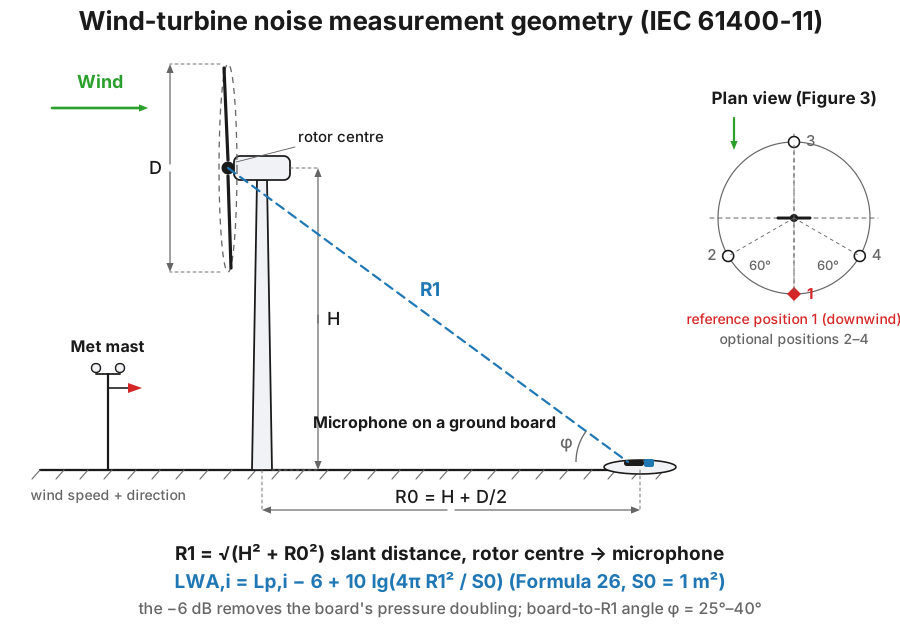
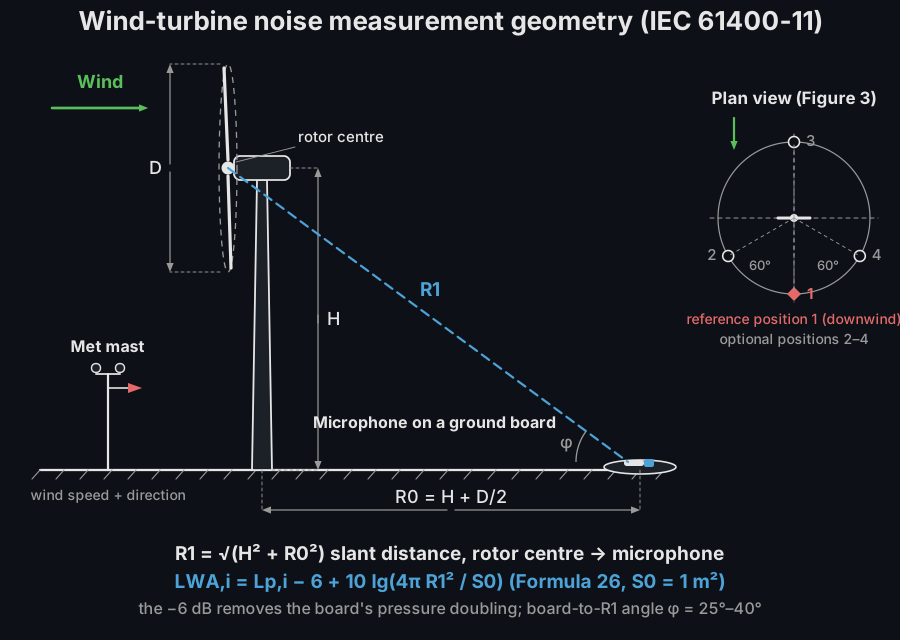
Section titled “Apparent sound power level”With the reference microphone on a ground board at the horizontal distance
R0 = H + D/2 (hub height H, rotor diameter D), the slant distance to the
rotor centre is R1 = √(H² + R0²) and the apparent sound power level is
L_WA,i = L_p,i − 6 + 10·lg(4π R1²/S0) per band (S0 = 1 m²), energy-summed
over bands. The −6 dB accounts for the ground-board pressure doubling.
from phonometry import environmental
# Background-corrected A-weighted one-third-octave band levels L_p,i (dB).band_levels = [55.0, 58.0, 60.0, 57.0, 54.0]r1 = environmental.slant_distance(hub_height=80.0, rotor_diameter=100.0)lwa = environmental.apparent_sound_power_level(band_levels, r1)   # dB re 1 pW
Why “apparent”
Section titled “Why “apparent””is written like a sound power level, but it is not one in the ISO 3744 sense of sampling the pressure field over an enveloping surface. The standard collapses the whole machine into an equivalent point source at the rotor centre and asks what power that source would need, radiating spherically, to reproduce the measured level at one downwind ground-board position: by definition it is the power “giving the same sound emission in the downwind direction as the wind turbine”. Everything a 150 m rotor does that a point source does not, the vertical and lateral directivity and the blade-passing swish, is folded into the number and evaluated in a single direction; the optional positions 2 to 4 of the plan-view pattern exist precisely to document how the emission varies around the machine. Apparent sound powers of different turbines are comparable because the geometry scales with the machine (, so every rotor is seen under a similar angle), which is the point of the definition, but an fed into an ISO 9613-2 prediction carries its built-in downwind bias with it. The ground board, in turn, is why the formula subtracts 6 dB: a capsule lying on a hard plate receives a perfectly coherent reflection (pressure doubling, dB) instead of the uncontrolled height-dependent interference pattern a tripod microphone would sample (see the image source behind the ground effect).
Wind-speed bins and standardized conditions
Section titled “Wind-speed bins and standardized conditions”A turbine’s noise emission rises with wind speed toward rated power, so a single number would be meaningless without its operating point: IEC 61400-11 reports as a function of wind speed. Sound and wind are logged in synchronized 10 s averages, and every period is sorted into a wind-speed bin 0.5 m/s wide centred on integer and half-integer hub-height wind speeds, with at least 10 periods of total noise and 10 of background (turbine parked) per bin. The hub-height wind speed itself is preferably not an anemometer reading at all: it is derived from the measured electric power through the turbine’s power curve (Clause 8.2.1), the most repeatable proxy for the wind the rotor actually sees, with the nacelle anemometer and a met mast as fallbacks. The measured range must at least cover 0.8 to 1.3 times the wind speed at 85 % of maximum power (roughly 6 to 10 m/s at 10 m height for a large machine). Within each bin the spectra are averaged, interpolated to the bin centre and background-corrected; a total-minus-background margin of 3 dB or less voids the bin, between 3 and 6 dB flags it with an asterisk. For comparability with consent conditions and older editions, Formula (29) also maps each result to the wind speed at 10 m height over a reference roughness length m (a logarithmic wind profile), giving at integer 10 m wind speeds regardless of the site’s actual terrain. The library implements the closed-form quantities of this pipeline (slant distance, per-band apparent power, tonal audibility); the binning, averaging and uncertainty machinery operates on whole measurement campaigns and stays out of scope.
Tonal audibility
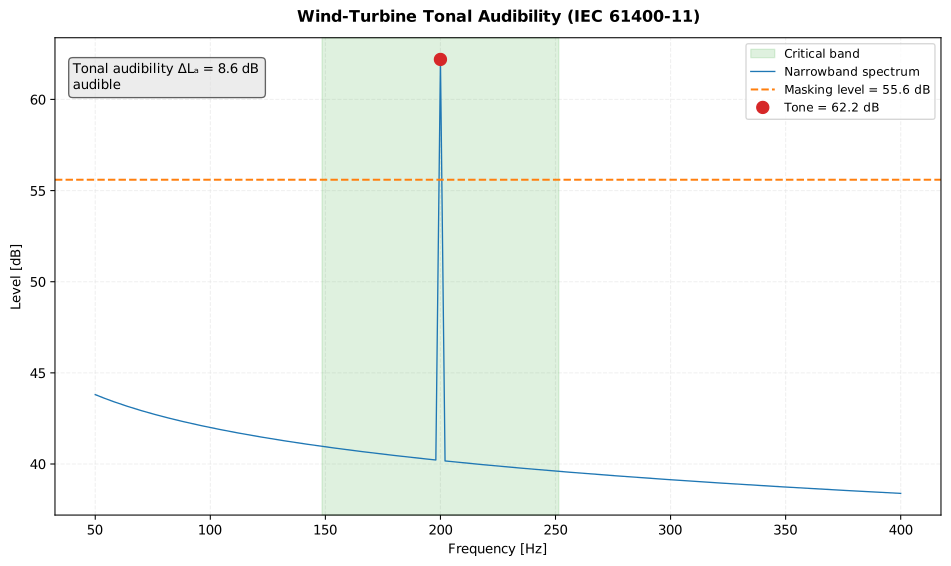
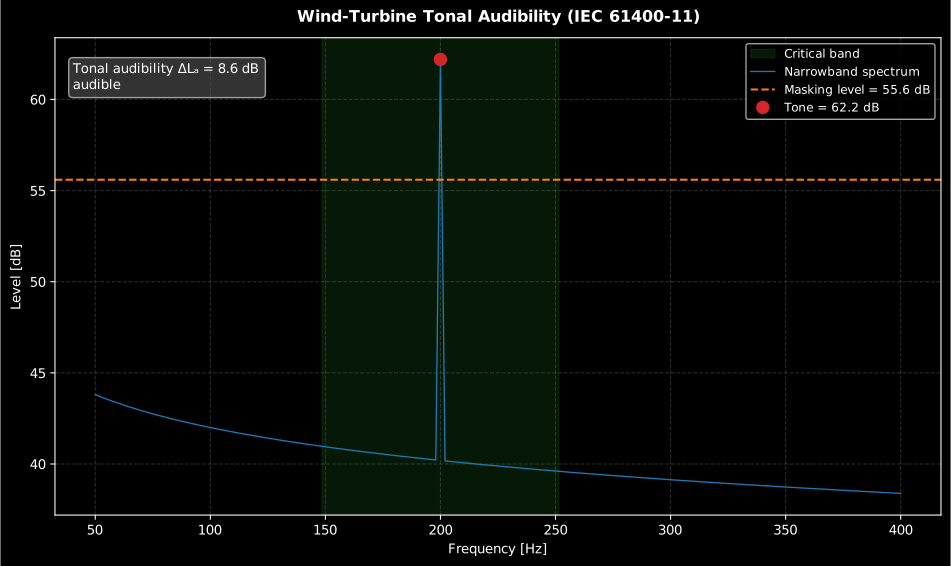
Section titled “Tonal audibility”From a narrowband spectrum (1–2 Hz resolution), the lines in the critical
band about the tone, CBW = 25 + 75·[1 + 1.4·(fc/1000)²]^0.69 Hz, are
classified into masking noise and tone lines (the 70 %-lowest energy mean, the
+6 dB criteria; tone lines must additionally lie within 10 dB of the
highest line above the threshold, and that highest line is the frequency of
the tone, subclauses 9.5.3/9.5.4). The candidate itself must first pass the
9.5.2 possible tone screening: a local maximum more than 6 dB above the
band energy average excluding the maximum and its adjacent lines. The
masking-noise level L_pn follows Formula 31, the
tonality is ΔL_tn = L_pt − L_pn, and the tonal audibility is
ΔL_a = ΔL_tn − L_a with L_a = −2 − lg[1 + (f/502)^2.5], reported when
ΔL_a ≥ −3 dB and audible when ΔL_a > 0.
Show the code for this figure
import numpy as npfrom phonometry import environmental
df = 2.0freqs = np.arange(50.0, 400.0 + df, df)levels = 42.0 - 6.0 * np.log10(freqs / 100.0)levels[int(np.argmin(np.abs(freqs - 200.0)))] += 22.0   # blade-passing-style toneenvironmental.wind_turbine_tonality(levels, freqs, tone_frequency=200.0).plot()
import numpy as npfrom phonometry import environmental
# A uniformly-spaced narrowband spectrum (2 Hz resolution): a flat 30 dB floor# with a discrete 60 dB tone at 500 Hz.frequencies = np.arange(440.0, 562.0, 2.0)levels = np.full(frequencies.size, 30.0)levels[np.argmin(np.abs(frequencies - 500.0))] = 60.0
res = environmental.wind_turbine_tonality(levels, frequencies)print(res.tone_frequency, res.tonality, res.tonal_audibility, res.is_audible)res.plot() # spectrum + critical band + masking level (needs matplotlib)wind_turbine_tonality returns a WindTurbineTonalityResult with the
critical_bandwidth, tone_level, masking_level, tonality,
audibility_criterion, tonal_audibility, is_audible and
has_identified_tone. When the candidate fails the 9.5.2 screening or no
line classifies as “tone”, has_identified_tone is False: the numeric
fields are non-standard fallbacks and such spectra must be excluded from
the 9.5.1 energy averaging of ΔL_a over the spectra of a wind-speed bin
(is_audible also requires an identified tone). The tone frequency and the
L_a criterion anchor to the highest classified tone line, not the probed
candidate. The audibility formula coincides with ISO 1996-2 Annex C; what is
specific to IEC 61400-11 is the determination of the tone and masking levels
and the Zwicker critical band from the spectrum. For a rating adjustment
K_T, pass the mean audibility to the ISO 1996-2 tonal_adjustment.
See also
Section titled “See also”- API reference:
environmental.wind_turbine_noise.
References
Section titled “References”- International Electrotechnical Commission. (2005). Wind turbines — Part 14: Declaration of apparent sound power level and tonality values (IEC TS 61400-14:2005). How a manufacturer turns IEC 61400-11 measurements of a batch of turbines into declared values with a stated uncertainty, the number a planning authority actually receives.
- International Electrotechnical Commission. (2018). Wind turbines — Part 11: Acoustic noise measurement techniques (IEC 61400-11:2012+AMD1:2018 CSV). The implemented edition: the measurement geometry, the wind-speed binning and the tonal-audibility chain (apparent sound power Formula 26, critical bandwidth Formula 30, masking level Formula 31, tonality/audibility Formulae 32-34). The full measurement pipeline is out of scope here.
- International Organization for Standardization. (2017). Acoustics — Description, measurement and assessment of environmental noise — Part 2: Determination of sound pressure levels (ISO 1996-2:2017). The tonal-audibility criterion the IEC method reuses comes from the Annex C of its 2007 edition (the 2017 edition carries the tonal methods in Annexes J and K), and its tonal_adjustment consumes the mean audibility.