Underwater acoustics: radiated noise and pile driving
Standards: ISO 18405ISO 17208ISO 18406Key references: Urick 1983Ainslie 2010
Underwater sound is referenced to 1 µPa (not the 20 µPa of airborne acoustics), and its exposure to 1 µPa²·s. This page covers the ISO 18405 reference levels realised as the shared primitives, the ISO 17208 ship radiated noise level and equivalent monopole source level, and the ISO 18406 percussive pile-driving single-strike, peak and cumulative sound exposure. Every quantity is an exact closed form, verified analytically.
1. Reference levels (ISO 18405)
Section titled “1. Reference levels (ISO 18405)”Three primitives, referred to 1 µPa, are computed from a captured pressure signal (in Pa):
with p₀ = 1 µPa and E₀ = 1 µPa²·s. The sound pressure level is the
mean-square level (ISO 18406 Formula 7); the sound exposure level integrates the
squared pressure over the record (Formulae 3–4); the peak level is the
zero-to-peak value.
from phonometry import underwater
spl = underwater.sound_pressure_level(pressure)        # dB re 1 µPasel = underwater.sound_exposure_level(pressure, fs)     # dB re 1 µPa²·spk = underwater.peak_sound_pressure_level(pressure)     # dB re 1 µPa
To re-reference a level between the underwater (1 µPa) and airborne (20 µPa)
conventions (a 20·lg(20) ≈ 26.02 dB shift, not an energy/intensity
equivalence), use underwater_to_in_air_spl / in_air_to_underwater_spl. For
background-noise subtraction, reuse the ISO 3744 background_noise_correction
(K1) helper.
2. Ship radiated noise and source level (ISO 17208-1/-2)
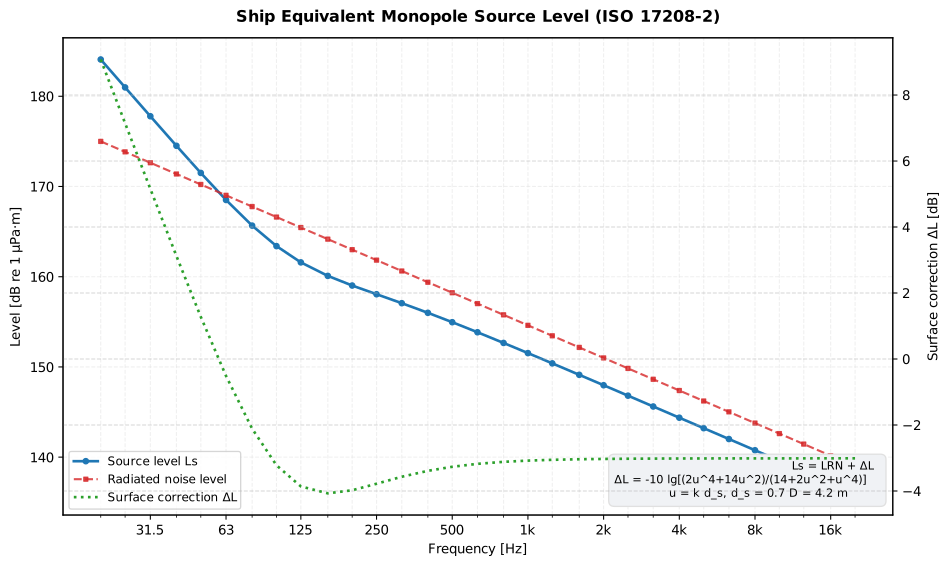
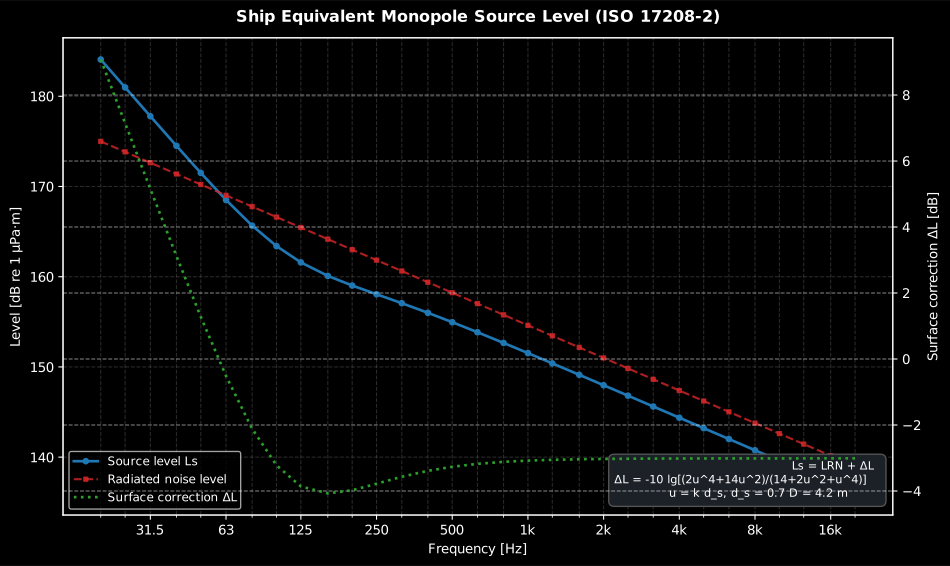
Section titled “2. Ship radiated noise and source level (ISO 17208-1/-2)”A surface ship measured in deep water is described first by its radiated noise level and then by an equivalent monopole source level:
where the Lloyd’s-mirror surface correction (ISO 17208-2 Formula 3) for a
nominal source depth d_s = 0.7·D (D = mean draught) and u = k·d_s,
k = 2πf/c, is
ΔL diverges at low u (grazing / low frequency) and tends to −10·lg(2) = −3.01 dB as u → ∞. The reported source level is an equivalent monopole
broadside value and must be quoted with its source depth.
Show the code for this figure
import numpy as npfrom phonometry import underwater
freqs = np.array([20, 25, 31.5, 40, 50, 63, 80, 100, 125, 160, 200, 250, 315,                  400, 500, 630, 800, 1000, 1250, 1600, 2000, 2500, 3150,                  4000, 5000, 6300, 8000, 10000, 12500, 16000, 20000.0])rnl = 175.0 - 12.0 * np.log10(freqs / 20.0)res = underwater.monopole_source_level(rnl, freqs, draught=6.0)res.plot()
from phonometry import underwater
lrn = underwater.radiated_noise_level(2e-6, 100.0) # p_rms = 2 µPa, r = 100 mres = underwater.monopole_source_level(lrn, 200.0, draught=6.0)print(res.source_level, res.surface_correction, res.source_depth)res.plot() # RNL, Ls and ΔL vs frequency (needs matplotlib)hydrophone_depths gives the three ISO 17208-1 measurement depths from the
15°/30°/45° depression angles, and source_level_uncertainty the tabulated
expanded uncertainty (5 dB ≤100 Hz, 3 dB 125 Hz–16 kHz, 4 dB >16 kHz).
What turns these closed forms into a comparable number is the measurement discipline ISO 17208-1 wraps around them. The ship transits a straight course past a vertical string of three hydrophones at a closest point of approach of 100 m or one ship length, whichever is greater, in water at least 150 m or 1.5 ship lengths deep so the bottom stays out of the picture (Clauses 5.2, 5.4). Only the data window of ±30° about the CPA is scored: the averaging runs while the ship crosses a window of length (about 1.15 CPA distances), centred on the beam aspect the radiated noise level is defined for (Clause 3, Figure 3). Four runs are required, two per side; each run’s three hydrophone levels are power-averaged (Formula 8), the runs are then arithmetically averaged (Formula 9), and port and starboard are also reported separately, because a real ship does not radiate symmetrically (Clause 6.5). Background noise is measured at the start and end of each test period and the ISO 3744-style correction applied per band; the recommended wind limit is 20 kn for ships above 100 m (Clause 5.3). Skip any of this and the number you quote is a level, but not an ISO 17208 radiated noise level.
3. Pile-driving sound (ISO 18406)
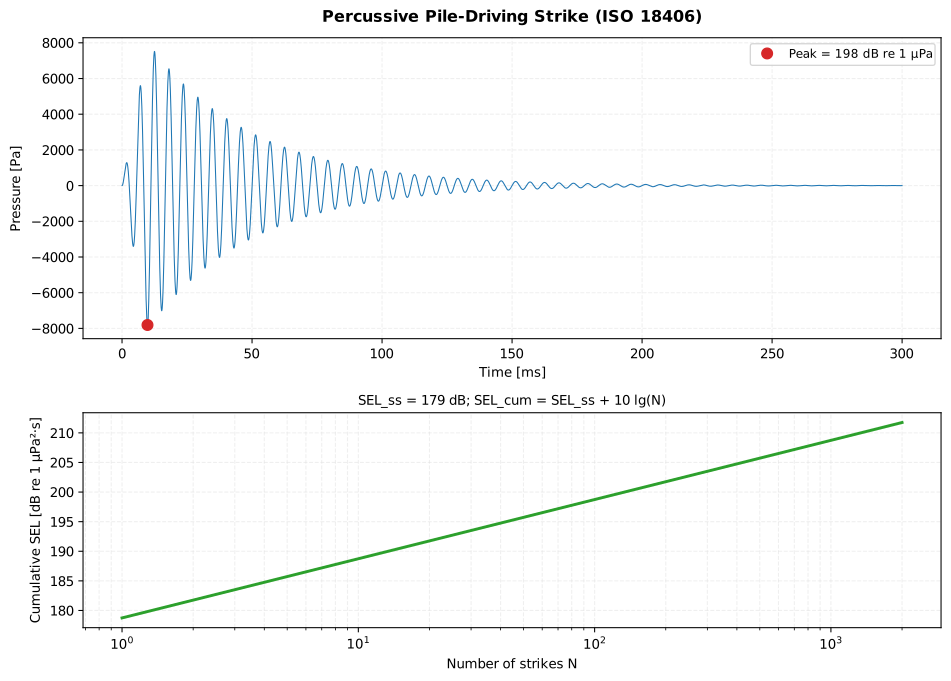
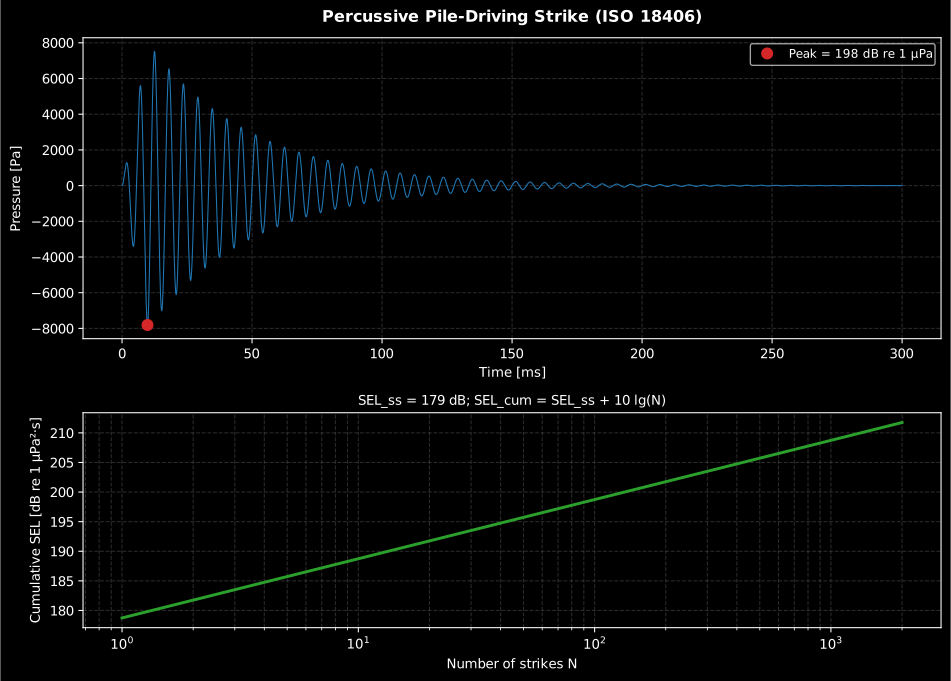
Section titled “3. Pile-driving sound (ISO 18406)”Percussive pile driving radiates one impulsive pulse per hammer strike. Each
strike has a single-strike sound exposure level SEL_ss; over a driving
sequence the exposures add to a cumulative sound exposure level:
Show the code for this figure
import numpy as npfrom phonometry import underwater
fs = 48000t = np.arange(int(0.3 * fs)) / fsenvelope = np.where(t < 0.01, t / 0.01, np.exp(-(t - 0.01) / 0.04))pressure = 8000.0 * envelope * np.sin(2 * np.pi * 180.0 * t)res = underwater.pile_strike_metrics(pressure, fs)res.plot()
from phonometry import underwater
sel_ss = underwater.single_strike_sel(strike_pressure, fs) # dB re 1 µPa²·ssel_cum = underwater.cumulative_sel_identical(sel_ss, 2000) # 2000 strikesres = underwater.pile_strike_metrics(strike_pressure, fs)print(res.single_strike_sel, res.peak_spl, res.pulse_duration)res.plot() # waveform + cumulative energy (needs matplotlib)pile_strike_metrics bundles the single-strike SEL, the peak sound pressure
level, the SPL/Leq and the 90 %-energy pulse duration for one recorded strike;
cumulative_sel sums a sequence of differing per-strike SELs.
These are the metrics that regulation is written in. ISO 18406 exists because
offshore wind-farm, oil-and-gas and bridge foundations are consented under
environmental impact frameworks that require the radiated sound to be
monitored, and its scope is drawn accordingly: percussive driving in 4 to
100 m of water, with vibro- and sheet-piling excluded (Clause 1). The minimum
campaign is one measurement position as close as possible to 750 m from
the pile, recording the entire driving sequence and reporting the actual
range; the standard is explicit that 750 m is chosen for comparability with
the large body of existing measurements, not because any regulator’s limit
lives there, and that a single-range level has no predictive value for other
sites (Clause 6.1.2, Notes 1–2). Impact criteria for marine fauna are phrased
in exactly the quantities of this section, a cap on the single-strike or
cumulative SEL and on the peak level at a stated range, which is why
pile_strike_metrics reports them together and cumulative_sel follows the
strike-by-strike energy sum of Formulae 8–9.
What this guide covers
Section titled “What this guide covers”Covered. ISO 18405:2017 for the reference levels re 1 µPa and 1 µPa²·s:
sound_pressure_level, sound_exposure_level and peak_sound_pressure_level.
ISO 17208-1:2016 and ISO 17208-2:2019 for the ship radiated noise level and the
equivalent monopole source level: radiated_noise_level and
monopole_source_level, with the Lloyd’s-mirror surface correction
(Formula 3) and the 0.7·draught source depth (Formula 1), the
three-hydrophone geometry (hydrophone_depths) and the tabulated
source-level uncertainty (source_level_uncertainty). ISO 18406:2017 for the
pile-driving metrics of section 3: the single-strike SEL (Formulae 3-4), the
mean-square SPL (Formula 7) and the cumulative SEL (Formulae 8-9), which
single_strike_sel, cumulative_sel, cumulative_sel_identical and
pile_strike_metrics compute.
Not covered. ISO 17208-1’s measurement discipline itself is not
implemented: the four-run, three-hydrophone power and arithmetic averaging
(Formulae 8-9), the CPA and water-depth geometry checks, the ±30° data-window
scoring and the ISO 3744-style background-noise correction described in
section 2 above are left to the reader; the library only supplies the
closed-form radiated_noise_level and monopole_source_level formulae. ISO
18406 itself excludes vibro- and sheet-piling from its scope (Clause 1), so
continuous pile-driving noise has no closed form here or elsewhere in
phonometry.
See also
Section titled “See also”- API reference:
underwater.acoustics,underwater.pile_driving_noiseandunderwater.ship_radiated_noise. - General underwater propagation modelling (ray, normal mode, parabolic equation) is covered in Underwater sound propagation.
References
Section titled “References”- Ainslie, M. A. (2010). Principles of sonar performance modelling. Springer. https://doi.org/10.1007/978-3-540-87662-5The systematic treatment of underwater acoustical quantities in the line that ISO 18405 standardised; supports the reference levels and the source level of sections 1-2.
- International Organization for Standardization. (2016). Underwater acoustics — Quantities and procedures for description and measurement of underwater sound from ships — Part 1: Requirements for precision measurements in deep water used for comparison purposes (ISO 17208-1:2016). The radiated noise level, the deep-water three-hydrophone geometry and the tabulated source-level uncertainty of section 2.
- International Organization for Standardization. (2017). Underwater acoustics — Measurement of radiated underwater sound from percussive pile driving (ISO 18406:2017). The single-strike (Formulae 3–4), peak and cumulative (Formulae 8–9) sound exposure of section 3, and the mean-square sound pressure level (Formula 7) of section 1.
- International Organization for Standardization. (2017). Underwater acoustics — Terminology (ISO 18405:2017). The 1 µPa sound-pressure and 1 µPa²·s sound-exposure references and the definitions of sound pressure level, sound exposure level and peak sound pressure level.
- International Organization for Standardization. (2019). Underwater acoustics — Quantities and procedures for description and measurement of underwater sound from ships — Part 2: Determination of source levels from deep water measurements (ISO 17208-2:2019). The equivalent monopole source level via the Lloyd's-mirror surface correction (Formula 3) for a 0.7·draught source depth.
- Urick, R. J. (1983). Principles of underwater sound (3rd ed.). McGraw-Hill. Reprinted 1996 by Peninsula Publishing. ISBN 978-0-932146-62-5. Open Library record (https://openlibrary.org/books/OL9317725M). The classic treatment of underwater sound levels and of ship radiated noise behind the reference conventions of sections 1-2.