Human Vibration
Standards: ISO 8041ISO 2631ISO 5349Directive 2002/44/ECKey references: Griffin 1996Mansfield 2004
Vibration transmitted to a person is evaluated with the same measurement chain
whatever its origin: the acceleration is frequency-weighted to reflect how
the body responds at each frequency, reduced to a weighted r.m.s.
acceleration (with dose measures for shocks and long records), condensed across
axes into a single magnitude (the vibration total value for hand-arm
exposure and for comfort; the highest axis value for the whole-body health
assessment), and finally normalised to an 8-hour daily exposure A(8) that
is compared against the action and limit values of the European directive.
The weightings themselves are defined once, in ISO 8041-1:2017, as a cascade of analog filters; ISO 2631-1 applies them to whole-body vibration, ISO 2631-2 to vibration in buildings, ISO 2631-4 to rail ride comfort, and ISO 5349-1/-2 to hand-transmitted vibration. This page covers the whole chain.
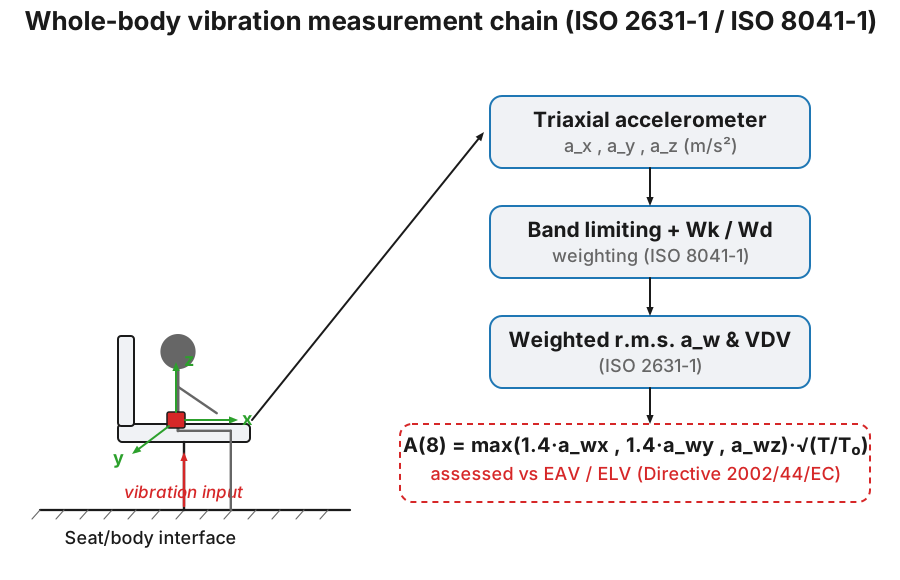
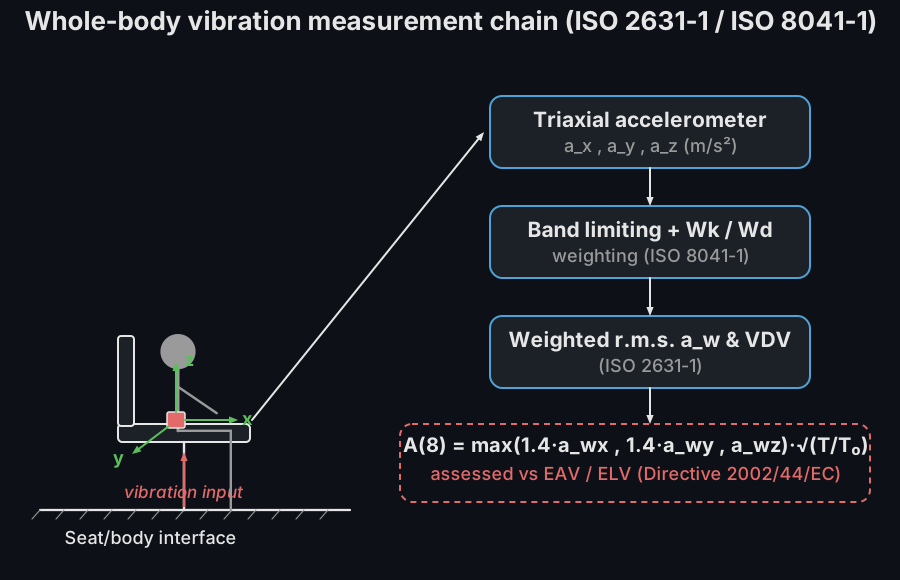
1. Frequency weightings (ISO 8041-1)
Section titled “1. Frequency weightings (ISO 8041-1)”Every human-vibration weighting is the product of four analog stages evaluated at (ISO 8041-1 Formulae (1)–(5)): a second-order Butterworth high-pass and low-pass band limiting, an acceleration–velocity transition carrying the overall gain , and an upward step:
A single Table 3 parameter set realises all nine weightings (Wb, Wc, Wd, We, Wf, Wh, Wj, Wk, Wm), with a corner set to infinity collapsing its stage to unity. The principal
whole-body weighting is Wk (vertical, seat surface); Wd is the horizontal
weighting, and Wh the hand-arm weighting.
from phonometry import vibration
# The overall weighting response at any frequencies (ISO 8041-1 Formula (5)).resp = vibration.frequency_weighting("Wk", [1.0, 6.3096, 20.0])print(resp.magnitude.round(3))      # [0.482 1.054 0.636]  (factors)print(resp.magnitude_db.round(2))   # [-6.33  0.46 -3.93]  (dB)
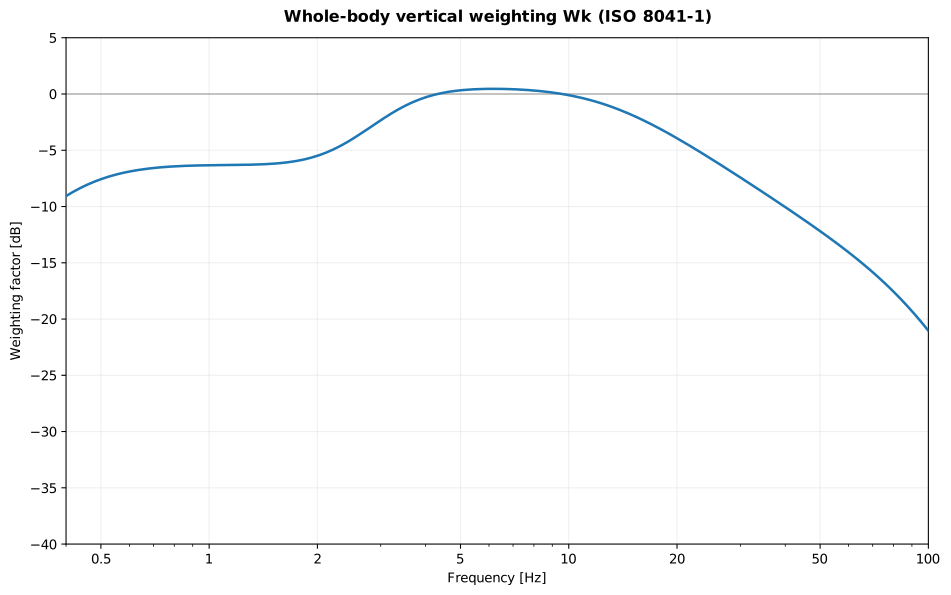
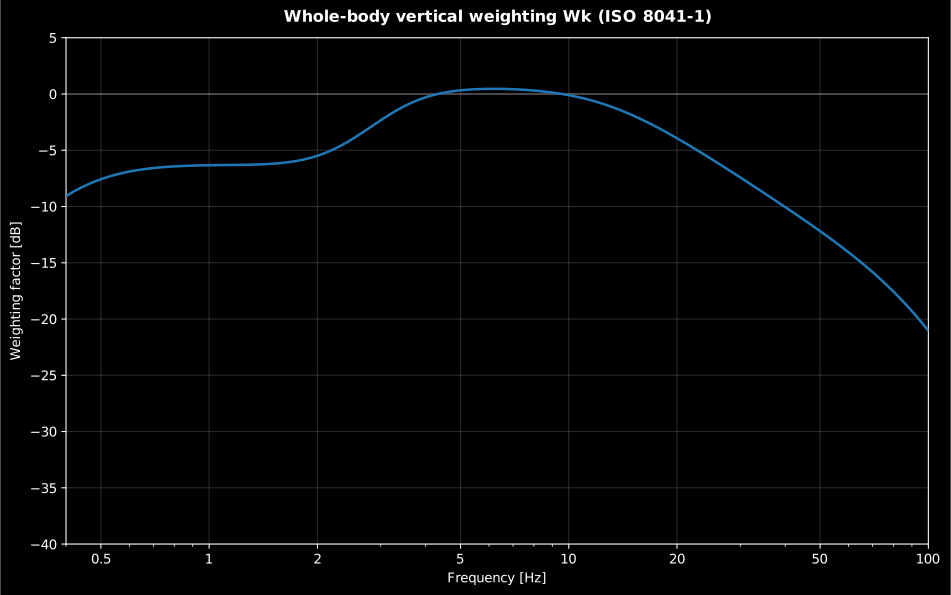
resp.plot()   # the weighting response in dB, as in the figure below (needs matplotlib)
The factors reproduce the ISO 8041-1 Annex B design-goal tables to their four
significant figures: Wk plateaus near −6 dB below 2 Hz, peaks at +0.46 dB near
6.3 Hz and rolls off above.
Show the code for this figure
import numpy as npimport matplotlib.pyplot as pltfrom phonometry import vibration
result = vibration.frequency_weighting("Wk", np.geomspace(0.4, 100.0, 240))
# One line:result.plot()plt.show()
# By hand, from the result's fields, mirroring what WeightingResponse.plot() draws:fig, ax = plt.subplots()ax.semilogx(result.frequencies, result.magnitude_db, color="#1f77b4")ax.set_xlabel("Frequency [Hz]")ax.set_ylabel("Weighting factor [dB]")ax.set_title("Whole-body vertical weighting Wk (ISO 8041-1)")plt.show()
To weight a time signal, apply_weighting applies the exact complex response in
the frequency domain (so magnitude and phase match the standard), which the
time-domain dose metrics below then consume.
Which weighting on which axis
Section titled “Which weighting on which axis”The weighting is selected by posture, measurement point and axis, not by application alone. ISO 2631-1 (Tables 1 and 2, clauses 7.2.3 and 8.2.2) maps them as follows; the multiplying factors return in the vibration total value of section 3:
| Posture, measurement point | Axis | Weighting | health | comfort |
|---|---|---|---|---|
| Seated, seat surface | x, y | Wd | 1.4 | 1.0 |
| Seated, seat surface | z | Wk | 1.0 | 1.0 |
| Seated, seat surface (rotation) | rx / ry / rz | We | — | 0.63 / 0.40 / 0.20 m/rad |
| Seated, backrest | x | Wc | (0.8)¹ | 0.8 |
| Seated, backrest | y / z | Wd | — | 0.5 / 0.4 |
| Seated, feet | x / y / z | Wk | — | 0.25 / 0.25 / 0.4 |
| Standing, floor | x, y | Wd | — | 1.0 |
| Standing, floor | z | Wk | — | 1.0 |
| Recumbent, under the pelvis | horizontal | Wd | — | 1.0 |
| Recumbent, under the pelvis | vertical | Wk | — | 1.0 |
| Recumbent, under the head | vertical | Wj | — | 1.0 |
| Motion sickness (clause 9) | vertical | Wf | — | — |
¹ The health assessment of clause 7 is defined on the seat surface; the
backrest x measurement with Wc, is encouraged but excluded
from the Annex B severity assessment (7.2.3). The remaining weightings live in the companion parts:
Wm for building occupants on all axes (ISO 2631-2), Wb for vertical rail
ride comfort (ISO 2631-4), and Wh for hand-transmitted vibration on all
three hand axes with every (ISO 5349-1).
2. Weighted acceleration and dose measures (ISO 2631-1)
Section titled “2. Weighted acceleration and dose measures (ISO 2631-1)”The basic evaluation is the weighted r.m.s. acceleration. From a one-third-octave spectrum it is (ISO 2631-1 Eq. (9); the identical construction gives the hand-arm of ISO 5349-1 Eq. (A.1)):
with the weighting factor at band centre and the measured band acceleration. The factors are evaluated at exactly the frequencies you pass; note that the ISO tables (ISO 8041-1 Annex B, ISO 2631-1 Table 3, ISO 5349-1 Table A.2) tabulate at the true one-third-octave centres Hz (6.31, 7.943, 15.85, …), not at the nominal band labels (6.3, 8, 16, …); pass true centres when comparing against the tabulated factors.
import numpy as npfrom phonometry import vibration
# A measured vertical seat spectrum (r.m.s. per one-third octave, m/s^2).freqs = np.array([1.0, 2.0, 4.0, 8.0, 16.0, 31.5, 63.0])accel = np.array([0.20, 0.45, 0.42, 0.25, 0.12, 0.05, 0.02])
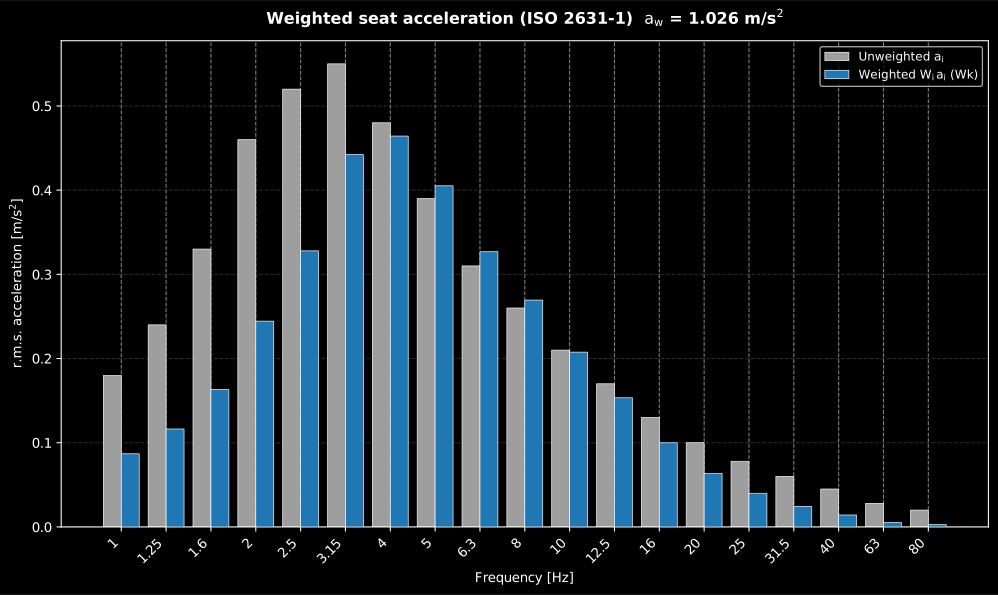
result = vibration.weighted_acceleration(accel, freqs, "Wk")print(round(result.overall, 3))          # 0.555  m/s^2 (a_w)print(result.weighted.round(3))          # W_i * a_i per band
result.plot()   # unweighted vs weighted bands, as in the figure below (needs matplotlib)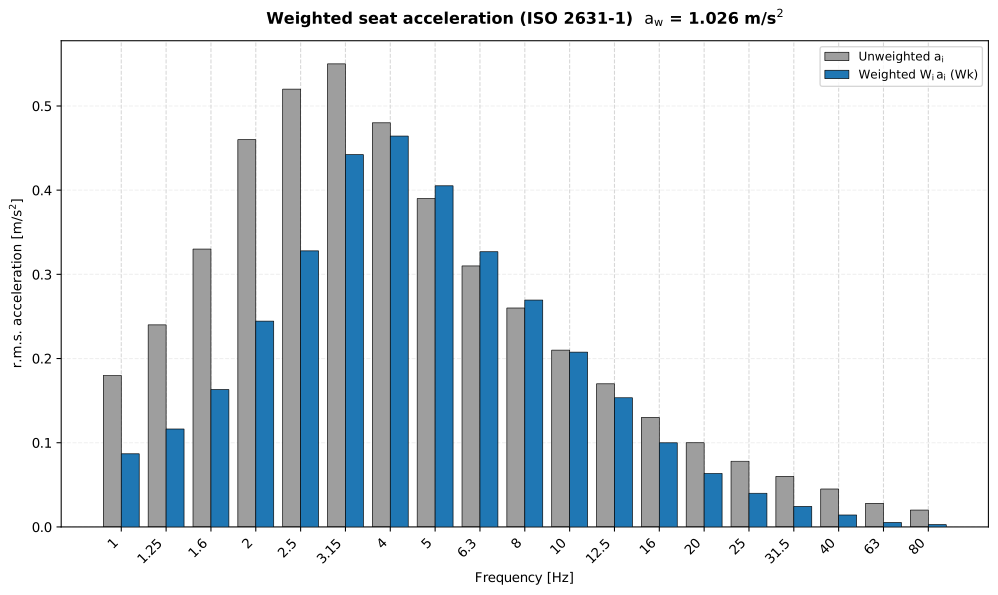
Show the code for this figure
import numpy as npimport matplotlib.pyplot as pltfrom phonometry import vibration
freqs = np.array([1.0, 1.25, 1.6, 2.0, 2.5, 3.15, 4.0, 5.0, 6.3, 8.0, 10.0,                  12.5, 16.0, 20.0, 25.0, 31.5, 40.0, 63.0, 80.0])accel = np.array([0.18, 0.24, 0.33, 0.46, 0.52, 0.55, 0.48, 0.39, 0.31, 0.26,                  0.21, 0.17, 0.13, 0.10, 0.078, 0.060, 0.045, 0.028, 0.020])result = vibration.weighted_acceleration(accel, freqs, "Wk")
# One line:result.plot()plt.show()
# By hand, mirroring what WeightedSpectrum.plot() draws:pos = np.arange(freqs.size)fig, ax = plt.subplots()ax.bar(pos - 0.2, result.band_accelerations, 0.4, color="#bbbbbb",       label="Unweighted $a_i$")ax.bar(pos + 0.2, result.weighted, 0.4, color="#1f77b4",       label="Weighted $W_i a_i$ (Wk)")ax.set_xticks(pos)ax.set_xticklabels([f"{f:g}" for f in freqs], rotation=45, ha="right")ax.set_xlabel("Frequency [Hz]")ax.set_ylabel(r"r.m.s. acceleration [m/s$^2$]")ax.set_title(f"Weighted acceleration ($a_w$ = {result.overall:.3f} m/s²)")ax.legend()plt.show()
When the r.m.s. value understates an intermittent or shock-laden exposure,
ISO 2631-1 adds dose measures computed on the weighted time signal: the
running r.m.s. and its maximum, the maximum transient vibration value
MTVV (Eq. (4), a 1 s running r.m.s.); the fourth-power vibration dose
value (Eq. (5)); the motion
sickness dose value ; and the
crest factor (peak / r.m.s.), whose value above 9 signals that the basic
method is inadequate.
import numpy as npfrom phonometry import vibration
fs = 1000.0raw = np.random.default_rng(0).standard_normal(int(60 * fs))   # 60 s recorda_w = vibration.apply_weighting(raw, fs, "Wk")                        # weighted signal
print(round(vibration.vibration_dose_value(a_w, fs), 3))   # 0.744  VDV [m/s^1.75]print(round(vibration.mtvv(a_w, fs), 3))                   # 0.265  MTVV [m/s^2]print(round(vibration.crest_factor(a_w), 2))               # 3.74   crest factor
3. Vibration total value and daily exposure A(8)
Section titled “3. Vibration total value and daily exposure A(8)”Across the three axes the vibration total value combines the axis-weighted r.m.s. accelerations with the posture multiplying factors (ISO 2631-1 Eq. (10); for hand-arm, ISO 5349-1 Eq. (1) with every ):
from phonometry import vibration
# Health, seated: k = 1.4 / 1.4 / 1.0 (ISO 2631-1, 7.2.3).a_v = vibration.vibration_total_value([0.35, 0.28, 0.62], k=[1.4, 1.4, 1.0])print(round(a_v, 3))     # 0.882  m/s^2
Health or comfort? Two different readings of the same measurement. The
health assessment of clause 7 stays per axis: each axis-weighted r.m.s.
(with = 1.4 / 1.4 / 1.0 seated) is judged by the highest single axis
value against the Annex B health guidance caution zone, a band based mainly on
4 h to 8 h exposures below which health effects are not clearly documented,
inside which caution is indicated and above which risks are likely; Directive
2002/44/EC turns that guidance into the enforceable A(8) action and limit
values used below. The comfort assessment of clause 8 instead combines all
axes (and, where relevant, backrest, feet and rotation) into the vibration
total value with its own set and reads it on the Annex C scale for
public transport, whose deliberately overlapping bands run from “not
uncomfortable” below 0.315 m/s² to “extremely uncomfortable” above 2 m/s²; the
standard defines no comfort limit, since acceptable magnitudes depend on trip
duration and what the passengers are trying to do. For orientation, the median
perception threshold of a Wk-weighted vibration is about 0.015 m/s² peak
(Annex C).
The daily exposure normalises the exposure magnitude to a reference
8-hour day ( s). For a single operation ;
several operations combine through their partial exposures
as (ISO 5349-1
Eqs. (2)/(3); ISO 5349-2 Eqs. (1)–(3)). Directive 2002/44/EC fixes which
magnitude each kind is based on (Annex, points 1): for hand-arm vibration
the vector total (Part A), but for whole-body vibration the highest
frequency-weighted axis value
(Part B), not the vector total above. wbv_exposure_basis returns that
dominant-axis value:
from phonometry import vibration
# Directive 2002/44/EC whole-body basis (Annex Part B): the dominant axis.a = vibration.wbv_exposure_basis(0.35, 0.28, 0.62)print(round(a, 3))    # 0.62  m/s^2 (max of 0.49, 0.392, 0.62; not a_v = 0.882)
daily_vibration_exposure builds the partial exposures, combines them and
assesses the result against Directive 2002/44/EC: hand-arm action value
A(8) = 2.5 and limit value 5 m/s²; whole-body action 0.5 and limit 1.15
m/s² (or a VDV of 9.1 / 21 m/s¹·⁷⁵):
from phonometry import vibration
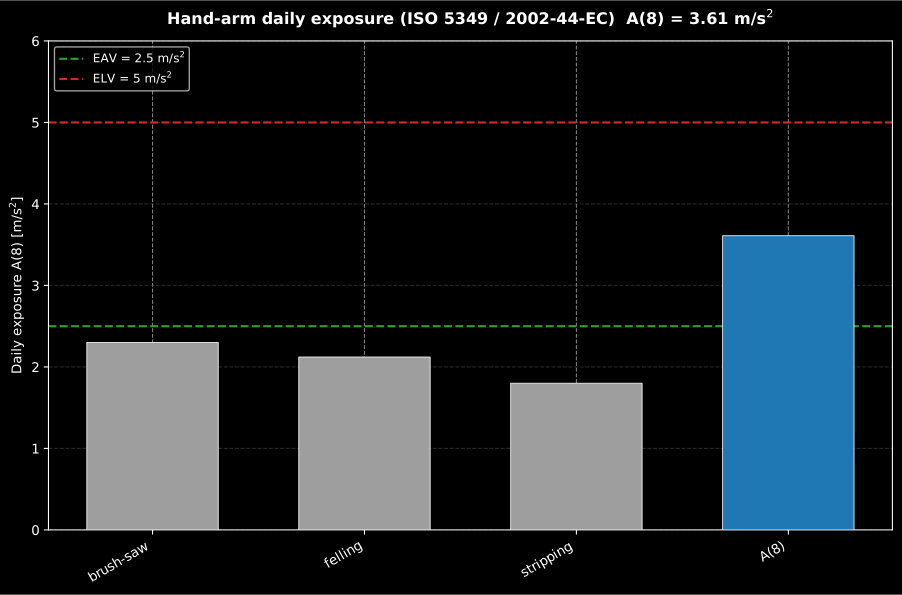
# ISO 5349-2 Annex E.3: a forestry worker's three chain-saw tasks.result = vibration.daily_vibration_exposure(    total_values=[4.6, 6.0, 3.6],                 # a_hv per task, m/s^2    durations_s=[2 * 3600, 1 * 3600, 2 * 3600],   # exposure time per task    kind="hav",    labels=["brush-saw", "felling", "stripping"],)print(result.partials.round(2))            # [2.3  2.12 1.8 ]  A_i(8)print(round(result.a8, 2))                 # 3.61  m/s^2print(result.assessment.zone)             # 'action'  (2.5 <= A(8) < 5.0)
result.plot()   # partial exposures and A(8) against the EAV/ELV, as in the figure below (needs matplotlib)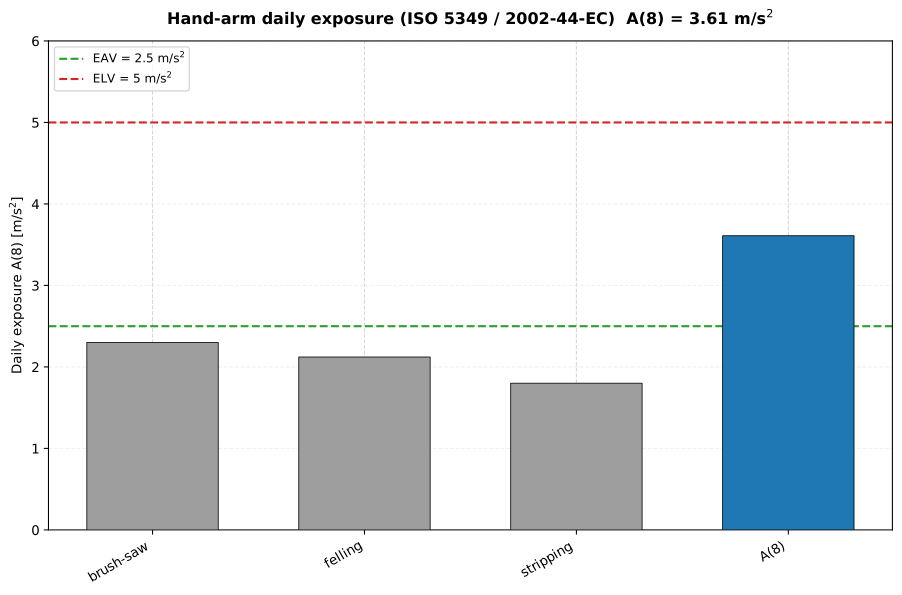
Show the code for this figure
import numpy as npimport matplotlib.pyplot as pltfrom phonometry import vibration
result = vibration.daily_vibration_exposure(    [4.6, 6.0, 3.6], [2 * 3600, 1 * 3600, 2 * 3600], kind="hav",    labels=["brush-saw", "felling", "stripping"],)
# One line:result.plot()plt.show()
# By hand, mirroring what DailyVibrationExposure.plot() draws:labels = [*result.labels, "A(8)"]values = [*result.partials.tolist(), result.a8]a = result.assessmentfig, ax = plt.subplots()ax.bar(range(len(values)), values,       color=["#bbbbbb"] * result.partials.size + ["#1f77b4"])ax.axhline(a.action_value, color="#2ca02c", ls="--", label=f"EAV = {a.action_value:g}")ax.axhline(a.limit_value, color="#d62728", ls="--", label=f"ELV = {a.limit_value:g}")ax.set_xticks(range(len(values)))ax.set_xticklabels(labels, rotation=30, ha="right")ax.set_ylabel(r"Daily exposure A(8) [m/s$^2$]")ax.legend()plt.show()
4. Exposure–response guidance
Section titled “4. Exposure–response guidance”For hand-transmitted vibration, ISO 5349-1 Annex C relates the daily exposure to the group-mean lifetime (in years) that produces vibration-white-finger in 10 % of an exposed group, (Eq. (C.1)):
from phonometry import vibration
print(round(vibration.hav_vwf_lifetime_years(7.0), 1))   # 4.0 years (Table C.1)
The standards deliberately define no safe limit; A(8) and the directive’s
action and limit values are the basis for any exposure criterion. For whole-body
exposure, energy_equivalent_acceleration gives the ISO 2631-1 Eq. (B.3)
energy-equivalent magnitude across periods of different magnitude and duration.
5. The exposure assessment report
Section titled “5. The exposure assessment report”A daily exposure is rarely the end of the job: it exists to be written down and
compared with the law. DailyVibrationExposure.report() writes a one-page PDF
assessment sheet laid out like the hand-arm and whole-body exposure calculators
of occupational-hygiene practice (the HSE calculators, the EU Good Practice
Guides): the standard-basis line naming the applied ISO method (ISO 5349-1/-2
for hand-transmitted vibration, ISO 2631-1 for whole-body vibration) and the
directive it is assessed against, a header grid (company, operator/worker,
workplace, instrumentation and calibration), the per-operation exposure analysis
(each operation’s vibration magnitude, the hand-arm vector total or
the whole-body Directive Part B dominant-axis value , its daily
exposure time and the partial exposure , closed by the daily
total and the combined ) with the contribution chart, and the boxed
with its exposure zone.
Because the number exists to be compared with the law, the fiche then assesses
against Directive 2002/44/EC (Article 3): the exposure action value
(EAV) and exposure limit value (ELV) for the vibration kind (hand-arm
/ m/s²; whole-body / m/s²), each marked exceeded / not
exceeded on the value exactly as displayed, with a PASS/FAIL verdict against the
limit value. A printed note records that the ISO standards define no safe
exposure limit and that reaching the EAV triggers the employer’s control
measures and the workers’ entitlement to health surveillance. verbose=True
adds each operation’s share of the daily vibration energy, and language="es"
renders the Spanish fiche (comma decimals).
The metadata argument accepts a ReportMetadata
whose relevant fields for a vibration exposure report are client (the
company), specimen (the operator or worker whose exposure was determined),
test_room (the workplace), test_date, instrumentation, calibration, and
the footer identity laboratory, operator, report_id and notes.
from phonometry import vibration, ReportMetadata
# The ISO 5349-2 Annex E.3 forestry worker: brush-saw (2 h, 4.6 m/s²),# chain-saw felling (1 h, 6.0 m/s²) and branch stripping (2 h, 3.6 m/s²).res = vibration.daily_vibration_exposure(    [4.6, 6.0, 3.6],    [2 * 3600, 1 * 3600, 2 * 3600],    kind="hav",    labels=["Brush-saw clearance", "Chain-saw felling", "Chain-saw branch stripping"],)
res.report(    "a8.pdf",    metadata=ReportMetadata(        client="Example forestry contractor",        specimen="Forestry worker (right hand)",        test_room="Managed woodland, plot 12",        instrumentation="Hand-arm vibration meter (ISO 8041-1), s/n 0042",        report_id="EXAMPLE-5349",    ),)   # A(8) = 3.61 m/s² -> action zone (EAV exceeded, ELV not), verdict PASS
The example fiche is regenerated with make reports and kept rendered in the
repository; click the preview to open the PDF.
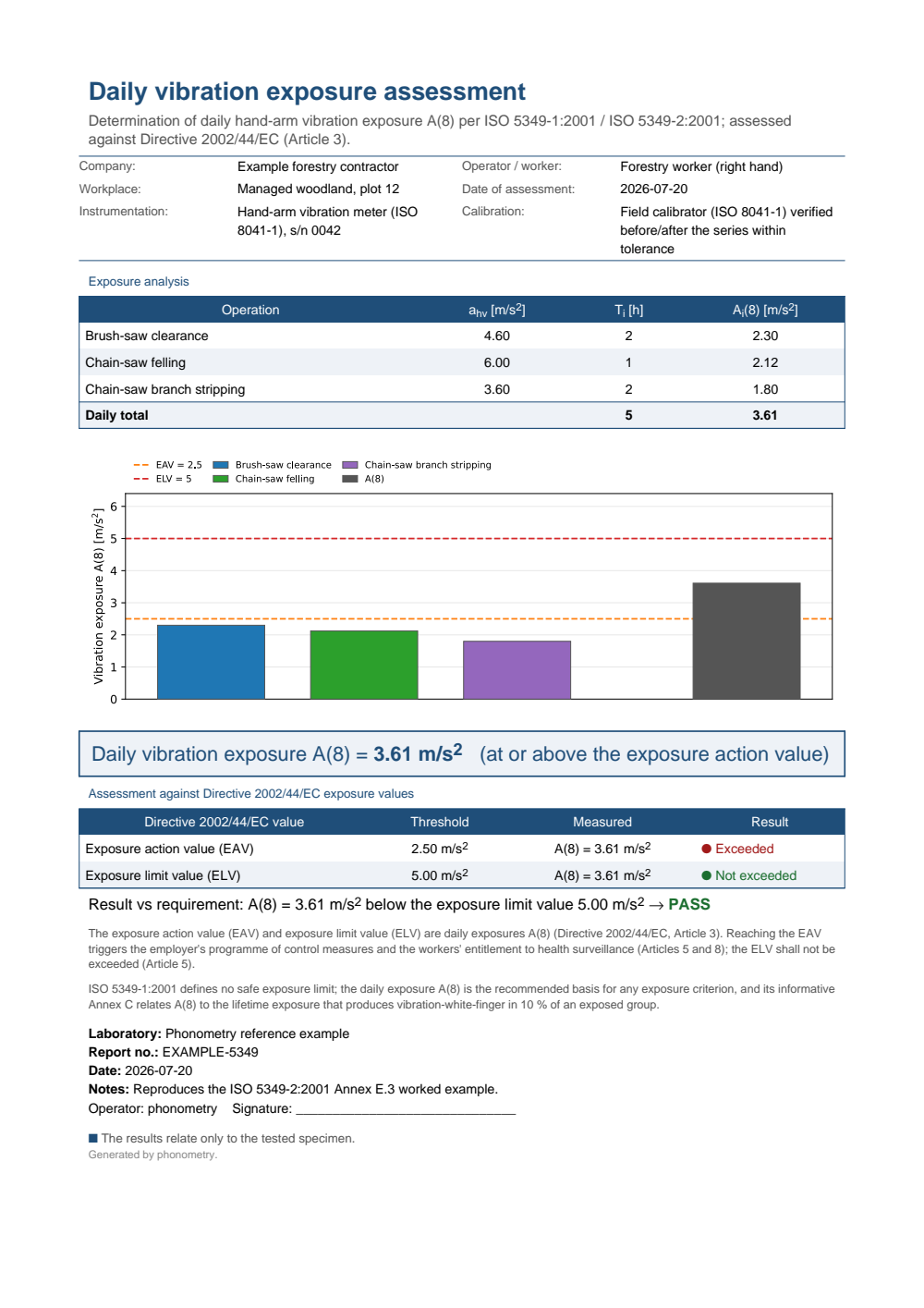
One-page daily vibration exposure assessment fiche: a header with the forestry contractor, the worker, the woodland workplace and the instrumentation, the per-operation exposure-analysis table (brush-saw clearance, chain-saw felling and branch stripping with the vibration total values, daily exposure times and partial exposures A_i(8) closed by the daily-total row), the per-operation contribution chart, the boxed daily exposure A(8) = 3.61 m/s2 in the action zone, and the Directive 2002/44/EC assessment table where the 2.5 m/s2 exposure action value is exceeded and the 5 m/s2 exposure limit value is not, ending in a PASS verdict.
What this guide covers
Section titled “What this guide covers”Covered. ISO 8041-1:2017 as far as it defines the frequency weightings:
the Table 3 cascade of analog stages (Formulae (1)-(5)) that
frequency_weighting and apply_weighting realise for all nine weightings,
reproducing the Annex B design-goal tables. ISO 2631-1:1997 for whole-body
vibration, covering the weighted r.m.s. a_w and vibration total value a_v
(weighted_acceleration, vibration_total_value), the MTVV, VDV, MSDV and
crest-factor dose measures, and the Annex B energy-equivalent magnitude
(energy_equivalent_acceleration). ISO 2631-2:2003 (Wm), ISO 2631-4:2001
(Wb) and ISO 5349-1/-2:2001 for hand-transmitted vibration, whose vector
total, daily exposure A(8) (daily_vibration_exposure,
wbv_exposure_basis) and Annex C vibration-white-finger dose relation
(hav_vwf_lifetime_years) are implemented too. The Directive 2002/44/EC
action and limit values close the assessment, written up by
DailyVibrationExposure.report().
Not covered. ISO 8041-1’s own subject, the design and type-testing of general purpose vibration meters, is not implemented: only the frequency-weighting definitions are taken from it. ISO 2631-5:2018, the multiple-shock spinal-response and injury-risk model for whole-body vibration, is a separate standard with its own module: see Multiple Shock Vibration for records containing repeated shocks, which the r.m.s. and VDV measures on this page do not substitute for.
See also
Section titled “See also”- API reference:
vibration.human_vibration.
References
Section titled “References”- European Parliament and Council. (2002). Directive 2002/44/EC on the minimum health and safety requirements regarding the exposure of workers to the risks arising from physical agents (vibration) (Directive 2002/44/EC). Official Journal of the European Union. The exposure action and limit values the daily exposure A(8) is assessed against.
- Griffin, M. J. (1996). Handbook of human vibration. Academic Press. ISBN 978-0-12-303041-2. The standard monograph on whole-body and hand-transmitted vibration: the biodynamics, discomfort and health-effect evidence behind the weightings, dose measures and exposure-response guidance on this page.
- International Organization for Standardization. (1997). Mechanical vibration and shock — Evaluation of human exposure to whole-body vibration — Part 1: General requirements (ISO 2631-1:1997). The whole-body evaluation: the weighted r.m.s. and dose measures and the vibration total value.
- International Organization for Standardization. (2001). Mechanical vibration — Measurement and evaluation of human exposure to hand-transmitted vibration — Part 1: General requirements (ISO 5349-1:2001). Hand-transmitted vibration: the general requirements of the evaluation.
- International Organization for Standardization. (2001). Mechanical vibration — Measurement and evaluation of human exposure to hand-transmitted vibration — Part 2: Practical guidance for measurement at the workplace (ISO 5349-2:2001). Hand-transmitted vibration: practical guidance for measurement at the workplace.
- International Organization for Standardization. (2001). Mechanical vibration and shock — Evaluation of human exposure to whole-body vibration — Part 4: Guidelines for the evaluation of the effects of vibration and rotational motion on passenger and crew comfort in fixed-guideway transport systems (ISO 2631-4:2001). Rail ride comfort: the Wb weighting.
- International Organization for Standardization. (2003). Mechanical vibration and shock — Evaluation of human exposure to whole-body vibration — Part 2: Vibration in buildings (1 Hz to 80 Hz) (ISO 2631-2:2003). Vibration in buildings: the Wm weighting.
- International Organization for Standardization. (2017). Human response to vibration — Measuring instrumentation — Part 1: General purpose vibration meters (ISO 8041-1:2017). The frequency-weighting definitions and tolerances the implemented weightings follow.
- Mansfield, N. J. (2004). Human response to vibration. CRC Press. ISBN 978-0-415-28239-0. A compact modern textbook on the ISO 2631-1 and ISO 5349 evaluation chains, from perception and comfort to the occupational exposure limits.