Test signals and sample-rate tools
Standards: IEC 60268Key references: Bendat & Piersol 2010
A measurement is only as trustworthy as its stimulus and its sample-rate
bookkeeping. This page covers the signal toolbox of phonometry.metrology:
tone bursts with the exact gating IEC 60268-1 prescribes, the
colored-noise generators (detailed in the
spectral analysis guide),
resampling whose anti-alias rejection is a stated, verifiable
specification rather than a library default, and fractional delay that
shifts a record by any sub-sample amount with band-limited exactness.
1. Tone bursts (IEC 60268-1)
Section titled “1. Tone bursts (IEC 60268-1)”The gated sine burst is the standard stimulus for dynamic behaviour:
sound-level-meter ballistics, quasi-peak meters, loudspeaker power handling.
IEC 60268-1:1985 (Clause A2.1) pins down what a well-formed burst is: it
“should start at the zero-crossing of the tone and should consist of an
integral number of full periods”. tone_burst generates exactly that, as a
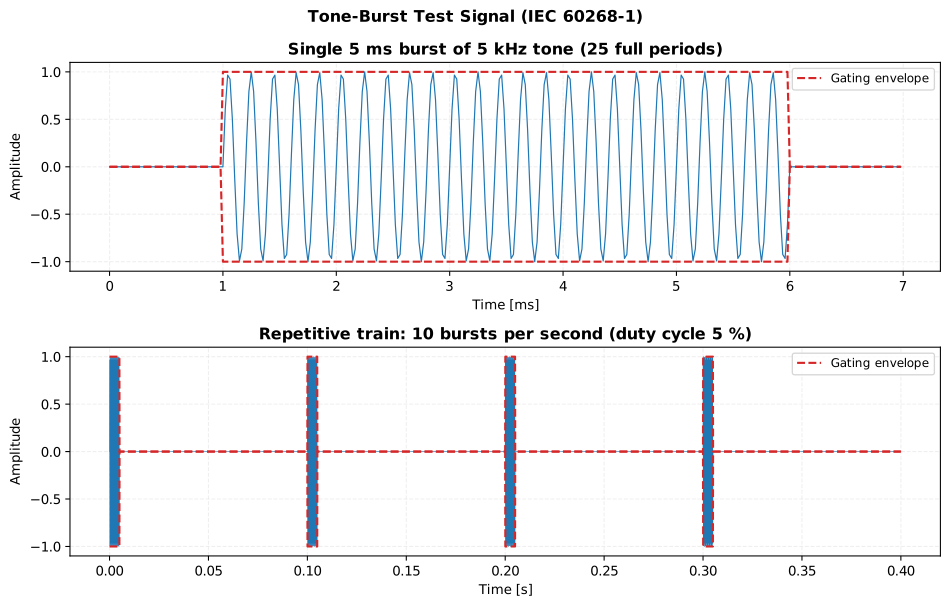
single burst or as the repetitive train of Clause A2.2 in which each burst
occupies one full repetition period:
from phonometry import tone_burst
# One 5 ms burst of 5 kHz tone (25 full periods), as in Table AII.single = tone_burst(48000, 5000, 25)print(single.burst_samples)         # 240 samples = 5 ms at 48 kHz
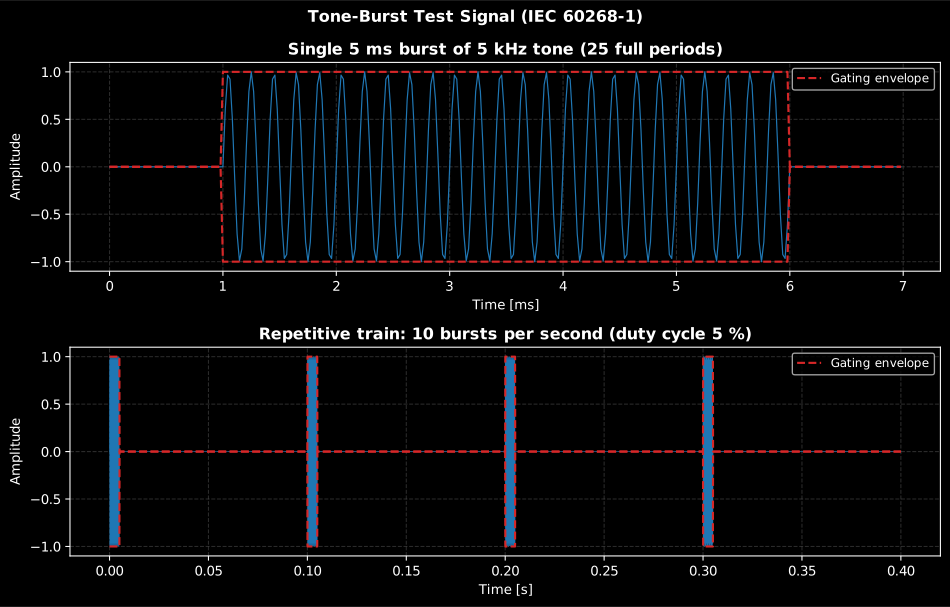
# Clause A2.2: 5 ms bursts at 10 bursts per second.train = tone_burst(48000, 5000, 25, repetitions=4, repetition_rate=10)print(train.period_samples, train.duty_cycle)   # 4800, 0.05train.plot()                        # waveform with the gating envelope
The result carries the record, the rectangular gating envelope and the
exact sample bookkeeping (burst_samples, onset_sample, period_samples,
duty_cycle), so a test report can state its stimulus numerically. Because
the gate spans an integral number of full periods starting at a zero
crossing, the burst energy has the closed form A²N/2 exactly, which is how
the generator is verified.
Show the code for this figure
import matplotlib.pyplot as pltimport numpy as npfrom phonometry import tone_burst
fs = 48000.0single = tone_burst(fs, 5000, 25, pre_silence=0.001, post_silence=0.001)train = tone_burst(fs, 5000, 25, repetitions=4, repetition_rate=10)
fig, axes = plt.subplots(2, 1, figsize=(10, 6.4))t_ms = 1e3 * np.arange(single.signal.size) / single.fsaxes[0].plot(t_ms, single.signal, lw=0.9)axes[0].plot(t_ms, single.envelope, "r--", label="Gating envelope")axes[0].plot(t_ms, -single.envelope, "r--")axes[0].set_xlabel("Time [ms]")
t_s = np.arange(train.signal.size) / train.fsaxes[1].plot(t_s, train.signal, lw=0.5)axes[1].plot(t_s, train.envelope, "r--", label="Gating envelope")axes[1].plot(t_s, -train.envelope, "r--")axes[1].set_xlabel("Time [s]")
for ax in axes:    ax.set_ylabel("Amplitude")    ax.legend(loc="upper right")plt.tight_layout()plt.show()
These are the bursts behind the Fast/Slow/Impulse ballistics reference responses (IEC 61672-1 Table 4 uses 4 kHz tonebursts of 200, 50 and 10 ms) and the quasi-peak dynamic tests of IEC 60268-1 itself (5 kHz bursts of 1 to 200 ms, Table AII).
2. Resampling with a stated anti-alias specification
Section titled “2. Resampling with a stated anti-alias specification”Sample-rate conversion hides a filter, and that filter decides how much
aliased energy contaminates the result. resample_signal performs rational
polyphase resampling (44.1 to 48 kHz is the ratio 160/147) with a lowpass
FIR designed inside the function by the Kaiser window method, from two
numbers the caller controls:
stopband_attenuation_db(default 120): the alias rejection, with the stopband starting exactly at the smaller of the two Nyquist frequencies, where folding happens;transition_width(default 0.05): the fraction of that Nyquist frequency given up to the filter’s transition band, so the passband ends at(1 - transition_width)·f_Nyqand is flat within the same Kaiser ripple boundδ = 10^(-A/20).
from phonometry import noise_signal, resample_signal
x = noise_signal(44100, 5.0, color="pink", seed=1)res = resample_signal(x, 44100, 48000)   # 120 dB alias rejectionprint(res.up, res.down)                  # 160, 147print(res.n_taps, res.passband_edge_hz)  # designed FIR, 20947.5 Hzres.plot()   # the delivered anti-alias filter against its design spec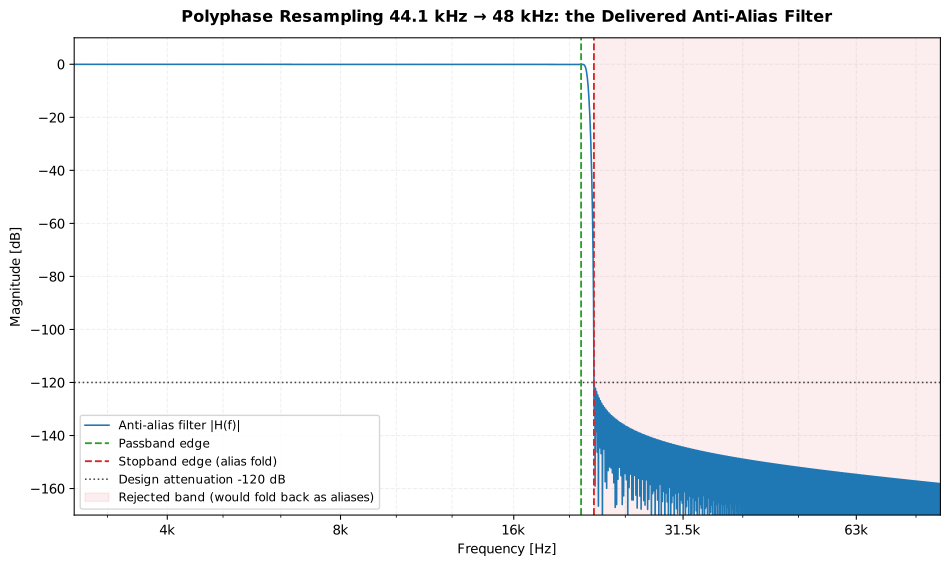
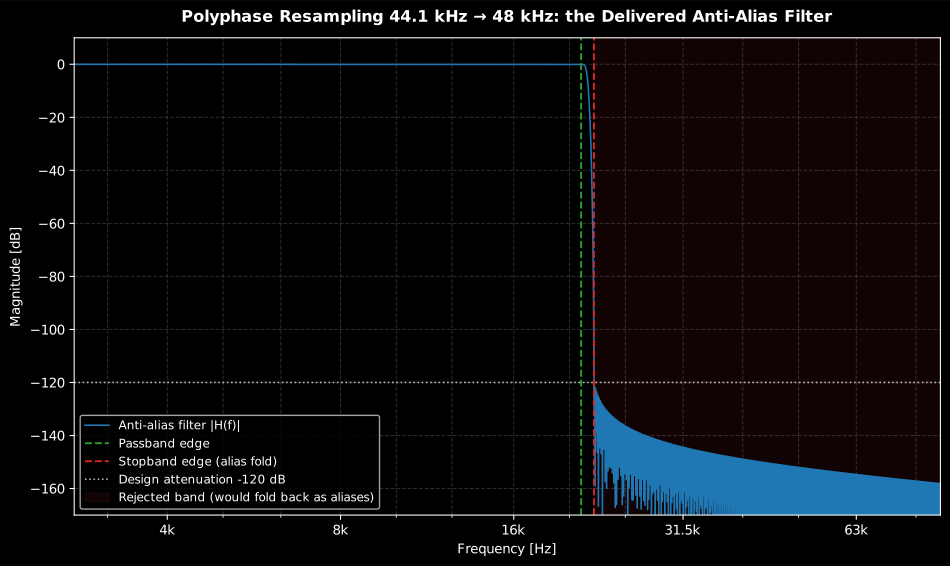
The delivered anti-alias filter of the default 44.1 → 48 kHz conversion: the stopband starts exactly at the smaller Nyquist frequency (where aliases fold) and stays below the −120 dB design line; the passband ends 5 % below it, flat within the same ripple bound.
Show the code for this figure
import matplotlib.pyplot as pltimport numpy as npfrom scipy import signalfrom phonometry import noise_signal, resample_signal
x = noise_signal(44100, 5.0, color="pink", seed=1)res = resample_signal(x, 44100, 48000)   # 120 dB alias rejection
# res is the ResampledSignalResult computed in the example above.# One line — the delivered anti-alias filter against its design spec:res.plot()plt.show()
# By hand, from the taps the result carries — mirroring what# ResampledSignalResult.plot() draws:fs_up = res.original_fs * res.upfreqs, h = signal.freqz(res.filter_taps, worN=1 << 18, fs=fs_up)mag_db = 20 * np.log10(np.maximum(np.abs(h), 1e-300))view = (freqs > 0) & (freqs <= 4 * res.stopband_edge_hz)
fig, ax = plt.subplots()ax.semilogx(freqs[view], mag_db[view], label="Anti-alias filter |H(f)|")ax.axvline(res.passband_edge_hz, color="g", linestyle="--",           label="Passband edge")ax.axvline(res.stopband_edge_hz, color="r", linestyle="--",           label="Stopband edge (alias fold)")ax.axhline(-res.stopband_attenuation_db, color="k", linestyle=":",           label="Design attenuation -120 dB")ax.axvspan(res.stopband_edge_hz, 4 * res.stopband_edge_hz,           color="r", alpha=0.08)ax.set(xlabel="Frequency [Hz]", ylabel="Magnitude [dB]")ax.legend()plt.show()
The designed taps travel with the result (filter_taps), so the
specification is checkable: the test suite measures the frequency response
of the returned filter and asserts the passband deviation and stopband
leakage against the design’s own ripple bound (the design internally targets
1 dB past the request, so the delivered filter meets the stated numbers
rather than a Kaiser-formula approximation of them). A passband tone
resampled through the default specification matches the analytic tone at the
new rate within 10^(-120/20) = 10^-6.
Several estimators resample internally at fixed rates (the ECMA-418-2 psychoacoustics at 48 kHz, STOI at 10 kHz); this function is the public, documented counterpart for preparing records outside those chains.
3. Fractional delay
Section titled “3. Fractional delay”fractional_delay shifts a record by any number of samples, including
sub-sample amounts, by multiplying the spectrum with the phase ramp
e^(-j2πf·D/fs): every component is delayed by exactly D samples. Two
boundary conventions cover the two use cases:
mode="linear"(default) zero-pads the record past the shift, so samples leaving one end land in padding instead of wrapping around. Use it for transients and impulse responses; it is bit-identical to the alignment kernel insidealign_impulse_responses. An integer delay reduces to an exact sample shift.mode="circular"applies the ramp over the record itself and wraps. For periodic records it is exact: a tone centered on a DFT bin delayed byDsamples equals the analytically delayed tone to machine precision, and its phase changes by exactly-2πf·D/fsradians.
import numpy as npfrom phonometry import fractional_delay
y = fractional_delay(x, 0.37)                    # 0.37 samples laterz = fractional_delay(x, -2.5, mode="circular")   # advance, wrapped
One subtlety worth knowing: a real record of even length cannot carry a fractionally delayed Nyquist-bin component (the inverse real FFT keeps only its real part). Any properly sampled signal is band-limited below Nyquist, so in practice the operation is exact; for synthetic corner cases, odd lengths avoid the bin entirely.
4. Colored noise
Section titled “4. Colored noise”The deterministic colored-noise generators (noise_signal: white, pink,
red, blue, violet with an exact power-law slope and bit-reproducible seeds)
complete the toolbox; they are documented with their spectral verification
in the
spectral analysis guide.
Where these tools are used
Section titled “Where these tools are used”The window figures of merit quantify the taper every spectral estimate in the library rests on; the burst generator feeds ballistics and dynamic-response testing; and the resampler and fractional delay are the sample-rate half of correlation and delay work, where sub-sample alignment is the difference between averaging impulse responses and smearing them.
What this guide covers
Section titled “What this guide covers”Covered. IEC 60268-1:1985 Annex A, Clause A2: the tone burst that
“should start at the zero-crossing of the tone and should consist of an
integral number of full periods” (A2.1) and the repetitive burst train of
A2.2, implemented by tone_burst and hand-checked against the Table AII
durations. Bendat & Piersol Section 10.2’s anti-alias requirement, turned
into an explicit, checkable specification by resample_signal’s stopband
attenuation and transition width.
Not covered. IEC 60268-1:1985 is a general standard for sound system
equipment. Only the Annex A tone-burst clauses are implemented here; its
other parts (amplifiers, loudspeakers, connectors, and so on) are
untouched. fractional_delay and the colored-noise generators of
noise_signal are general-purpose DSP tools with no governing standard of
their own; their accuracy claims are closed-form, not normative.
See also
Section titled “See also”- Time Weighting: the detector ballistics the tone bursts exercise (IEC 61672-1 Table 4).
- Correlation and delay: the alignment work built on the fractional-delay kernel.
- Synchronous averaging: period alignment with the same band-limited shift when
fs·Tis not an integer. - Spectral analysis: the colored-noise verification and the window metrics.
- API reference:
metrology.signals.
References
Section titled “References”- Bendat, J. S., & Piersol, A. G. (2010). Random data: Analysis and measurement procedures (4th ed.). Wiley. https://doi.org/10.1002/9781118032428Section 10.2 (data preparation: sampling, aliasing and the anti-alias filtering requirement the resampler states explicitly). ISBN 978-0-470-24877-5.
- International Electrotechnical Commission. (1985). Sound system equipment — Part 1: General (IEC 60268-1:1985). Annex A, Clause A2: tone bursts starting at the zero crossing of the tone with an integral number of full periods (A2.1), repetitive burst trains at a stated repetition rate (A2.2), and the Table AII burst durations the sample counts are hand-checked against.