Dynamic stiffness of resilient materials
Standards: ISO 9052Key references: Vigran 2008
A floating floor is a heavy floating slab resting on a resilient layer; the
two form a mass-spring system whose natural frequency governs how much the
floor improves impact and airborne insulation. EN 29052-1:1992 (identical to
ISO 9052-1:1989) measures the dynamic stiffness per unit area s' of the
resilient layer from the resonance of a standard load plate on a
200 mm × 200 mm specimen. s' is the input to the floating-floor term of the
EN 12354-2 impact model covered in
Predicting Sound Insulation (EN 12354). (ISO 16251-1 does not apply
here: its scope is limited to soft, locally-reacting floor coverings and
explicitly excludes floating floors.)
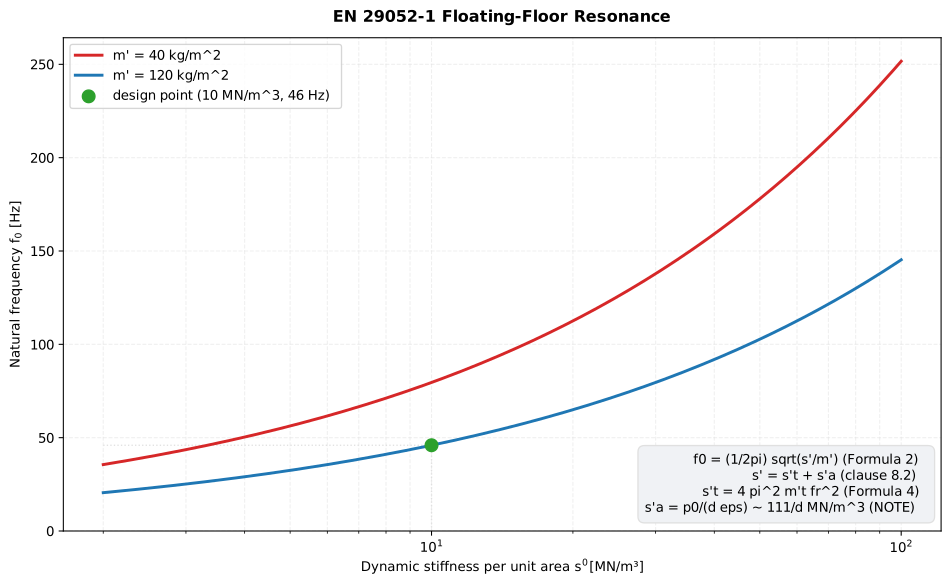
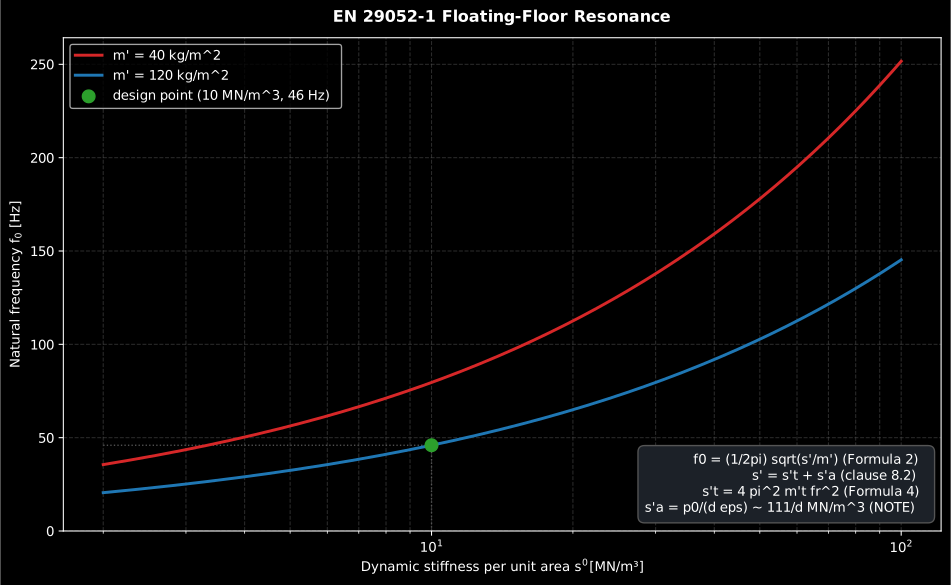
Show the code for this figure
import matplotlib.pyplot as pltimport numpy as npfrom phonometry import materials
# One line — from a measured resonance, the result draws its own f0(s')# design curve with the determination marked:res = materials.floating_floor_resonance(    resonant_frequency=25.0, total_mass_per_area=200.0,    floor_mass_per_area=120.0,    airflow_resistivity=50.0, thickness=0.020, porosity=0.9,)res.plot()plt.show()
# By hand, the same design curve for a light and a heavy floating floor:s = np.logspace(np.log10(2.0), np.log10(100.0), 300)   # MN/m3for m in (40.0, 120.0):    plt.semilogx(s, materials.natural_frequency(s * 1e6, m), label=f"m' = {m:g} kg/m²")plt.xlabel("Dynamic stiffness s' [MN/m³]"); plt.ylabel("Natural frequency f₀ [Hz]")plt.legend(); plt.show()
1. Dynamic stiffness and resonance
Section titled “1. Dynamic stiffness and resonance”The dynamic stiffness per unit area is a dynamic force per area divided by the
resulting change in thickness (Formula 1): s' = (F/S)/Δd. The resiliently
supported floor is a resonator whose natural frequency (Formula 2) and, in the
laboratory arrangement, measured resonant frequency (Formula 3) are
so the apparent dynamic stiffness follows from the resonance (Formula 4):
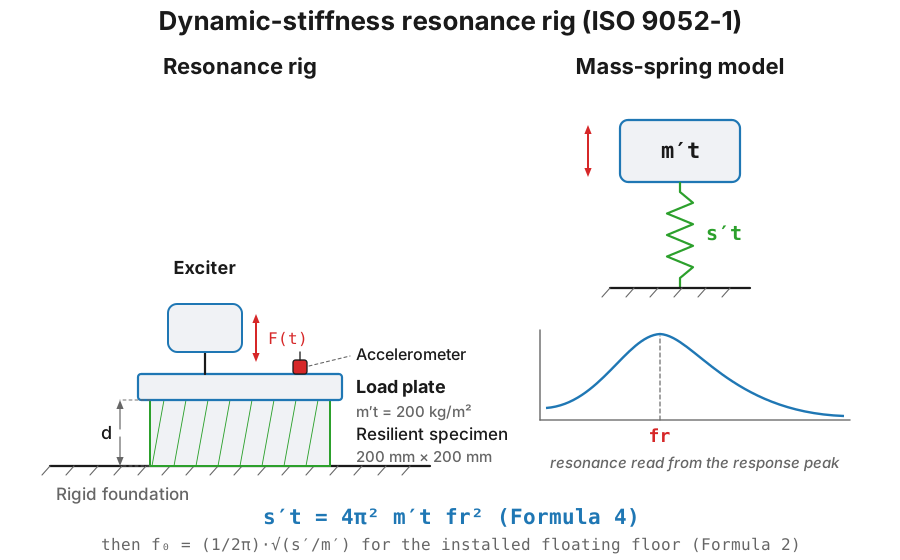
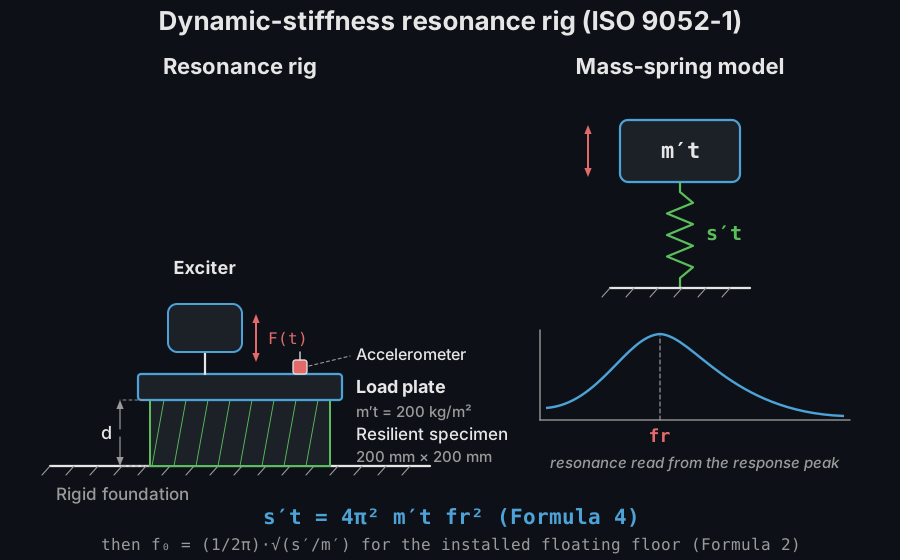
In the test arrangement the specimen lies between the rigid foundation and a load plate whose total mass per unit area, plate plus added load, is 200 kg/m² (8 kg on the 0.04 m² specimen). That load reproduces the static preload of a typical floating floor, about 2 kPa. A vertical exciter drives the plate, an accelerometer picks up its response, and the fundamental vertical resonance of the plate-on-specimen system is read from the response peak; Formula 4 turns it into .
from phonometry import materials
# Standard 8 kg load plate on the 0.04 m2 specimen -> m't = 200 kg/m2;# the fundamental resonance is measured at 25 Hz.s_t = materials.apparent_dynamic_stiffness(resonant_frequency=25.0, total_mass_per_area=200.0)print(round(s_t / 1e6, 3))                              # 4.935  MN/m3
# Installed on a 120 kg/m2 floating screed with s' = 10 MN/m3:print(round(materials.natural_frequency(10e6, 120.0), 1))      # 45.9  Hz
2. The enclosed-gas term and airflow resistivity
Section titled “2. The enclosed-gas term and airflow resistivity”For an air-permeable material the enclosed pore air adds a parallel stiffness
from its isothermal compression (Formula 7): s'a = p₀/(d·ε), with p₀ the
atmospheric pressure, d the loaded thickness and ε the porosity. The
standard’s worked NOTE (p₀ = 0.1 MPa, ε = 0.9) is s'a = 111/d MN/m³ for
d in millimetres:
from phonometry import materials
print(round(materials.enclosed_gas_stiffness(thickness=0.020, porosity=0.9) / 1e6, 2))# 5.56  MN/m3   (the NOTE's 111/20 = 5.55 MN/m3)
The dynamic stiffness of the installed material is then set by the lateral
airflow resistivity r (clause 8.2): s' = s't for r ≥ 100 kPa·s/m²,
s' = s't + s'a for 10 ≤ r < 100 kPa·s/m², and for r < 10 kPa·s/m² the
method only resolves s' = s't when the gas term is negligible.
floating_floor_resonance chains the whole determination:
from phonometry import materials
res = materials.floating_floor_resonance(    resonant_frequency=25.0, total_mass_per_area=200.0,    floor_mass_per_area=120.0,    airflow_resistivity=50.0, thickness=0.020, porosity=0.9,)print(round(res.dynamic_stiffness / 1e6, 2), round(res.natural_frequency, 1))# 10.49 47.1
res.plot()   # the f0(s') design curve with this determination marked (needs matplotlib)
The DynamicStiffnessResult carries the apparent, enclosed-gas and installed
stiffnesses, the test resonance and the installed-floor natural frequency, and
its .plot() draws the f₀(s') design curve.
Test-report fiche
Section titled “Test-report fiche”DynamicStiffnessResult.report(path) renders a one-page accredited
dynamic-stiffness test report (EN 29052-1:1992 = ISO 9052-1:1989): a metadata
header (specimen, the total mass per unit area used during the test, the
loaded thickness (in metres, shown in mm), test facility, climate), a compact metrics table (the
resonant frequency , the apparent stiffness of Formula 4, the
enclosed-gas term when it applies, the installed of clause 8.2 and
the natural frequency of Formula 2) beside the design curve, and
a boxed apparent dynamic stiffness with the installed and the
resonance alongside. Clause 9 rounds every stiffness to the nearest
MN/m³. It is a characterisation, so there is no pass/fail verdict;
language="es" renders the Spanish fiche. The fiche always embeds the
design curve, so it needs both the report and plot extras
(pip install "phonometry[report,plot]").
from phonometry import ReportMetadata, materials
res = materials.floating_floor_resonance(    resonant_frequency=45.0, total_mass_per_area=200.0,    floor_mass_per_area=110.0,    airflow_resistivity=50.0, thickness=0.020, porosity=0.9,)res.report(    "dynamic_stiffness.pdf",    metadata=ReportMetadata(        specimen="20 mm mineral-wool resilient layer",        mass_per_area=200.0, thickness=0.020,   # thickness d in metres (20 mm)        measurement_standard="EN 29052-1",    ),)   # one-page fiche (needs phonometry[report,plot])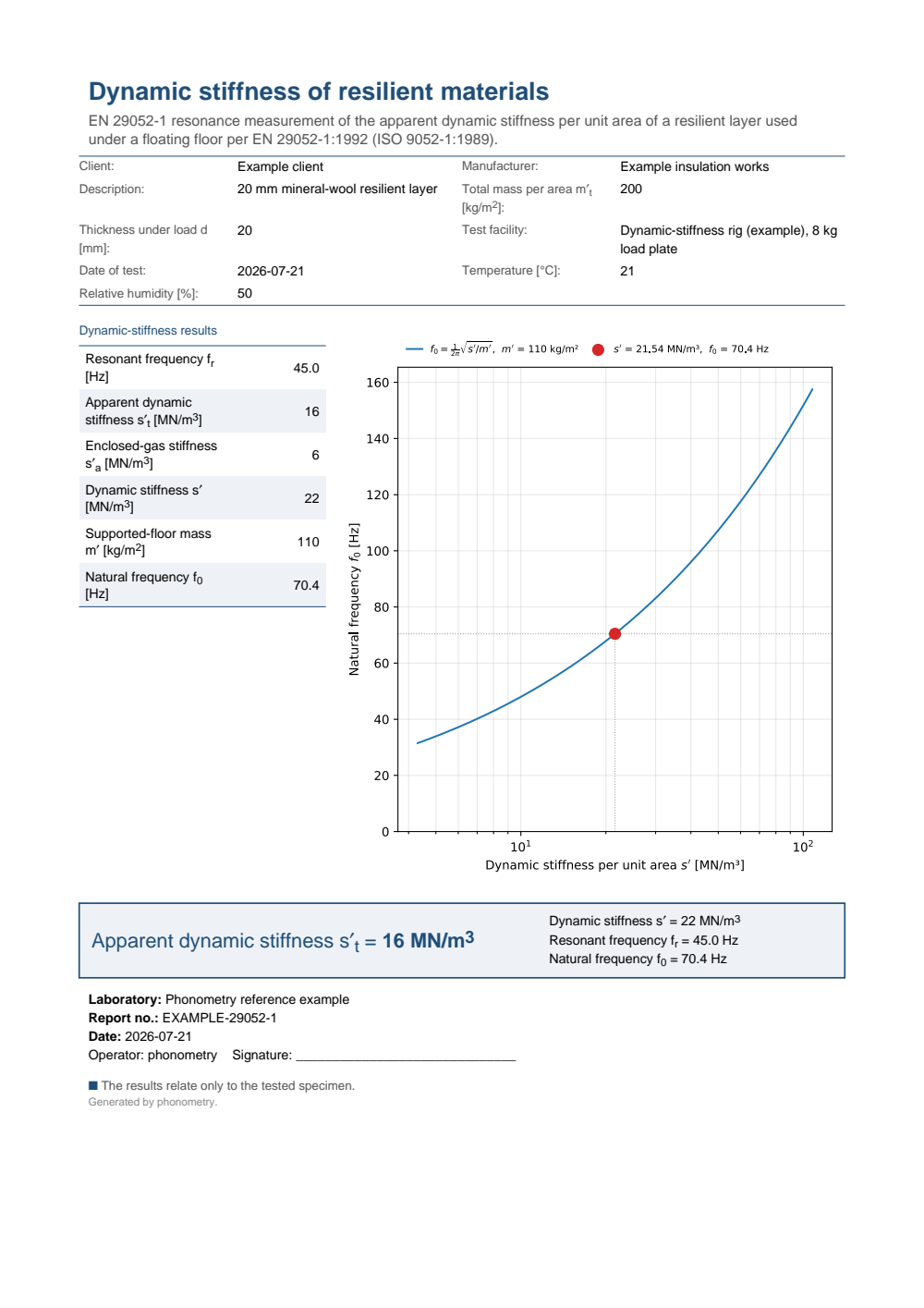
One-page dynamic-stiffness fiche: a metadata header with the total mass per unit area and the loaded thickness, a metrics table of the resonant frequency, the apparent, enclosed-gas and installed dynamic stiffnesses and the natural frequency beside the f0(s') design curve, and the boxed apparent dynamic stiffness s't.
3. What the resonance method assumes, and where it bites
Section titled “3. What the resonance method assumes, and where it bites”The evaluation treats the rig as a single-degree-of-freedom system: the load plate moves as a rigid piston on a massless spring. That holds while the specimen is light against the plate and its first internal resonance sits well above ; a heavy or very thick layer starts to act as a distributed system and the simple Formula 4 reading degrades. Three practical pitfalls follow from the preload:
s'is a stiffness at the standard preload. Resilient layers are visibly non-linear in static load: mineral wool stiffens as it compresses, some foams soften. The 200 kg/m² load plate fixes the operating point, so the tabulateds'strictly describes floors near that surface mass. Designing a much heavier screed with the sames'extrapolates beyond the measurement.- Drive small. The tangent stiffness is defined for small dynamic strains; driving the plate hard pushes the layer into its non-linear range and shifts the apparent resonance downward. Keep the excitation at the lowest level that gives a clean peak.
- Respect the contact. The standard seats the load plate on a thin bonding layer (a plaster paste) so the full specimen area carries the load. A dry, uneven contact concentrates the force, stiffens the response locally and biases upward.
The natural frequency that matters in the end is not the rig’s but the
installed floor’s from Formula 2: the floating floor only improves
insulation well above , which is why a low s' (a soft layer under a
heavy slab) is the design goal.
What this guide covers
Section titled “What this guide covers”Covered. EN 29052-1:1992 (identical to ISO 9052-1:1989) for materials
under floating floors: the dynamic stiffness per unit area of Formula 1, the
resonance relations of Formulae 2-4 (apparent_dynamic_stiffness,
natural_frequency), the enclosed-gas term of Formula 7
(enclosed_gas_stiffness), and the clause 8.2 airflow-resistivity regimes of
Formulae 5-6 (installed_dynamic_stiffness), chained end to end by
floating_floor_resonance. DynamicStiffnessResult.report renders the
clause 9 test-report fiche.
Not covered. Clause 7’s measurement procedure, extracting the resonant
frequency fr from the raw excitation-response signal by sinusoidal,
white-noise or pulse methods and extrapolating to zero force amplitude, is
not implemented: pass an already-extrapolated fr. The lateral airflow
resistivity r of clause 8.2 is likewise taken as an input rather than
measured; ISO 9053’s static and alternating methods are implemented
separately, in materials.airflow_resistance. Clause 6’s specimen-selection
requirement (at least three 200 mm × 200 mm specimens) is not enforced.
See also
Section titled “See also”- API reference:
materials.dynamic_stiffness.
References
Section titled “References”- International Organization for Standardization. (1989). Acoustics — Determination of dynamic stiffness — Part 1: Materials used under floating floors in dwellings (ISO 9052-1:1989). The international original of EN 29052-1:1992, the method this page implements: the dynamic stiffness per unit area (Formula 1), the resonance relations (Formulae 2-4), the enclosed-gas term (Formula 7, clause 8.2 NOTE s'a = 111/d MN/m³) and the airflow-resistivity regimes (Formulae 5-6). Conformance is anchored on the standard's own numeric NOTE plus hand-computed closed-form values of the resonance relations.
- Vigran, T. E. (2008). Building acoustics. CRC Press. https://doi.org/10.1201/9781482266016Floating-floor design and the role of the resilient layer's dynamic stiffness in the impact-sound improvement. ISBN 978-0-415-42853-8.