Transfer stiffness of resilient elements (ISO 10846)
Standards: ISO 10846Key references: Cremer et al. 2005
The vibro-acoustic transfer property of a resilient element (a vibration
isolator, mount, bellows or hose) is its dynamic transfer stiffness k₂₁,
the frequency-dependent ratio of the blocking force on the output (receiver)
side to the displacement on the input (source) side (ISO 10846-1, 3.7):
Because a vibration isolator is only effective between structures of large
driving-point stiffness, the force it delivers to the receiver approximates this
blocking force (ISO 10846-1, Eq. 7), so k₂₁ is the quantity that characterises
the isolator’s transmission. k₂₁ feeds the structure-borne source and building
prediction standards: ISO 9611, EN 15657 and EN 12354-5.
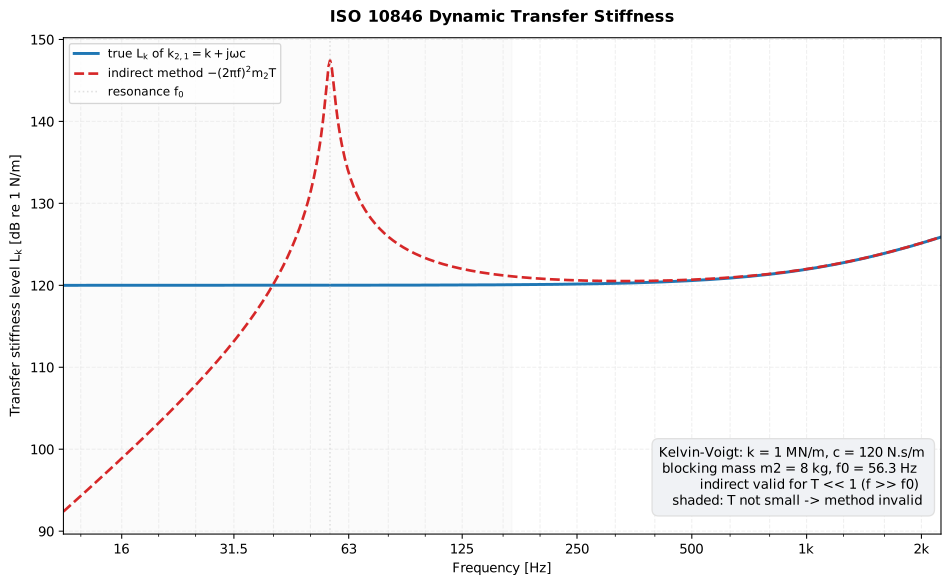
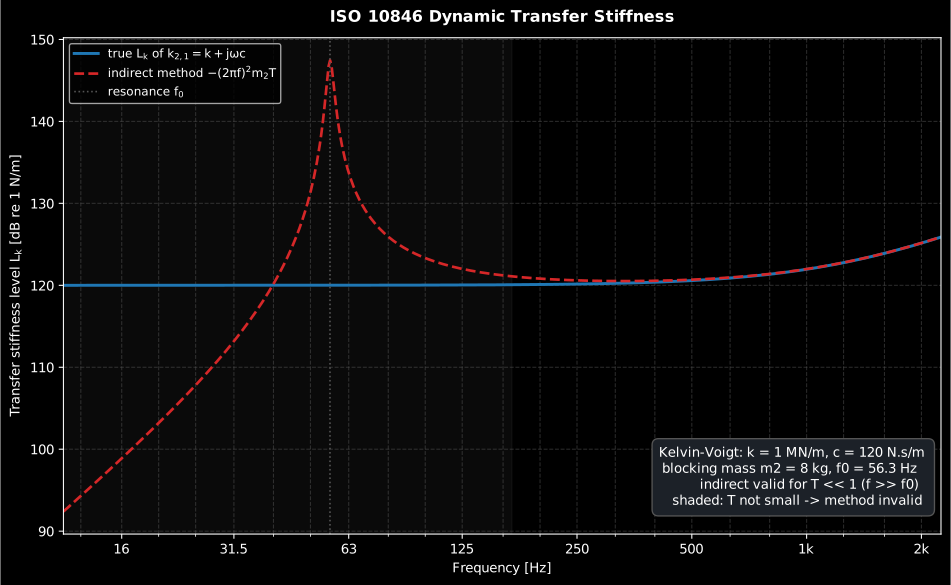
Show the code for this figure
import matplotlib.pyplot as pltimport numpy as npfrom phonometry import vibration
# Kelvin-Voigt isolator k + jwc loaded by an 8 kg blocking mass.k, c, m2 = 1.0e6, 120.0, 8.0f0 = np.sqrt(k / m2) / (2.0 * np.pi)f = np.logspace(np.log10(f0 / 5.0), np.log10(f0 * 40.0), 600)
k_true = k + 1j * 2.0 * np.pi * f * ct = vibration.base_transmissibility(f, m2, k, c)k_indirect = vibration.transfer_stiffness_indirect(f, t, m2)  # warns where T is not small
# One line — the indirect determination bundled as a result draws its own# Lk(f) level spectrum:res = vibration.indirect_transfer_stiffness_result(f, t, blocking_mass=m2)res.plot()plt.show()
# By hand, the true element stiffness against the indirect-method estimate:fig, ax = plt.subplots()ax.semilogx(f, vibration.transfer_stiffness_level(k_true),            label="true $L_k$ of $k+j\\omega c$")ax.semilogx(f, vibration.transfer_stiffness_level(k_indirect), "--",            label="indirect method $-(2\\pi f)^2 m_2 T$")ax.axvline(f0, color="0.6", linestyle=":", label="resonance $f_0$")ax.set(xlabel="Frequency [Hz]", ylabel="Transfer stiffness level $L_k$ [dB re 1 N/m]")ax.grid(True, which="both", alpha=0.3)ax.legend()plt.show()
1. The transfer-stiffness level and loss factor
Section titled “1. The transfer-stiffness level and loss factor”Results are reported as a level re the reference stiffness k₀ = 1 N/m
(ISO 10846-2 and -3, 3.17), and in the low-frequency range where inertial forces
in the element are negligible the loss factor is the tangent of the phase
angle of k₂₁ (ISO 10846-1, 3.8):
from phonometry import vibration
# A resilient mount with |k2,1| = 1 MN/m and a 5 % loss factor:k = 1e6 * (1.0 + 0.05j)print(round(float(vibration.transfer_stiffness_level(k)), 2))   # 120.00  dB re 1 N/mprint(round(float(vibration.loss_factor(k)), 3))                # 0.05
2. Direct and indirect determination
Section titled “2. Direct and indirect determination”Why a blocked force rather than, say, the isolator’s transmissibility? Because a transmissibility is a property of a whole assembly: it changes with whatever masses and stiffnesses the isolator happens to connect, so data measured on one rig would not transfer to another installation. The blocked force per unit input displacement is a property of the element alone, and it predicts the force the element delivers to any receiver that is much stiffer than the element itself, which is exactly the situation a vibration isolator is designed for. ISO 10846 therefore sandwiches the isolator between a driven input mass and an output that is either rigidly blocked or loaded with a known mass:
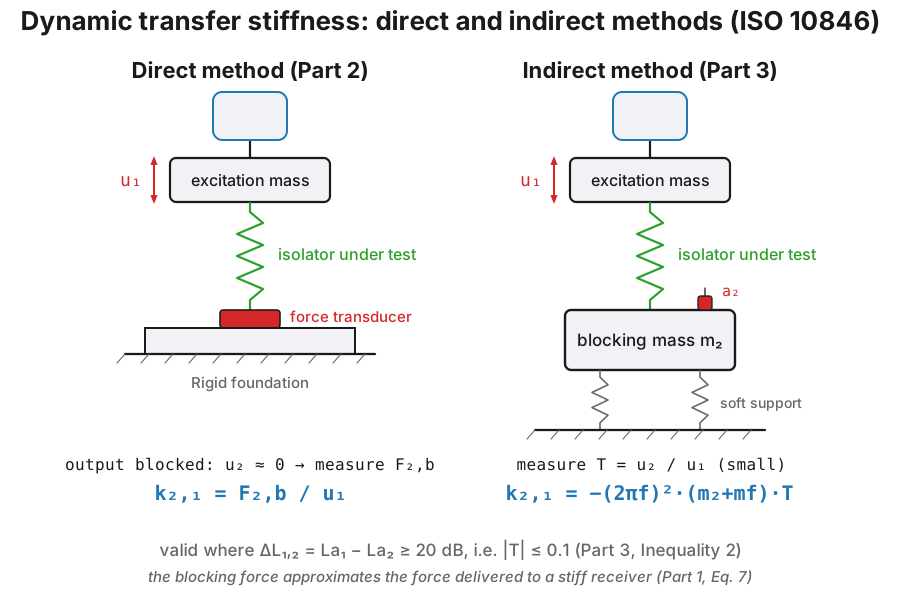
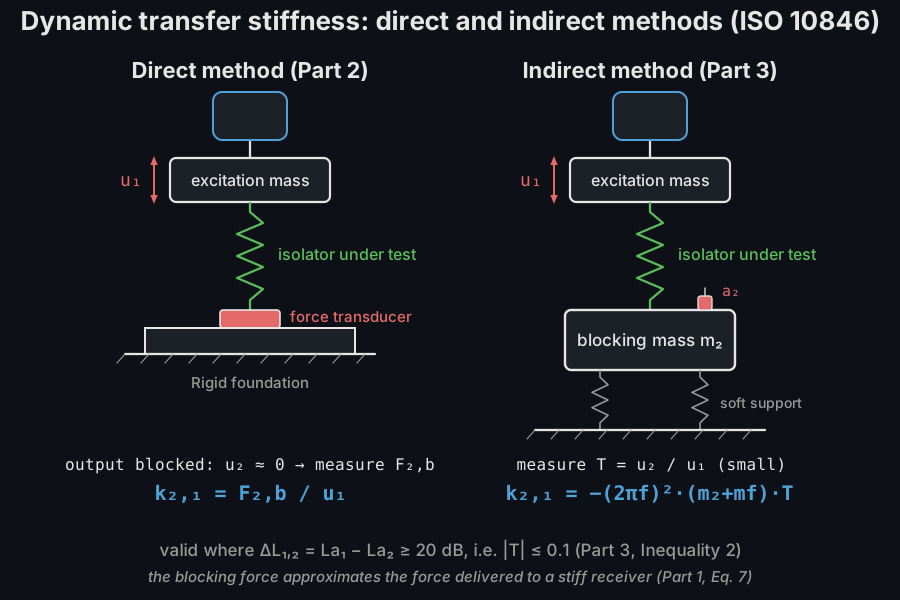
The direct method (ISO 10846-2) measures the blocked output force and the
input displacement, k₂₁ = F₂,b/u₁. The indirect method (ISO 10846-3) loads
the output with a compact blocking mass m₂ and measures the vibration
transmissibility T = u₂/u₁; the blocking force is then the inertia force of the
mass (ISO 10846-3, Eq. 1):
with m_f the mass of the output flange. The approximation is valid well above
the mass/spring resonance, where T is small.
import numpy as npfrom phonometry import vibration
# Indirect method: a 10 kg blocking mass, transmissibility 0.01 at 500 Hz.k = vibration.transfer_stiffness_indirect(500.0, 0.01, blocking_mass=10.0)print(f"{abs(complex(k)):.3e}")            # 9.870e+05  N/m
# Bundle a swept measurement into a result carrying its level and loss factor:f = np.logspace(1.5, 3.3, 200)t = vibration.base_transmissibility(f, mass=8.0, stiffness=1e6, damping=120.0)res = vibration.indirect_transfer_stiffness_result(f, t, blocking_mass=8.0)print(round(float(res.level[-1]), 1))      # ~126  dB re 1 N/m (high-f)
res.plot()   # the Lk(f) level spectrum, as in the figure above (needs matplotlib)
The TransferStiffnessResult carries the complex k₂₁ and exposes .level,
.loss_factor, .magnitude, .to("impedance"/"apparent_mass") and .plot().
The two methods split the frequency axis between them. The direct method works from 1 Hz, the lower bound of the ISO 10846-2 scope (in practice the floor is set by the rig and its instrumentation), up to where the test rig’s own resonances intrude (typically a few hundred hertz for large elements); the indirect method only becomes valid well above the blocking-mass/spring resonance, where the transmissibility is small, and extends the characterisation into the kilohertz range. A full isolator dataset is usually the two spliced together.
3. Validity of the indirect method
Section titled “3. Validity of the indirect method”ISO 10846-3 (clause 6) requires the T ≪ 1 approximation to be accurate
within 1 dB (12 % of the stiffness magnitude), which bounds the usable
frequency range on both sides:
- Impedance mismatch (Inequality 2). Valid only where
ΔL₁,₂ = La₁ − La₂ ≥ 20 dB, i.e.|T| ≤ 0.1, the constantTRANSMISSIBILITY_LIMIT.transfer_stiffness_indirectcomputes the per-band|T|and emits aPhonometryWarningwhen any band exceeds it (routine near or below the mass/spring resonance, as in the figure above). - Rigid blocking mass (Inequality 3). Above an upper frequency
f₃the blocking mass no longer moves as a rigid body; results are valid only while its measured effective massm₂,eff = 2F₂/(a′₁ + a″₁)(Eq. 4) stays within 1 dB of the rigid mass:10 lg(m₂,eff²/m₂²) ≤ 1 dB. - Linearity (clause 7.6). Two input spectra 10 dB apart must give transfer-stiffness levels within 1.5 dB.
The blocking-force idealisation itself is quantified by ISO 10846-1, Eq. (6):
for an isolator of output driving-point stiffness k₂,₂ on a termination of
stiffness k_t, the delivered force is F₂/F₂,b = 1/(1 + k₂,₂/k_t), within
10 % of the blocking force for |k₂,₂| < 0.1 |k_t| (Eq. 7):
import warningsfrom phonometry import vibration
# |T| = 0.5 violates Inequality (2): the indirect result is flagged.with warnings.catch_warnings(record=True) as caught:    warnings.simplefilter("always")    vibration.transfer_stiffness_indirect(50.0, 0.5, blocking_mass=10.0)print(caught[0].category.__name__)                     # PhonometryWarning
# Blocking-force approximation at the 10 % limit (ISO 10846-1, Eq. 6):print(round(abs(complex(vibration.blocking_force_ratio(1e5, 1e6))), 4))   # 0.9091
4. Relation to the FRF family
Section titled “4. Relation to the FRF family”The dynamic stiffness is a member of the frequency-response-function family
(ISO 10846-1, Annex A / Table A.2): it is the reciprocal of the receptance and
relates to the mechanical impedance Z and effective mass m_eff by
k = jω·Z = −ω²·m_eff. These conversions are the same as the
mechanical mobility convert_frf
pivot:
from phonometry import vibration
k = 1e6 + 5e4j                                  # N/m, at 250 HzZ = vibration.convert_frf(k, 250.0, "dynamic_stiffness", "impedance")print(abs(complex(vibration.convert_frf(Z, 250.0, "impedance", "dynamic_stiffness"))))  # 1.0012e6
5. Test-report fiche
Section titled “5. Test-report fiche”TransferStiffnessResult.report(path) renders a one-page
dynamic-transfer-stiffness characterisation report for a resilient element
(ISO 10846-1:2008 definition; determined by the direct method, ISO 10846-2:2008,
or the indirect blocking-mass method, ISO 10846-3:2002). The transfer stiffness
is a continuous frequency-response function, not an octave-band quantity, so the
sheet presents it honestly as the level spectrum plus a compact table
of characteristic points (the determination method, the blocking mass for the
indirect method, the frequency range, and the low-frequency stiffness plateau
, its level and the loss factor there), and a boxed
low-frequency (the plateau that characterises the element below its
internal resonances). It is a characterisation, so there is no pass/fail
verdict; language="es" renders the Spanish fiche. The fiche always embeds the
spectrum, so it needs both the report and plot extras
(pip install "phonometry[report,plot]").
import numpy as npfrom phonometry import ReportMetadata, TransferStiffnessResult, transfer_stiffness_direct
freqs = np.array([20, 31.5, 50, 80, 125, 200, 315, 500, 800, 1250, 2000], dtype=float)k21 = 1e6 + 1j * (2 * np.pi * freqs) * 80.0     # Kelvin-Voigt element k + jwcu1 = 1e-6 + 0jk = transfer_stiffness_direct(k21 * u1, u1)     # direct method: k2,1 = F2,b/u1res = TransferStiffnessResult(frequencies=freqs, transfer_stiffness=k)res.report(    "transfer_stiffness.pdf",    metadata=ReportMetadata(        specimen="Rubber vibration isolator",        measurement_standard="ISO 10846-2",    ),)   # one-page fiche (needs phonometry[report,plot])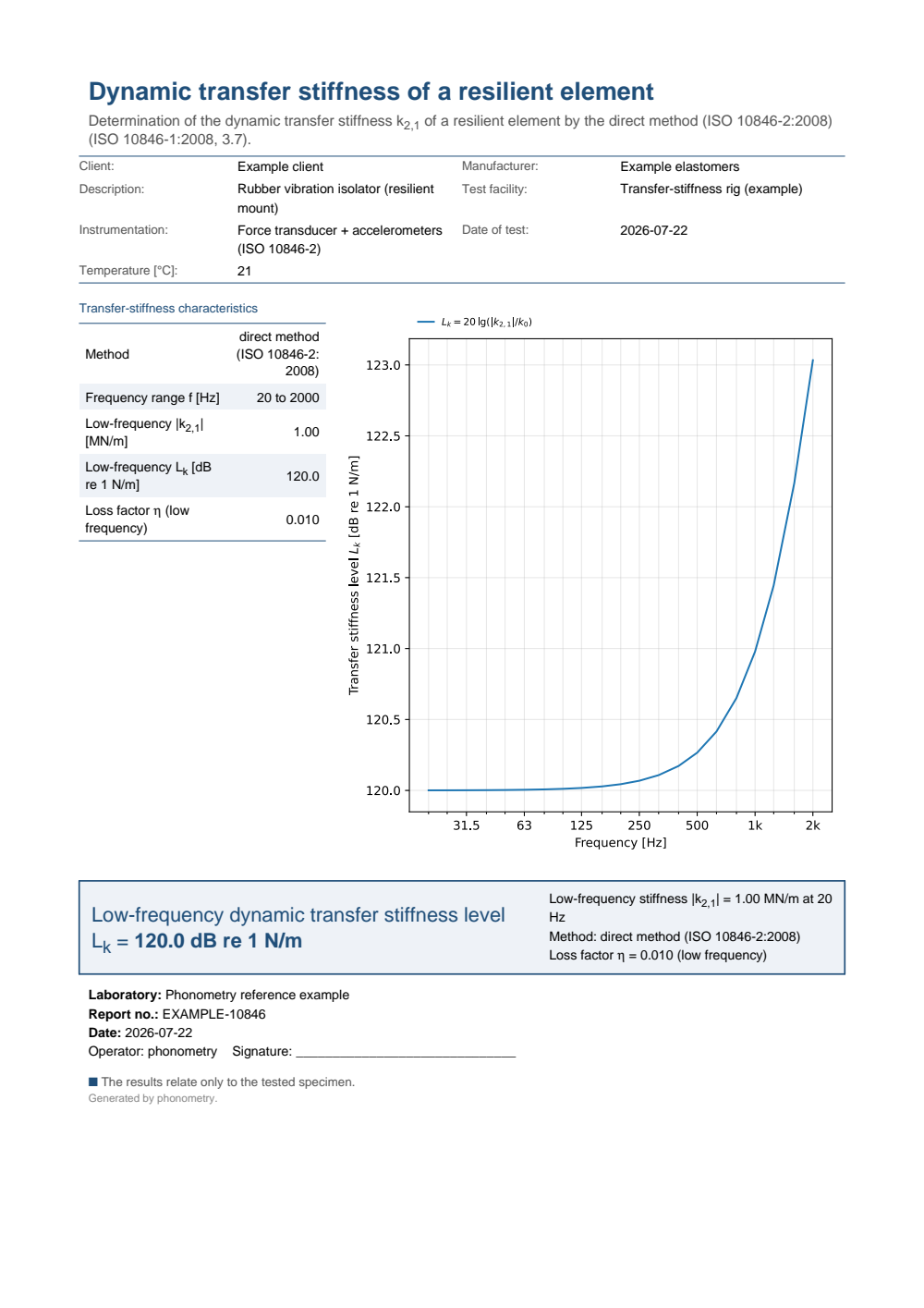
One-page dynamic-transfer-stiffness fiche: a metadata header, a table of the FRF characteristic points (the determination method, the frequency range and the low-frequency stiffness, level and loss factor) beside the transfer-stiffness level spectrum, and the boxed low-frequency level.
What this guide covers
Section titled “What this guide covers”Covered. ISO 10846-1:2008’s k₂₁ = F₂,b/u₁ definition, the level (ISO
10846-2 and -3, 3.17) and loss factor (ISO 10846-1, 3.8)
(transfer_stiffness_level, loss_factor), the ISO 10846-2:2008 direct
method (transfer_stiffness_direct), and the ISO 10846-3:2002 indirect
method of Formula 1 (transfer_stiffness_indirect). The blocking-force
approximation of Equations 6-7 (blocking_force_ratio) and the Annex A /
Table A.2 FRF relations (convert_frf) are implemented too.
TransferStiffnessResult bundles a swept determination, and .report()
renders the characterisation fiche.
Not covered. Parts 4 and 5 of the ISO 10846 series, covering elements
other than resilient supports and the driving-point low-frequency method,
are not implemented. transfer_stiffness_indirect only checks Inequality 2
(the |T| ≤ 0.1 transmissibility limit): Inequality 3, the rigid
blocking-mass check of Formula 4, is described but not computed
automatically. The clause 7.6 linearity criterion (two input spectra 10 dB
apart within 1.5 dB) is likewise not checked in code.
See also
Section titled “See also”- API reference:
vibration.transfer_stiffnessandvibration.mechanical_mobility.
References
Section titled “References”- Cremer, L., Heckl, M., & Petersson, B. A. T. (2005). Structure-borne sound: Structural vibrations and sound radiation at audio frequencies (3rd ed.). Springer. https://doi.org/10.1007/b137728Vibration isolation theory: why an isolator's performance depends on the source and receiver mobilities, the physics behind the blocked-force characterisation. ISBN 978-3-540-22696-3.
- International Organization for Standardization. (2002). Acoustics and vibration — Laboratory measurement of vibro-acoustic transfer properties of resilient elements — Part 3: Indirect method for determination of the dynamic stiffness of resilient supports for translatory motion (ISO 10846-3:2002). The indirect method k₂₁ = −(2πf)²(m₂+m_f)T (Formula 1) with its validity conditions (clause 6: Inequalities 2 and 3; clause 7.6 linearity). Conformance is anchored on the indirect inertia relation, the |T| = 0.1 ↔ ΔL₁,₂ = 20 dB validity limit and its 1 dB (12 %) accuracy bound, and the 7.6 linearity criterion.
- International Organization for Standardization. (2008). Acoustics and vibration — Laboratory measurement of vibro-acoustic transfer properties of resilient elements — Part 1: Principles and guidelines (ISO 10846-1:2008). The principles part of the series: the blocking-force idealisation and the FRF relations this page implements: the dynamic transfer stiffness k₂₁ = F₂,b/u₁ and its FRF relations (clause 5 and Annex A / Table A.2) and the blocking-force approximation (Eqs. 6/7). Parts 4 and 5 of the series extend the same quantities to elements other than supports and to the driving-point low-frequency method. Conformance is anchored on the closed-form Table-A.2 identity k = jω·Z and the Eq. (6) force ratio 1/1.1.
- International Organization for Standardization. (2008). Acoustics and vibration — Laboratory measurement of vibro-acoustic transfer properties of resilient elements — Part 2: Direct method for determination of the dynamic stiffness of resilient supports for translatory motion (ISO 10846-2:2008). The direct method, and (with Part 3) the level L_k re 1 N/m and the loss factor (clauses 3.8/3.17). Conformance is anchored on the closed-form level of a decade of stiffness.