Sound Intensity (p-p)
Sound pressure tells you how loud a point is; sound intensity tells you where the energy is going. It is the acoustic power flux (W/m²), a signed vector quantity — which is why intensity probes can localize sources, separate them from background noise and measure sound power in situ (ISO 9614) where a pressure measurement alone cannot.
The two-microphone principle (IEC 61043)
Section titled “The two-microphone principle (IEC 61043)”A p-p probe holds two matched microphones a small distance Δr apart. The pressure at the probe center is their mean, and the particle velocity comes from the pressure gradient (Euler’s equation, finite-difference form):
In practice the estimator works in the frequency domain through the cross-spectrum of the two channels (the standard’s equivalent form):
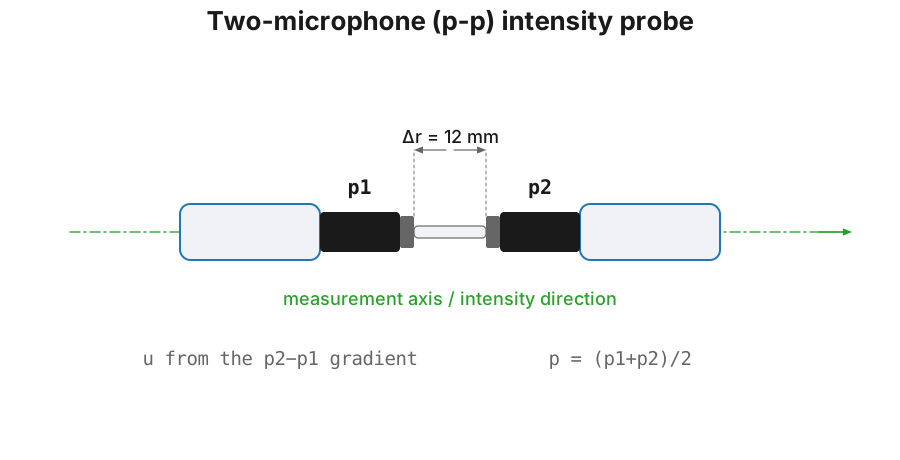
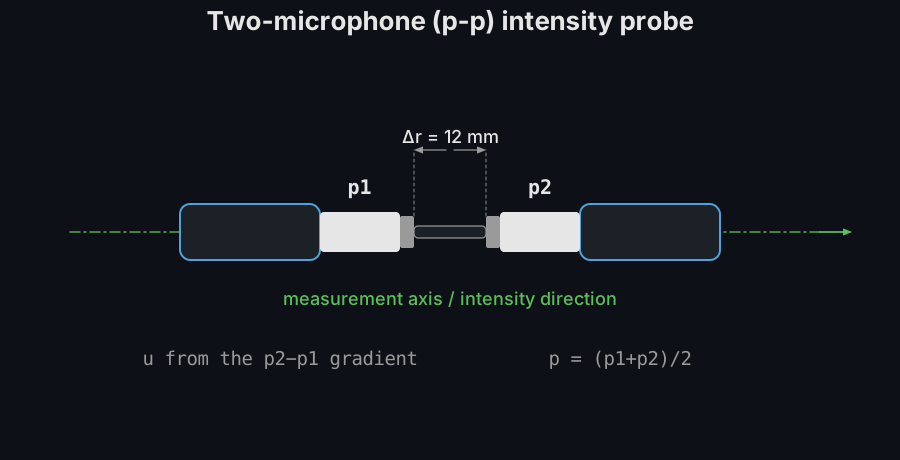
from phonometry import sound_intensity
res = sound_intensity(p1, p2, fs, spacing=0.012, fraction=3,                      limits=[100, 2500])print(res.total_intensity_level, res.total_direction)      # LI [dB], ±1print(res.frequency, res.intensity_level)                  # per band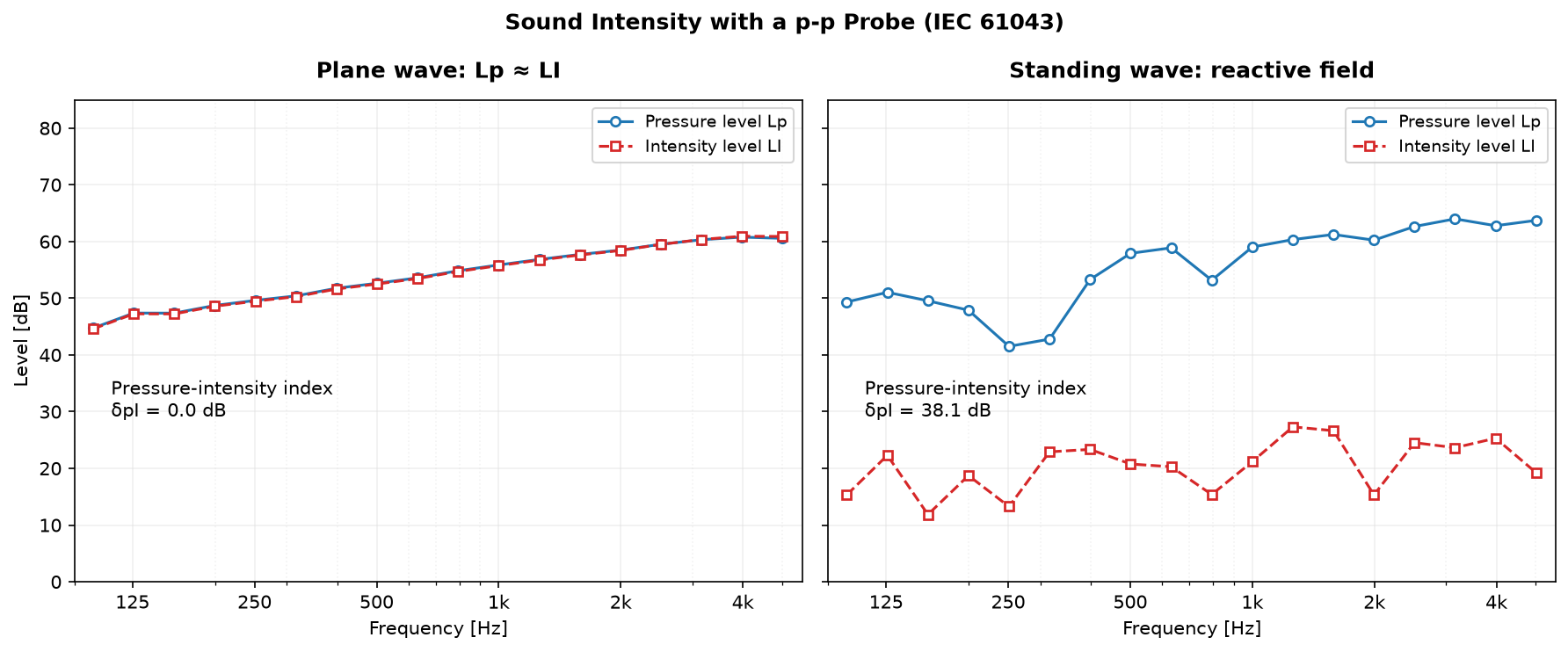
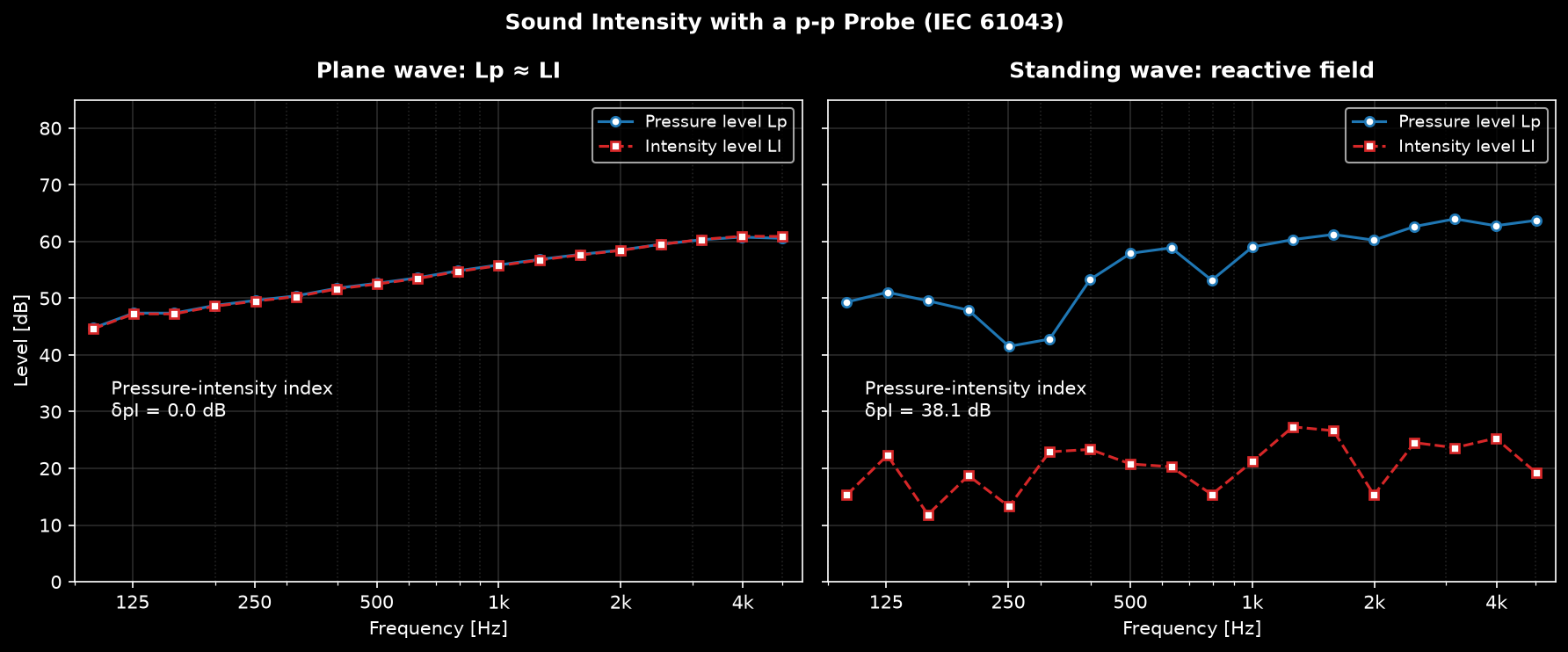
Left: in a plane progressive wave all pressure is transported — L_I ≈ L_p. Right: a standing wave carries (almost) no net energy — the pressure is high but the intensity collapses. The gap L_p − L_I is the pressure-intensity index, the fundamental quality indicator of every intensity measurement.
Knowing when to trust the number
Section titled “Knowing when to trust the number”Two physical limits bound every p-p measurement, and the result object carries both:
- High frequency: the finite-difference gradient underestimates I by
— verified in CI against IEC 61043 Table 3.
IntensityResult.bias_correctionprovides the factor andmax_valid_frequency(≈ 0.1·c/Δr; 2.9 kHz for a 12 mm spacer) the practical ceiling. Larger spacers reach lower frequencies, smaller ones higher. - Reactive fields: when
pressure_intensity_index(F2 in ISO 9614-1) approaches the probe’s residual index δ_pI0, phase errors dominate. The ISO 9614-1 Annex A field indicators and the dynamic-capability criterion are available directly:
from phonometry import field_indicators, dynamic_capability_index
fi = field_indicators(pressure_levels, normal_intensity)   # F2, F3, F4ld = dynamic_capability_index(18.0)   # δpI0 = 18 dB → Ld = δpI0 − Kok = ld > fi.f2                                            # criterion 1
sound_intensity() parameters
Section titled “sound_intensity() parameters”| Parameter | Type | Units | Range / default | Notes |
|---|---|---|---|---|
p1, p2 | 1D arrays | Pa | equal length | Microphone closer to the source first; reversing them flips the sign |
fs | int | Hz | > 0 | |
spacing | float | m | > 0 | Microphone separation Δr (typ. 6/12/50 mm) |
rho | float | kg/m³ | default 1.204 | Air density |
c | float | m/s | default 343.0 | Speed of sound (bias/validity estimates) |
fraction | int, optional | — | 1, 3 or None (default) | Octave/third-octave band integration |
limits | list, optional | Hz | default library band range | Band analysis limits |
See Theory for the derivations and Calibration for absolute scaling of the two channels.