A model says what an enclosure should be worth. It takes the transmission loss of the panels, subtracts a penalty for the reverberant build-up in the cavity and returns an insertion loss. It is a good number and it is not the one a buyer can hold anybody to, because it knows nothing about the gap under the door, the conduit that was run through the wall afterwards, or the fan that was fitted to keep the machine cool.
These three standards measure what was built. The quantity is a difference of two runs: determine the machine’s sound power without the enclosure, determine it again with the enclosure in place, and subtract band by band.
That is Equation (1) of both parts of ISO 11546, and nothing else in either document is more complicated than it. The care is all in what “the same determination twice” means.
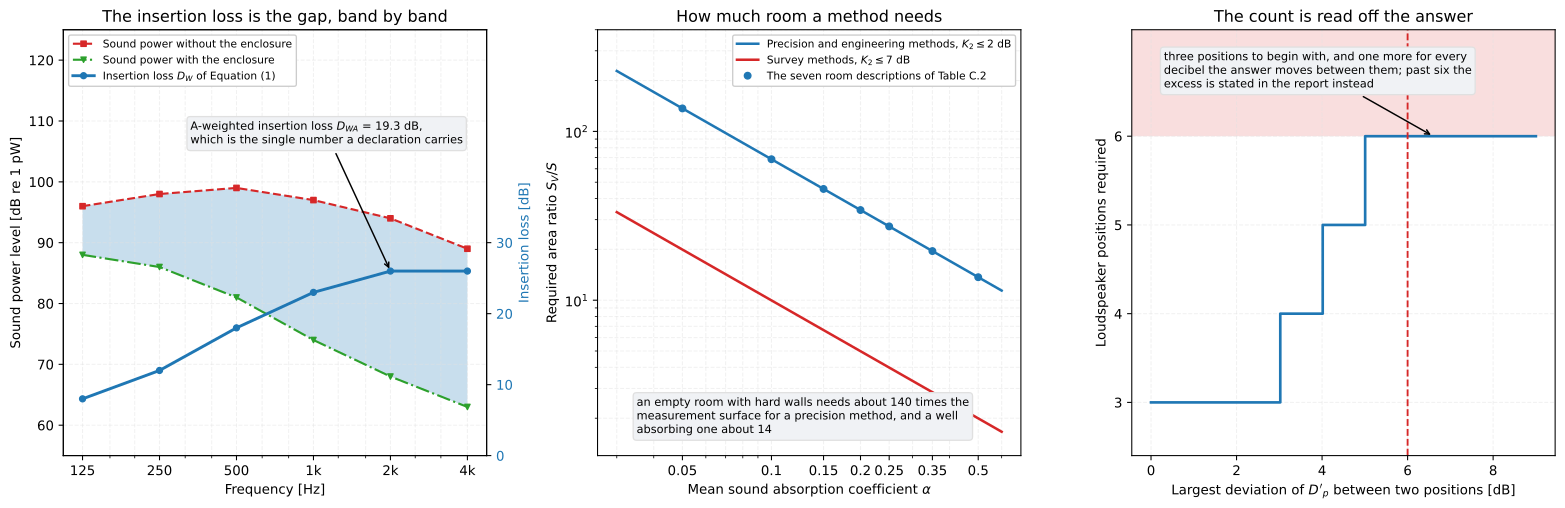
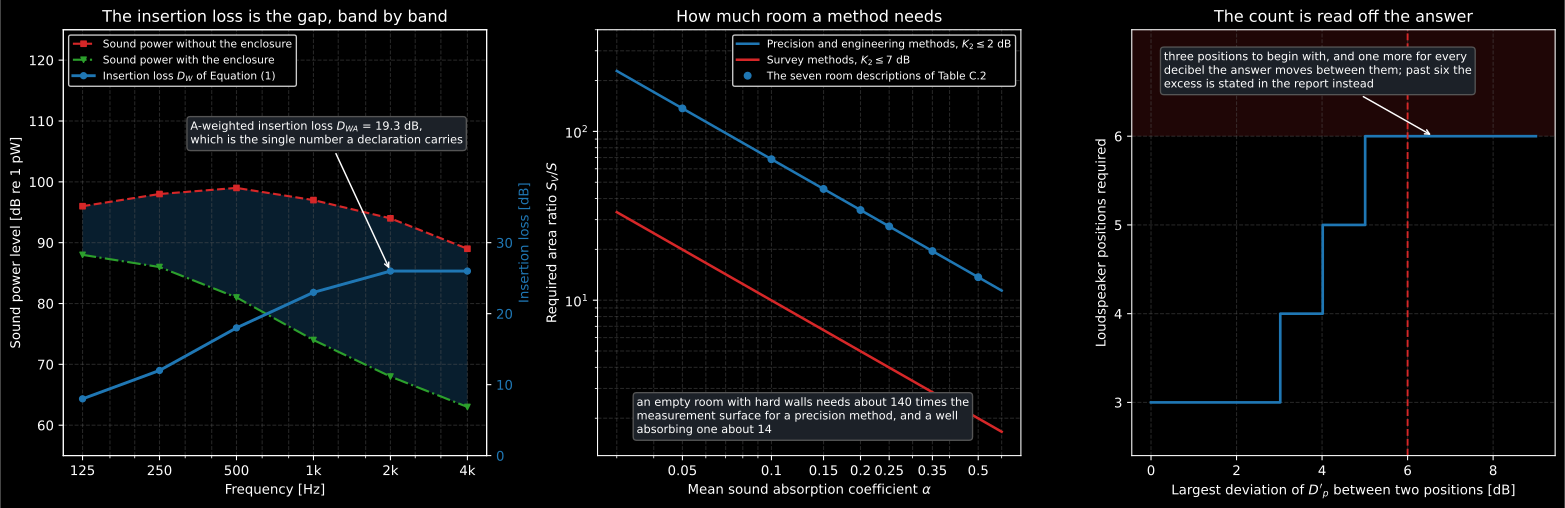
The insertion loss is the gap between two runs; the room has to be good enough for the method that measured them; and in situ the number of source positions is decided by the answer.
1. Two parts, one procedure
Section titled “1. Two parts, one procedure”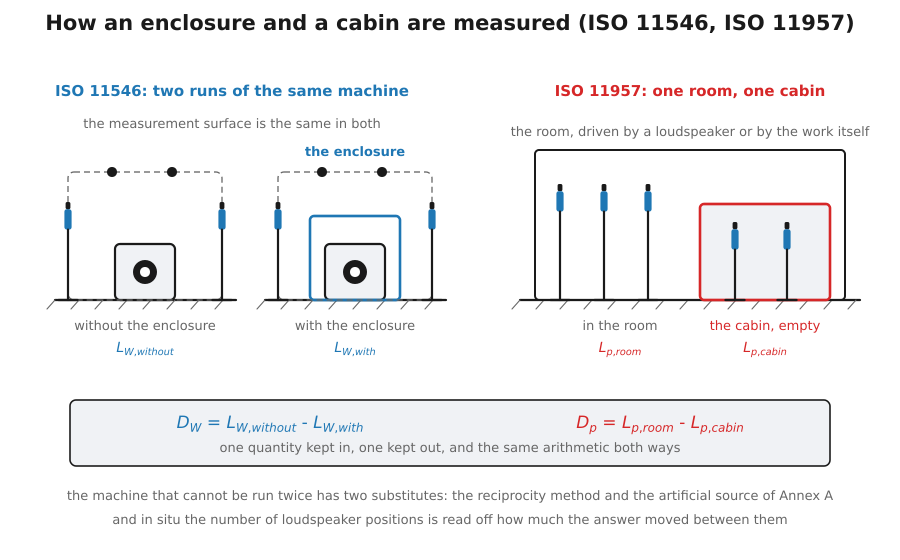
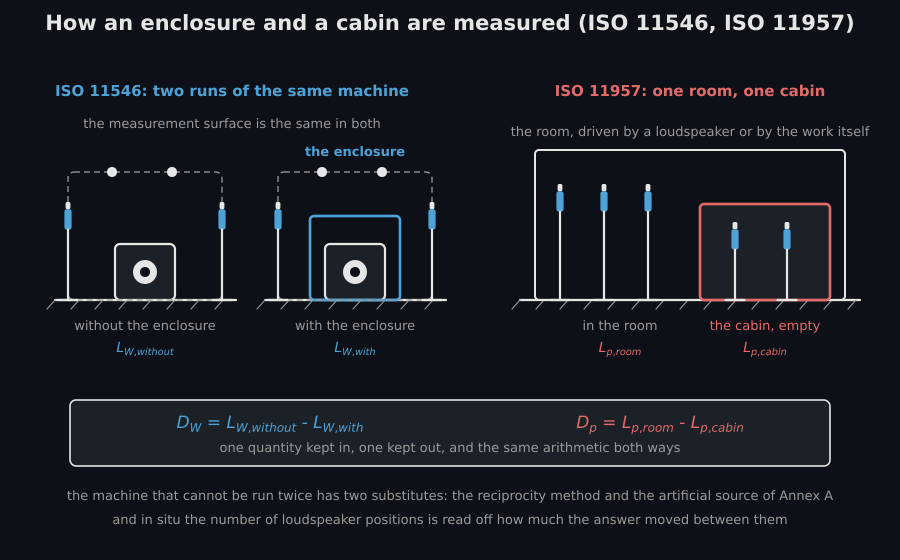
ISO 11546-1 measures in a laboratory, for a declaration: the manufacturer’s figure, obtained under conditions a buyer can compare across suppliers. ISO 11546-2 measures the same thing in situ, for an acceptance: the enclosure as installed, in the room it was installed in, with the machine it was built for.
The two share their definitions, their equations, their reporting rules and their artificial source word for word. What changes is the environment, the base standard the levels come from, and, in part 2, an annex that asks whether the room is good enough at all.
from phonometry import noise_control
bands = [125.0, 250.0, 500.0, 1000.0, 2000.0, 4000.0]without = [96.0, 98.0, 99.0, 97.0, 94.0, 89.0]   # dB, machine alonewith_box = [88.0, 86.0, 81.0, 74.0, 68.0, 63.0]  # dB, enclosure fitted
res = noise_control.sound_power_insulation(    without, with_box, frequencies=bands, band_fraction=1,)print(res.rounded())                    # [ 8 12 18 23 26 26] dBprint(round(res.a_weighted_insulation, 1))   # 19.3 dB
The A-weighted number is of Equation (2), and it is the single figure
a declaration carries. Clause 9.4 reports every band value rounded to the
nearest decibel, which is what .rounded() does.
Both parts also measure a sound pressure insulation at a stated position,
Equations (3) and (4), through sound_pressure_insulation. It is a different
quantity with the same arithmetic: it belongs to one microphone position, which
is why the standard makes the position reportable.
2. What the method may declare
Section titled “2. What the method may declare”Table 1 of both parts is the part that gets skipped, and it is the part that decides what may be written on the data sheet. Not every way of determining a sound power gives a spectrum: a survey-grade determination hands back an A-weighted value and nothing per band, so cannot be declared from it at all.
for entry in noise_control.applicable_methods(condition="in-situ"): if not entry.band_values: print(entry.base_standard, entry.quantities)# ISO 3746 ('D_WA',)# ISO 11202 ('D_pA',)Those two rows exist only in part 2. The laboratory table of part 1 admits no survey-grade determination at all, and its own footnote goes further: where a standard has a grade 3 variant, ISO 9614-1 and ISO 11204, that variant is excluded. A declaration is the one place where the measurement has to be at least an engineering one, and Table 1 is where the document says so.
The table also decides which substitute source is available. Where the machine cannot be run, both parts replace it. Clause 1 draws the scope around the first case rather than the substitutes: the part applies to a free-standing enclosure smaller than 2 m³ without any restriction, and a larger one may still be measured with its actual source while the base standard’s own limit on volume is met. The two substitutes are:
- the reciprocity method of part 1, 7.2, which puts the enclosure in a diffuse field and measures inside it, giving . It exists in part 1 only, and asking for it in situ is refused rather than approximated;
- an artificial source, the tapping machine of Annex A dropped on an
undamped steel plate, used at several positions. The positions are averaged
arithmetically, which is the standard’s own word and not the energy mean
used almost everywhere else in this library, so
artificial_source_insulationwrites it out rather than borrowing one.
3. Is the room good enough?
Section titled “3. Is the room good enough?”Annex C of part 2 asks the question the emission standards ask backwards. They ask what the environmental correction of a room is; the annex asks how much room a method needs. Holding at the limit Table C.1 sets and solving for the room gives
which is Figure C.1 in closed form: the curve the annex asks the reader to read
off by eye. test_environment_applicability evaluates it and compares it with
the room in front of you.
verdict = noise_control.test_environment_applicability( base_standard="ISO 3744", mean_absorption_coefficient=0.15, room_surface_area_m2=520.0, measurement_surface_area_m2=14.1,)print(round(verdict.required_area_ratio, 1)) # 45.6print(round(verdict.actual_area_ratio, 1)) # 36.9print(verdict.applicable) # FalseThat room cannot carry a precision determination. It can carry a survey one, which asks 6,6 rather than 45,6, and the answer that comes back from it is an A-weighted value with no spectrum behind it. The two facts belong together, and reading Table 1 after Annex C is how they stay together.
Where nobody measured the absorption, Table C.2 gives seven room descriptions
and their coefficients, from 0,05 for an empty room with smooth hard walls to
0,5 for a room with large amounts of sound-absorbing material on ceiling and
walls. They are ROOM_ABSORPTION_ESTIMATES, transcribed from that table and
from no other. The 2010 editions of the sound power standards print a longer
table under the same title: Table A.1 of ISO 3744:2010 and of ISO 3746:2010 has
eight rows, adding 0,30 for a room with an absorbing ceiling and bare walls,
and words two of the seven differently.
How the measurement goes
Section titled “How the measurement goes”Pick the base standard first, because Table 1 decides what the result may be
called: a survey method gives an A-weighted number and nothing per band, and no
amount of care afterwards turns that into a spectrum. Fix the measurement
surface and keep it for both runs. Determine the machine’s sound power without
the enclosure, fit the enclosure without moving the machine or the microphones,
and determine it again. Where the machine cannot be run twice, use the
reciprocity method or the artificial source of Annex A instead, and say which in
the report. In situ, run test_environment_applicability on the room before
anything else: a room that cannot meet the environmental correction the base
standard asks for will not be rescued by a careful measurement.
4. The cabin is the inverse problem
Section titled “4. The cabin is the inverse problem”An enclosure keeps noise in. A cabin keeps it out, and ISO 11957 measures that as the difference between the level in the room and the level inside the empty cabin.
Equation (1) is the laboratory quantity, measured in a reverberation room to ISO 3741. Equation (2) is the same arithmetic in situ, where no requirement is placed on the room at all, and the answer carries a prime to say so: . The prime is not decoration. Definition 3.6 exists because a number measured in a room that was never qualified cannot be compared with one that was, and clause 4 says outright that only data from the same method may be used when comparing cabins.
room = [88.0, 90.0, 91.0, 89.0, 86.0, 82.0]    # dB, level in the roominside = [76.0, 72.0, 66.0, 59.0, 52.0, 47.0]  # dB, level in the cabin
cab = noise_control.cabin_insulation(    room, inside, frequencies=bands, band_fraction=1,    method="in-situ-loudspeaker",)print(cab.symbol, cab.rounded())   # D'_p [12 18 25 30 34 35] dB
There is a third method, and it is the one a workplace usually wants: drive the
room with the noise that is actually there. That is the only method for which
the standard defines an A-weighted difference, of Equation (3), and
cabin_insulation refuses to compute one under any other, because a figure
labelled that came from a loudspeaker is a claim the document does
not make.
5. The count that is read off the answer
Section titled “5. The count that is read off the answer”Almost every number in a measurement standard is fixed before the measurement: six microphone positions, 2 m from the cabin, 3 m apart. Clause 7.2.1 of ISO 11957 has one that is not. The number of loudspeaker positions shall be at least the largest deviation, in decibels, of between any two of them, read in octave bands, starting at three and stopping at six.
It is a criterion that judges the measurement by how much it disagreed with itself. A room where moving the loudspeaker changes the answer by four decibels is a room where three positions were not enough to average it out.
by_position = [ [12.0, 16.0, 25.0, 30.0, 34.0, 35.0], [13.5, 18.0, 27.5, 32.0, 36.5, 36.0], [11.0, 14.5, 23.0, 28.5, 33.0, 34.0],]check = noise_control.check_source_positions(by_position)print(check.max_octave_spread_db) # 4.5print(check.required_positions) # 5print(check.satisfied) # FalseTwo more positions, and the clause adds that the three used first should not be
used again. Past six decibels the excess is stated in the report instead, which
exceeds_maximum marks.
The other numeric rules of the two clauses are here too. check_band_flatness
is the requirement that the three one-third-octave levels inside an octave
differ by at most 6 dB at 125 Hz, 5 dB at 250 Hz and 4 dB above, which is what
makes an octave-band result mean what the standard says it means.
minimum_cabin_clearance_m is the clearance of 6.2, written exactly as printed
including the low-frequency sentence that relaxes it rather than tightening it.
internal_noise_level is the noise the cabin’s own fans make, corrected for the
background only while the margin stays between 6 dB and 10 dB, which is a
different rule from the one 6.4 applies to the insulation itself.
How the measurement goes
Section titled “How the measurement goes”Drive the room with a loudspeaker, or let the actual noise do it where the
A-weighted insulation is wanted, since Equation (3) is defined for nothing else.
Check the driving spectrum with check_band_flatness before trusting an
octave-band result. Take the level in the room and the level inside the empty
cabin, both corrected for their own background by the ISO 3741 rule, and keep
the cabin empty: what is being measured is the cabin, not the equipment in it.
In situ, start at three loudspeaker positions, compute the spread of the answer
between them with check_source_positions, and add positions until the count
the clause asks for is reached. Measure the internal noise level separately,
with the room quiet, because a cabin with its own fans has a floor of its own.
6. One number, and what it is worth
Section titled “6. One number, and what it is worth”All three documents delegate their single number to ISO 717-1, putting their own quantity where that standard writes the sound reduction index.
rating = noise_control.weighted_cabin_insulation( cab.insulation[:5], apparent=True, band_fraction=1,)print(rating.rating, rating.c, rating.ctr) # 28 -1 -5Clause 4 of ISO 11957 calls the preferred single number and then warns, in the same paragraph, against reading too much into it: what a cabin is worth depends on the spectrum it stands in. The annexes answer that objection directly. Given a spectrum, the estimated insulation is
with the A-weighted total of the same spectrum. The sign of is the trap: the annex prints an attenuation, positive where the weighting takes level away, while a library’s band corrections are the correction itself. Both terms are built here from the same table, so the answer cannot disagree with its own inputs, and an insulation of zero returns exactly zero.
spectrum = [92.0, 94.0, 95.0, 93.0, 90.0, 85.0] # dB, the actual noiseprint(round(noise_control.estimated_cabin_noise_insulation( spectrum, cab.insulation, frequencies=bands,), 1)) # 25.6 dBAgainst that spectrum the cabin is worth 25,6 dB(A), where its rating is 28. The two numbers answer different questions, and the rating is not the one to put in a hearing-conservation calculation.
7. What the report has to say, and what it cannot
Section titled “7. What the report has to say, and what it cannot”Clause 10 of ISO 11957 is unusually candid. In the laboratory the uncertainty of ISO 3741 carries over from 250 Hz to 10 kHz, and only while the room is at least twenty times the volume of the cabin. The loudspeaker method in situ adds about 2 dB to the standard deviation. For the actual-noise method the clause states nothing at all and sends a declared value to ISO 4871.
u = noise_control.uncertainty_conditions( room_volume_m3=520.0, cabin_volume_m3=18.0, method="in-situ-loudspeaker",)print(round(u.volume_ratio, 1), u.ratio_satisfied) # 28.9 Trueprint(u.excess_standard_deviation_db) # 2.0A measurement whose room is too small for the cabin still returns a number. What it does not return is the uncertainty statement, and a report that quotes one anyway is quoting a clause that excluded it.
What this guide covers
Section titled “What this guide covers”Covered
The arithmetic of all three documents. From ISO 11546-1 and -2: Equations (1) to (5) through
sound_power_insulation,sound_pressure_insulation,reciprocity_insulationandartificial_source_insulation, the last averaging its source positions arithmetically as the clause says; Table 1 as data throughapplicable_methods, including the quantities each row may declare and the rows that give no spectrum; the ISO 717-1 rating of clause 7 throughweighted_insulation; the estimate of Annex C and Annex D throughestimated_a_weighted_insulation; the leak, seal and fill ratios of the definitions; the source clearance of 7.2; and the whole of Annex C of part 2, with Table C.1, Table C.2 and Figure C.1 in closed form throughtest_environment_applicability, cross-checked against the environmental correction of ISO 3744. From ISO 11957: Equations (1), (2) and (3) throughcabin_insulation, with the prime of definition 3.6 and the refusal to name an A-weighted insulation outside the actual-noise method; the ISO 717-1 rating of clause 8; the estimate of Annex A; the source-position criterion of 7.2.1 throughcheck_source_positions; the flatness rule of 6.4 throughcheck_band_flatness; the clearance of 6.2; the internal noise level of 6.7 with its own background window; and the conditions clause 10 attaches its uncertainty statement to. The background correction all three hand to ISO 3741 isemission.reverberation_background_correction.Not covered
Nothing here predicts an insulation: the panel transmission loss and the interior correction that give a designed insertion loss are a separate page, and this one starts from levels that were measured. Nothing here builds or qualifies a test environment: the reverberation room of ISO 3741, the hard-walled room of ISO 3743-1 and the microphone arrays of the ISO 11200 series belong to their own standards, and the applicability annex reads their requirements rather than checking a room against them. The artificial source of Annex A is a hardware drawing, and its plate, drop and standoff are constants here and nothing more. Mounting, sealing, operating every movable part ten times, the instrumentation classes and the report template are procedure, not arithmetic; the one piece of the reporting clauses that computes is the rounding to the nearest decibel. No worked numeric example is printed in any of the three documents, so nothing here reproduces one.
References
Section titled “References”- International Organization for Standardization. (1995). Acoustics — Determination of sound insulation performances of enclosures — Part 1: Measurements under laboratory conditions (for declaration purposes) (ISO 11546-1:1995). The laboratory measurement a manufacturer declares from: Equations (1) to (5), Table 1, the reciprocity and artificial-source methods of clause 7, and the estimate of Annex C. Read from BS EN ISO 11546-1:2009, which endorses it without modification.
- International Organization for Standardization. (1995). Acoustics — Determination of sound insulation performances of enclosures — Part 2: Measurements in situ (for acceptance and verification purposes) (ISO 11546-2:1995). The same quantities measured where the enclosure was installed, plus Annex C, which asks whether the room is good enough for the base standard at all. Read from BS EN ISO 11546-2:2009, which endorses it without modification.
- International Organization for Standardization. (1996). Acoustics — Determination of sound insulation performances of cabins — Laboratory and in situ measurements (ISO 11957:1996). The cabin: Equations (1), (2) and (3), the source-position criterion of 7.2.1, the flatness and background rules of 6.4 and 6.7, and the estimate of Annex A. Read from BS EN ISO 11957:2009, which endorses it without modification.
- International Organization for Standardization. (2010). Acoustics — Determination of sound power levels of noise sources using sound pressure — Precision methods for reverberation test rooms (ISO 3741:2010). The background-noise correction all three documents hand their measurements to, and the reverberation room the cabin laboratory method is carried out in.
- International Organization for Standardization. (2020). Acoustics — Rating of sound insulation in buildings and of building elements — Part 1: Airborne sound insulation (ISO 717-1:2020). The single-number rating all three documents delegate to, with their own quantity written where it writes the sound reduction index.