What a seat does to the vibration
Standards: ISO 10326
A driver does not sit on the floor of the machine. The seat is in between, and whether it helps is not obvious: a suspension seat is a spring and a damper, and a spring has a resonance. Feed it the wrong spectrum and it amplifies exactly what it was bought to attenuate.
Human vibration exposure measures what reaches the person. This page is the laboratory method that measures what the seat did to it, and it answers with one number.
1. The SEAT factor
Section titled “1. The SEAT factor”Mount the seat on a vibration simulator, drive the platform with the input spectrum the application standard prescribes, sit a test person in it, and measure the frequency-weighted r.m.s. acceleration in two places. The ratio is the seat effective amplitude transmissibility, which everybody calls the SEAT factor (10.2.2):
Below 1 the seat is doing its job. At 1 the two measurements are equal, so the seat passed the vibration through unchanged, which is what a rigid plank would do and also what a seat does when its attenuation over part of the spectrum is cancelled by amplification over the rest. Above 1 it is making the ride worse than no seat at all, which is not a hypothetical: it is what a suspension does when the machine’s dominant frequency lands on its resonance.
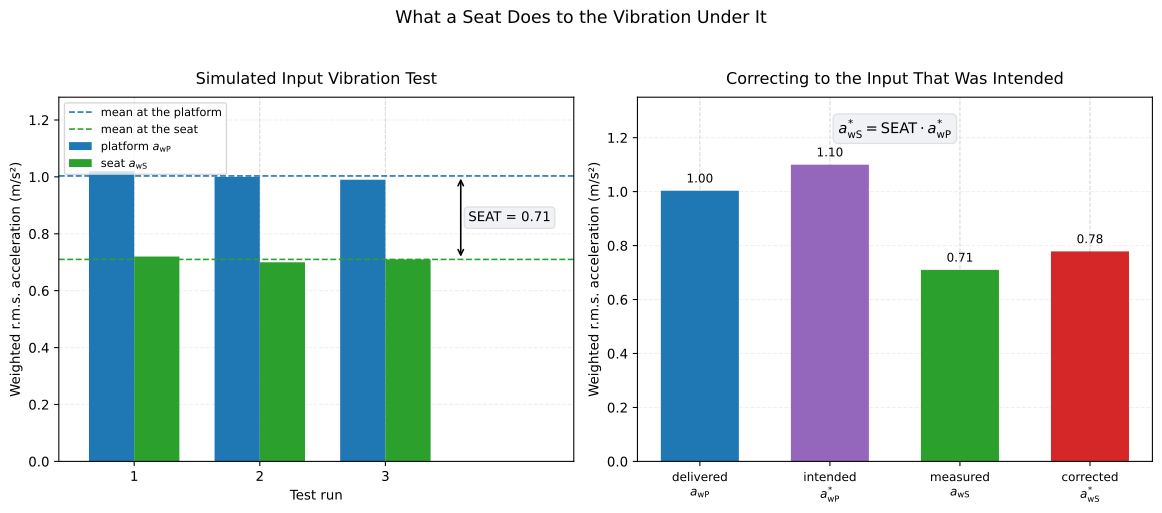
is the arithmetic mean of three consecutive runs whose seat
values lie within ± 5 % of that mean, and the mean of the
platform values from those same runs, which have to stay inside the input
tolerances rather than inside the 5 % (10.2.1). The library treats the
agreement as a condition rather than a footnote: mean_of_test_runs refuses a
set that does not meet the spread, because a mean of runs that disagree by more
is not a measurement this standard recognises. seat_transmission puts both
sets through it, so on the platform side it is stricter than the clause.
Show the code for this figure
import matplotlib.pyplot as pltfrom phonometry import vibration
# Three runs at the platform and three at the seat, in m/s2.test = vibration.seat_transmission(    [0.72, 0.70, 0.71], [1.02, 1.00, 0.99])print(round(test.seat_factor, 3), test.attenuates)     # 0.708 Truetest.plot()plt.show()
# Runs that do not agree within 5 % are not a measurement:try:    vibration.mean_of_test_runs([1.0, 1.2, 1.0])except ValueError as error:    print(error)# The runs differ from their mean by 12.5 %, more than the 5 % this test allows.
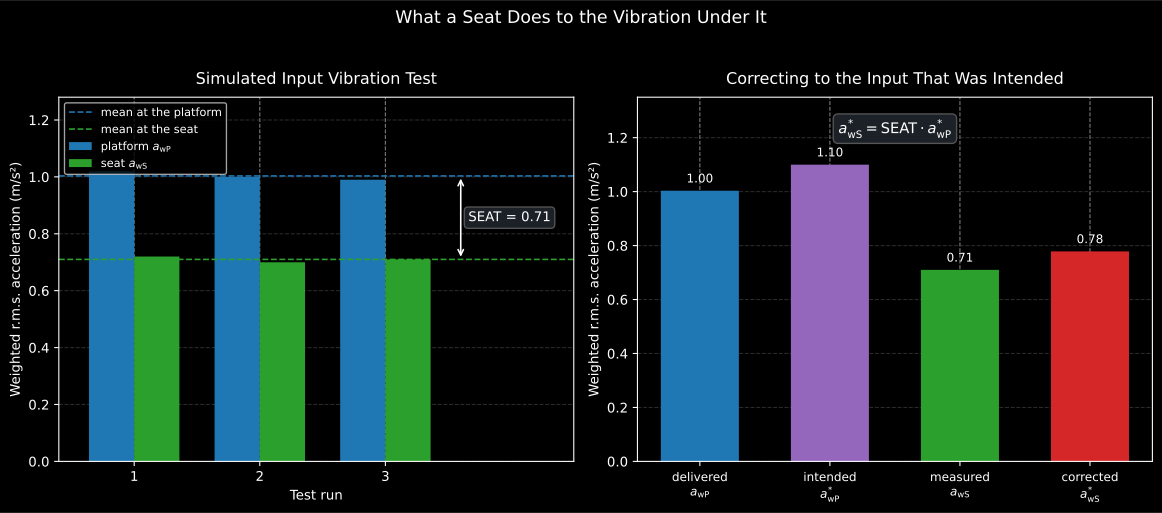
One test, and the ratio it exists to produce. The three runs agree to well inside the tolerance, so their means are the two numbers the SEAT factor is built from.
How the measurement goes
Section titled “How the measurement goes”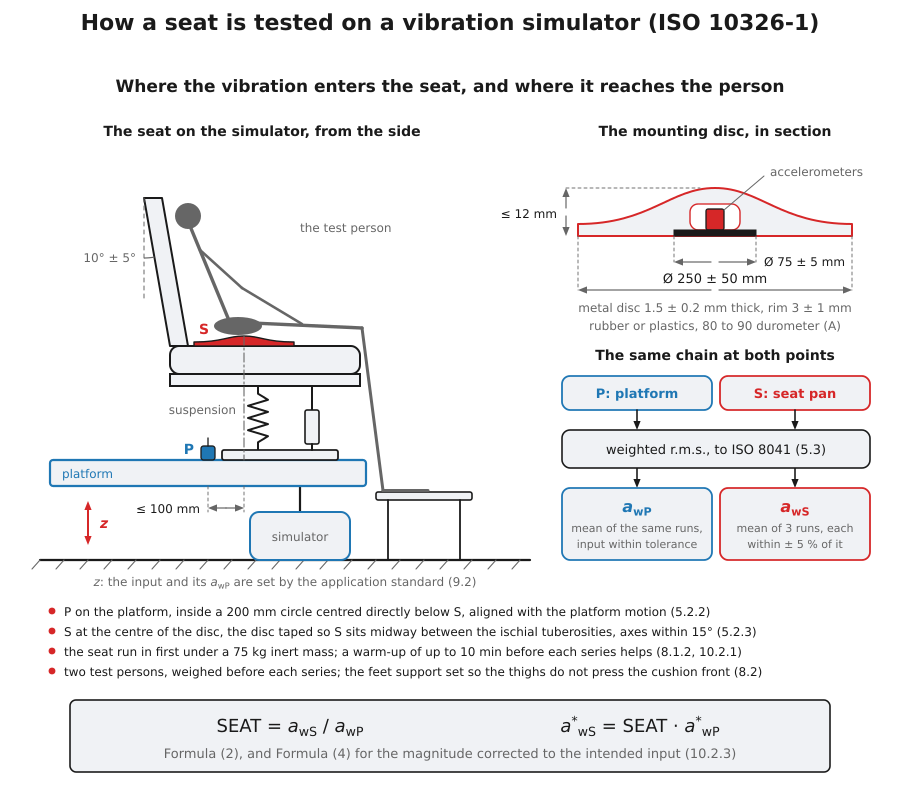
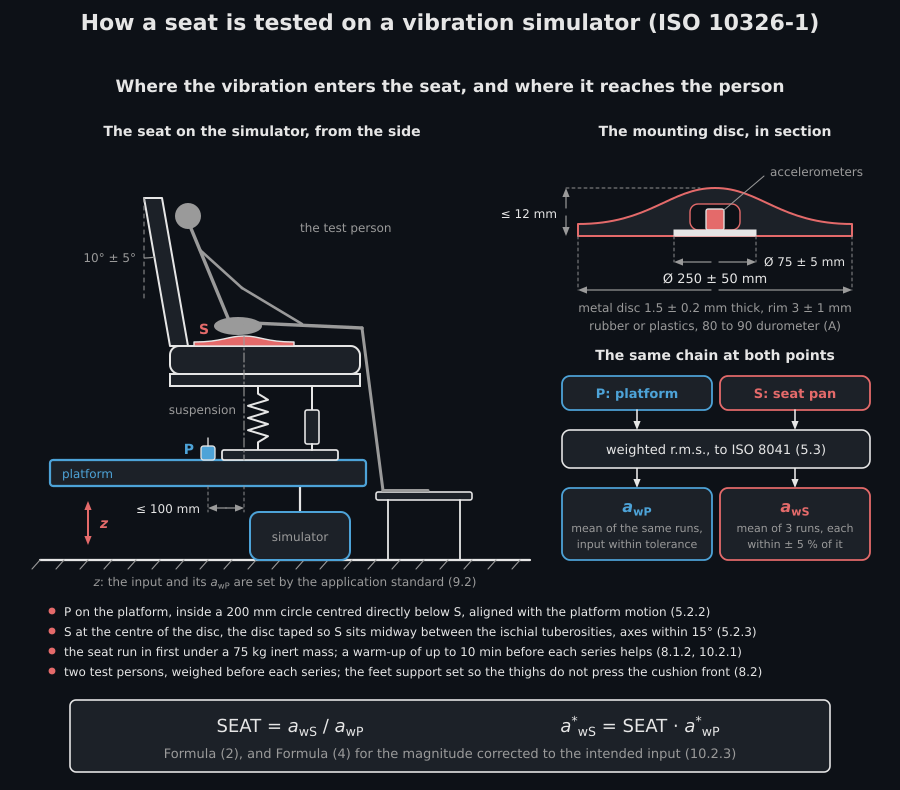
Use a measuring chain that meets ISO 8041, alike at the platform and at the seat, and calibrate it to ISO 16063-1 before and after each test series. Mount the seat, check the safety requirements of ISO 13090-1, and, if the seat has a suspension, run it in: a 75 kg inert mass on the cushion, the seat adjusted for a 100 kg operator, and a sine near the natural frequency of the suspension at 75 % of its full amplitude, until the seat settles. Set the ride height as 8.1.3 describes and an adjustable backrest to about 10° back. Fix the platform accelerometer inside a 200 mm circle centred directly below the seat accelerometer, and tape the disc to the cushion so its accelerometers lie midway between the ischial tuberosities. Train the test persons in preliminary runs until they hold a normal, still posture throughout. Weigh each of them just before their series, set the feet support so the thighs do not press on the front of the cushion, and drive the prescribed input without a break through each run; a warm-up of up to 10 min helps. Repeat until three consecutive runs give seat values within ± 5 % of their mean, with the platform inside its input tolerances. The mean of those seat values is and the mean of the platform values from the same runs is , one pair per test person, since Clause 11 asks each of them to pass. Report the run-in duration, the disc, the masses of the test persons and the SEAT factor or the corrected magnitude.
2. Correcting to the input that was intended
Section titled “2. Correcting to the input that was intended”A simulator does not reproduce its target spectrum exactly. Clause 10.2.3 scales the magnitude measured on the seat by the ratio between the input the test intended and the input it actually delivered:
from phonometry import vibration
test = vibration.seat_transmission([0.72, 0.70, 0.71], [1.02, 1.00, 0.99])
# The platform delivered 1.003 m/s2 where 1.10 was intended.print(round(test.corrected_acceleration(1.10), 3))     # 0.778
# The correction does nothing when the simulator hit its target:print(round(test.corrected_acceleration(test.platform_acceleration), 3))# 0.71
The standard prints that correction twice and only one printing is right. Formula (4), the one shown above, is correct. Formula (3) beside it carries an asterisk on all four of its symbols and so reduces to , which corrects nothing; the reading the library implements is the one the clause’s own prose asks for. It is recorded in the errata.
3. The damping test
Section titled “3. The damping test”The other test in Clause 10 does not involve a person. Load the seat with an inert mass of 75 kg ± 1 %, drive the base at the resonance frequency of the suspension, and take the ratio there (10.3):
from phonometry import vibration
# A suspension that doubles what it is given, at its own frequency.print(vibration.resonance_transmissibility(2.4, 1.2))   # 2.0print(vibration.DAMPING_TEST_MASS_KG)                   # 75.0
The arithmetic is the SEAT arithmetic and the meaning is not. The SEAT factor is a verdict over a whole spectrum with a person in the seat; is what the seat does at the one frequency where it does the most, with an inert mass in it. Clause 9.5.1 notes that the test may not suit a suspension with active damping, and that a reduced mass of 60 kg has been found appropriate.
4. What the numbers are not
Section titled “4. What the numbers are not”Clause 11 is short and worth reading before quoting any figure from this page
as a pass or a fail. This standard fixes the method and states no acceptance
value at all: the application standard written for the machine states them,
either as a maximum SEAT factor or as a maximum corrected magnitude on the
seat, and separately as a maximum transmissibility at resonance. attenuates
is therefore a statement about the seat, not a verdict about the machine.
What this guide covers
Section titled “What this guide covers”Covered
The SEAT factor of Formula (2), from the runs of one test, with the ± 5 % agreement 10.2.1 requires of three consecutive runs enforced rather than assumed.
The correction to an intended input of 10.2.3, as Formula (4) with the SEAT factor substituted, which is what the clause’s prose asks for and what its printed Formula (3) fails to say.
The transmissibility at resonance of Formula (5), and the test masses of 10.3 and 9.5.1.
Not covered
No acceptance values, because the standard states none: Clause 11 leaves them to the application standard for the machine, and nothing here supplies a default. The input spectral classes those standards prescribe, such as the earth-moving machinery classes of ISO 7096, are not implemented either.
Nothing weights a signal here. The accelerations this page divides are already frequency-weighted; the weightings themselves, and the r.m.s. integration behind them, are in human vibration exposure.
No laboratory. The simulator tolerances of Clause 9, the transducer mounting of 5.2, the semi-rigid disc, the test persons and posture of 8.2, the run-in periods of 8.1.2 and the test report of Clause 12 are described in the standard and none of them is implemented: this page is the arithmetic that follows a test, not the test.
References
Section titled “References”- International Organization for Standardization. (2016). Mechanical vibration — Laboratory method for evaluating vehicle seat vibration — Part 1: Basic requirements (ISO 10326-1:2016). Clause 10: the SEAT factor of Formula (2), the three consecutive runs within ± 5 % of 10.2.1, the correction of 10.2.3 with Formulae (3) and (4), and the damping test of 10.3 with Formula (5) and its 75 kg inert mass. Clause 11 leaves the acceptance values to the application standard. The printed Formula (3) is an identity; see the errata.