Railway vibration by category of train (E DIN 4150-2)
Standards: E DIN 4150DIN 4150
The 1999 edition of DIN 4150-2 treats a railway as a set of classes of train, each occupying the clock intervals its trains ran through, and lifts the guide values by 1,5 for an urban line. The draft that is to replace it, published for comment in August 2023, rewrites that part from the ground up and touches little else: one cell of Table 1, one worked example, two new sources, and the days two to six of a construction site printed instead of read off a curve. This page is the railway; the rest of the draft is the last section, and the library reads either edition with one argument.
1. One interval per passage, and a KB_Fmax that is not a maximum
Section titled “1. One interval per passage, and a KB_Fmax that is not a maximum”The draft’s first decision is that every train passage counts as one clock
interval, however long it lasts (6.5.3.2). So the clock maximum r.m.s. of a
category of train, a kind of vehicle on a track in a direction, is the
r.m.s. of one clock maximum per passage over the passages measured (Formula
(5)), and, unlike the 1999 edition’s (A.1) and the meter’s own Formula (1),
nothing below 0,1 is set to zero on the way, because the next number is
built on it: the KB_Fmax of the category is not the largest clock maximum
anyone observed but 1,5 times its r.m.s. (Formula (7)), since a single
passage with a flat spot on a wheel says nothing about the line. The
KB_Fmax of the railway is the largest over the categories (Formula (8)).
Example 8 of Annex B measures 2,5 h in a new residential building next to a tram and a metro: 14 metro passages each way underground and 9 and 10 tram passages each way on the surface.
from phonometry import vibration
# Annex B, Table B.1: the clock maximum of every passage, by category.metro_north = [0.017, 0.036, 0.024, 0.035, 0.025, 0.036, 0.035, 0.037, 0.041, 0.042,               0.068, 0.040, 0.022, 0.025]metro_south = [0.076, 0.034, 0.025, 0.054, 0.033, 0.018, 0.033, 0.060, 0.019, 0.092,               0.030, 0.019, 0.024, 0.058]tram_east = [0.379, 0.369, 0.348, 0.288, 0.270, 0.549, 0.320, 0.290, 0.663]tram_west = [0.649, 0.717, 0.658, 0.508, 0.423, 0.332, 0.735, 0.363, 0.441, 0.663]
kb_ftm = [vibration.train_category_rms(c) for c in (metro_north, metro_south, tram_east, tram_west)]print([round(v, 3) for v in kb_ftm])  # [0.037, 0.047, 0.406, 0.568]print(vibration.train_kb_fmax(kb_ftm).round(3))  # [0.055 0.07  0.609 0.851]print(round(vibration.railway_kb_fmax(kb_ftm), 3))  # 0.851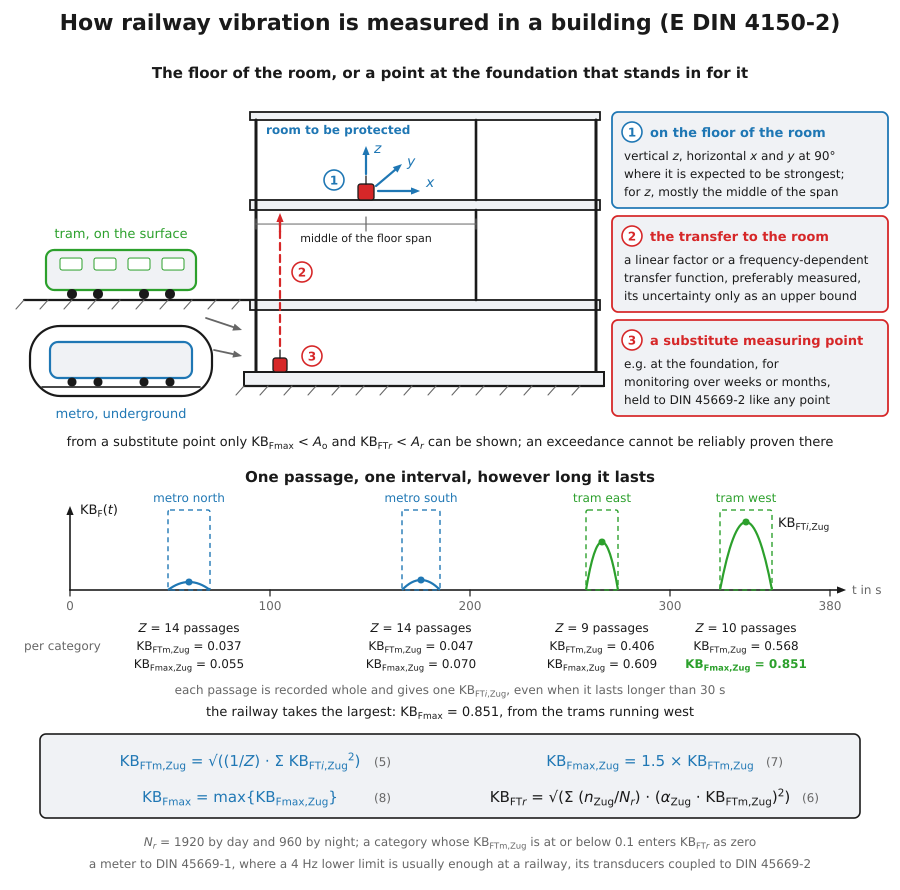
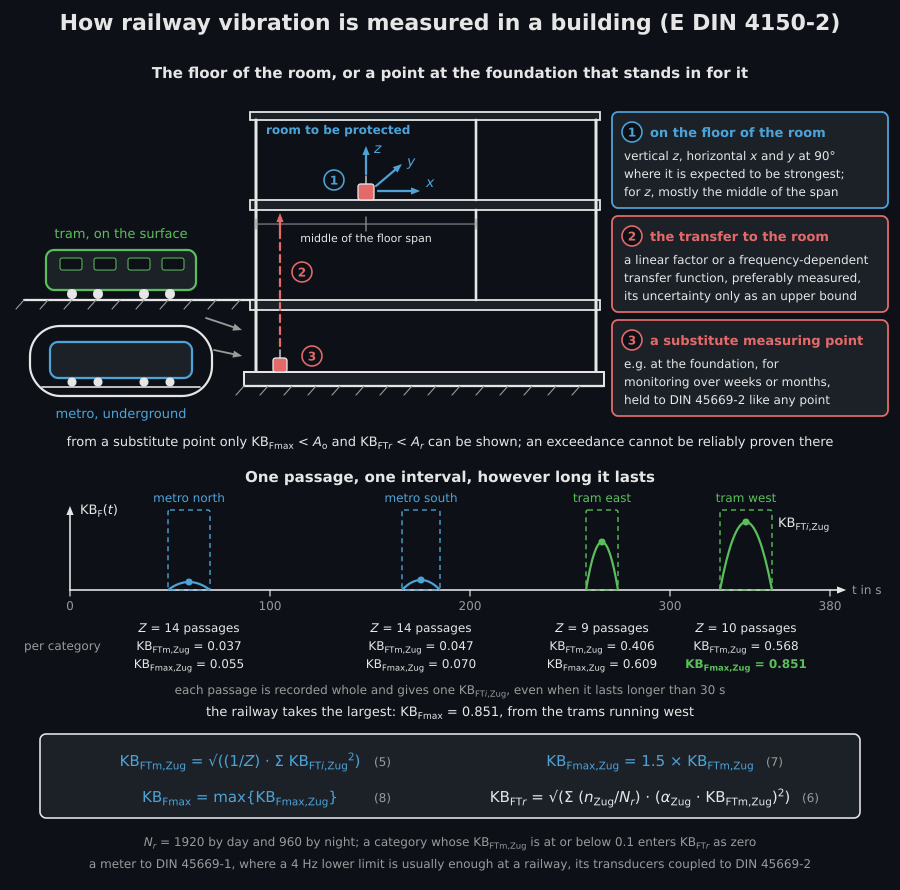
In Example 8 the vertical, measured at the middle of the floor span, is the direction that decides, and the 2,5 h recorded are taken as representative. Clause 5 of the draft says where that point goes and what the meter has to be, and it adds what the 1999 edition did not have: a point at the foundation that may stand in for the room during a monitoring.
How the measurement goes
Section titled “How the measurement goes”Use a vibration meter to DIN 45669-1; beside a railway a lower frequency
limit of 4 Hz is usually enough. Set up and couple the transducers as
DIN 45669-2 asks, on the floor of the room to be protected, where the
vibration is expected to be strongest: for the vertical, mostly the middle
of the floor span. At a railway, carry the whole measurement out with
particular regard to DIN 45672-1 and DIN 45672-2. Take z and the two
horizontals x and y at right angles, mostly parallel to the outer walls;
the horizontals may also be taken at or near a wall. Record every passage
whole and keep one clock maximum from it, sorted into categories from the
operating programme or timetable, normally at least one per track or
direction and kind of train. Measure long enough to catch the typical
exposure, and mark anything atypical.
For monitoring over weeks or months, a substitute point, at the foundation
for instance, may stand in for the room if it meets DIN 45669-2 and its
transfer to the room, a linear factor or a frequency-dependent function, is
determined, preferably by measurement, with its uncertainty taken only as an
upper bound; from there only KB_Fmax < A_o and KB_FTr < A_r can be
shown, never reliably an exceedance. Expect up to about 15 % uncertainty on
any KB_F quantity, work KB_Fmax and KB_FTr to at least three decimals
and round them to two as DIN 1333 does, and report the site plan with points
and directions, the coupling, the meter and its settings, and the operating
conditions.
2. A weighting factor for the kind of train
Section titled “2. A weighting factor for the kind of train”The assessment vibration severity of a railway is Formula (6): each
category weighted by the number of its trains in the period, out of the
1920 clock intervals of the day or the 960 of the night, and by a
weighting factor α_Zug of Table 2 for the kind of train and whether
the line runs on the surface or underground. A tram, light rail or metro on
the surface is 0,7, an S-Bahn 0,8, another passenger train 0,9, a freight
train up to 600 m 1,0, and a freight train over 600 m 1,3 wherever it runs;
underground everything but the long freight train is 1,0. A category whose
r.m.s. is at or below 0,1 enters the sum as zero, which is where the
suppression the passages were spared is applied. The rest hours of the day
are not applied to a railway, as they were not in 1999.
from phonometry import vibration
print(vibration.train_weighting_factor("freight_long"))  # 1.3print(vibration.train_weighting_factor("s_bahn", alignment="underground"))  # 1.0
# Example 8: 144 metros a track a day at 1,0, whose r.m.s. is below 0,1 and# counts as zero, and 80 trams a track at 0,7.kb_ftm = [0.03654, 0.04676, 0.40606, 0.56758]day = vibration.train_assessment_severity(kb_ftm, [144, 144, 80, 80], alpha=[1.0, 1.0, 0.7, 0.7])print(f"KB_FTr = {day:.4f}")  # 0.0997, printed 0,099 8
guide = vibration.guide_values("residential", edition="2023")verdict = vibration.assess_people_in_buildings(    vibration.railway_kb_fmax(kb_ftm), guide, kb_ftr=day, source="railway", edition="2023")print(verdict.complies, verdict.criterion)  # False A_r
Under the draft a railway is compared with A_o like any other source,
which the 1999 edition did not do; the trams of Example 8 exceed the night
A_o of 0,2 of a new residential building and the requirement is not met
by night before KB_FTr is even formed.
from phonometry import vibration
night = vibration.guide_values("residential", time_of_day="night", edition="2023")verdict = vibration.assess_people_in_buildings(0.851, night, source="railway", edition="2023")print(verdict.complies, verdict.criterion)  # False A_o
3. A new line, and an old one made bigger
Section titled “3. A new line, and an old one made bigger”A line to be built new is held at night to an upper value of its own (6.5.3.5): 0,6 on the surface whatever the area, and underground the Table 1 value in an industrial or commercial area and 0,3 elsewhere. By day Table 1 applies as it stands.
from phonometry import vibration
print(vibration.railway_guide_values("mixed", time_of_day="night"))# GuideValues(a_u=0.1, a_o=0.6, a_r=0.07, time_of_day='night', edition='2023')print(vibration.railway_guide_values("residential", time_of_day="night", alignment="underground"))# GuideValues(a_u=0.1, a_o=0.3, a_r=0.05, time_of_day='night', edition='2023')
An existing line that is altered or extended is judged by the change it
brings (6.5.3.6). The case without the project, with the present or the
forecast timetable, is set against the planned case; the planned case is
first held to the guide values like any immission, a KB_Fmax at or below
A_u settling it on its own, and where KB_Fmax exceeds A_o or KB_FTr
exceeds A_r the requirement still counts as met if the quantity grows by
less than 25 %, the least increase a laboratory study found people to
notice. The clause says the requirements are met if one of its conditions
holds; its own Example 9, whose KB_Fmax does not change at all, goes to
mitigation because KB_FTr grows by more, so every condition that applies
has to hold, and the library reads it that way. Example 9 adds a second
track to a single-track line
past a house in a mixed area: 28 regional and 8 freight trains a day become
34 and 12, and a third of the freight trains grow past 600 m.
from phonometry import vibration
# Annex B, Example 9. Existing track: regional 0,24, freight 0,44; new track:# 0,22 and 0,40; the long freight trains at 1,3.nullfall_day = vibration.train_assessment_severity([0.24, 0.44], [28, 8], alpha=[0.9, 1.0])nullfall_night = vibration.train_assessment_severity(    [0.24, 0.44], [12, 18], alpha=[0.9, 1.0], time_of_day="night")kb_ftm = [0.24, 0.22, 0.44, 0.40, 0.44, 0.40]alpha = [0.9, 0.9, 1.0, 1.0, 1.3, 1.3]planfall_day = vibration.train_assessment_severity(kb_ftm, [17, 17, 4, 4, 2, 2], alpha=alpha)planfall_night = vibration.train_assessment_severity(    kb_ftm, [7, 7, 12, 12, 6, 6], alpha=alpha, time_of_day="night")print(f"{nullfall_day:.3f} {nullfall_night:.3f} {planfall_day:.3f} {planfall_night:.3f}")# 0.039 0.065 0.046 0.094
change = vibration.assess_railway_change(    kb_fmax_before=0.66,    kb_fmax_after=0.66,    kb_ftr_before=nullfall_night,    kb_ftr_after=planfall_night,    guide=vibration.railway_guide_values("mixed", time_of_day="night"),    time_of_day="night",)print(change.complies, change.kb_fmax_met, change.kb_ftr_met)  # False True Falseprint(f"{change.kb_ftr_increase_percent:.0f} %")  # 44 %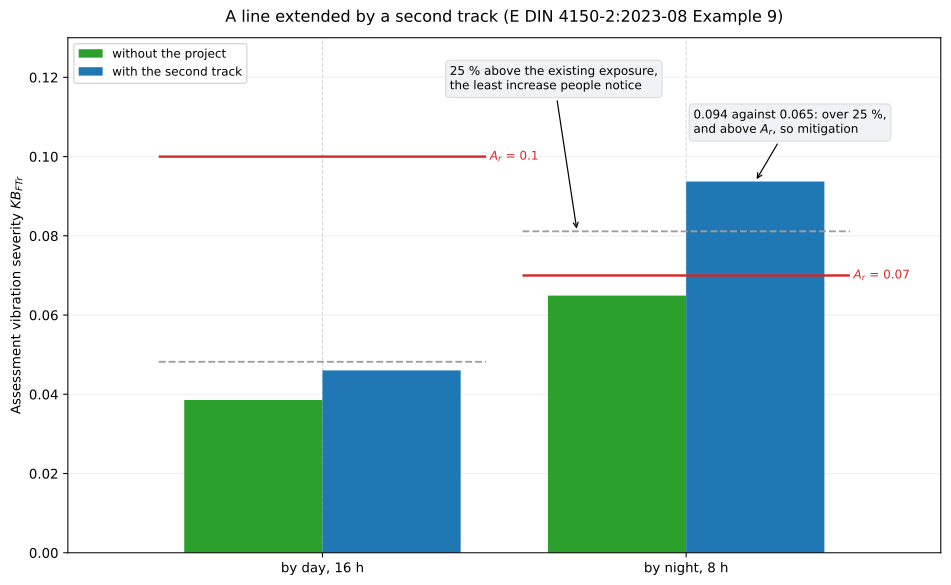
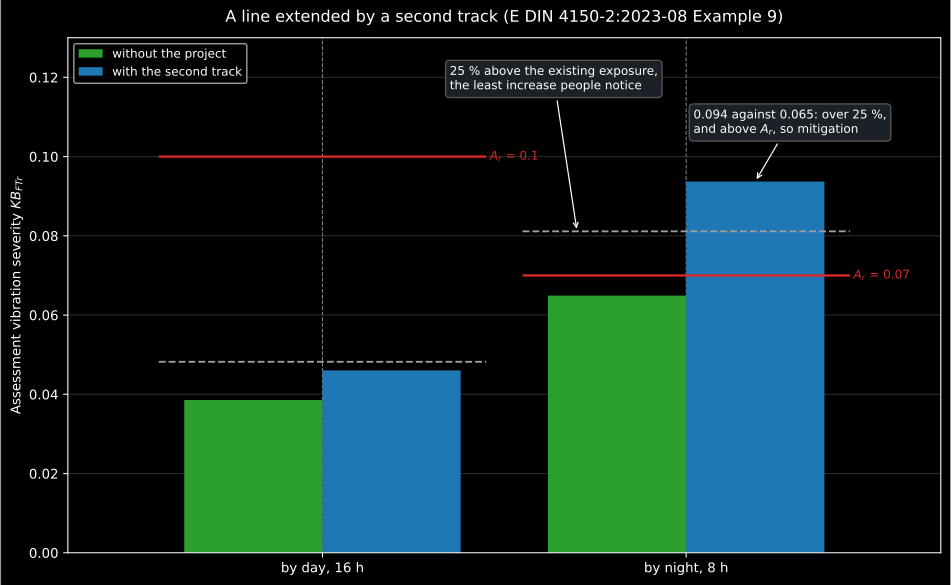
Figure code
import matplotlib.pyplot as pltimport numpy as np
from phonometry import vibration
before = [    vibration.train_assessment_severity([0.24, 0.44], [28, 8], alpha=[0.9, 1.0]),    vibration.train_assessment_severity([0.24, 0.44], [12, 18], alpha=[0.9, 1.0], time_of_day="night"),]kb_ftm = [0.24, 0.22, 0.44, 0.40, 0.44, 0.40]alpha = [0.9, 0.9, 1.0, 1.0, 1.3, 1.3]after = [    vibration.train_assessment_severity(kb_ftm, [17, 17, 4, 4, 2, 2], alpha=alpha),    vibration.train_assessment_severity(kb_ftm, [7, 7, 12, 12, 6, 6], alpha=alpha, time_of_day="night"),]x = np.arange(2)fig, ax = plt.subplots(figsize=(10, 6.2))ax.bar(x - 0.19, before, 0.38, label="without the project")ax.bar(x + 0.19, after, 0.38, label="with the second track")for i, which in enumerate(("day", "night")):    a_r = vibration.railway_guide_values("mixed", time_of_day=which).a_r    ax.hlines(a_r, x[i] - 0.45, x[i] + 0.45, color="red")    ax.hlines(before[i] * 1.25, x[i] - 0.45, x[i] + 0.45, color="grey", linestyle="--")ax.set_xticks(x, ["by day", "by night"])ax.legend()
The night of Example 9 is printed over 920 clock intervals, which gives the
0,066 and 0,096 on the page; 6.5.3.2 fixes the night at 960, which gives
0,065 and 0,094, and the conclusion is the same. The
errata page has it, with the one condition
of 6.5.3.6, a result of Example 8 that its own four-decimal inputs do not
give, a decision in the construction flowchart drawn the wrong way round,
ten clock maxima printed on Figure B.2 that do not give the 0,39 the text
uses, an example that cites the clause for a new line while applying the one
for an extension, two cross-references that name the wrong formula and the
wrong clause, and a rare event met below A_o in one sentence and at it in
the next clause and the flowchart.
4. What else the draft changes
Section titled “4. What else the draft changes”The guide values carry the edition and the period they were read for, so
the verdict knows which rules to apply without being told, and asking for
the values of one edition under the rules of the other is refused.
Everything below is what edition="2023" reads differently from the
1999 edition; the
numbers not named here are the same in both.
- Table 1 changes one cell: the night
A_uof a mixed area, now with urban areas in the row, goes from 0,15 to 0,1. - The 15 % a measurement of
KB_Fis uncertain by no longer excuses aKB_FmaxaboveA_u. The 1999 Example 3 read 0,17 against 0,15 as met on that ground; the draft’s Example 3 reads 0,114 against 0,10, goes on toKB_FTr, finds 0,075 against anA_rof 0,07, and fails it. - A road by night is not judged on
A_o: 6.5.2 says a rare exceedance of the night-time upper value does not fail the requirement, and puts a single clock maximum above 0,6, in any area, down as a reason to look into the cause and put it right, which is what the 1999 edition said of a railway. An existing road by an existing building: the neighbours must put up withA_uandA_rexceeded by up to 50 %, by day and by night (6.5.2), whichsource="road_existing"gives as guide values 1,5 times over. - An induced seismic event, a few seconds with its energy below 15 Hz,
years after the intervention that causes it (6.5.1.3):
KB_Fmaxis about 0,44 times the peak velocity, and it is held by day and by night to the daytimeA_o, with noKB_FTr. - A construction site: the draft’s Table 3 prints the days two to six
that the 1999 Figure 3 made one read off a curve, cell for cell what the
interpolation gives, and says that
Dcounts only the days on which Table 1 is exceeded. - The urban railway of 1999, with its factor 1,5 on
A_uandA_r, is gone; its place is the factor 0,7 of Table 2 on the r.m.s.
from phonometry import vibration
print(vibration.guide_values("mixed", time_of_day="night", edition="2023"))# GuideValues(a_u=0.1, a_o=0.3, a_r=0.07, time_of_day='night', edition='2023')
# The draft's Example 3: inside the 15 % and no longer excused by it.guide = vibration.guide_values("mixed", time_of_day="night", edition="2023")verdict = vibration.assess_people_in_buildings(0.114, guide, kb_ftr=0.075, edition="2023")print(verdict.complies, verdict.criterion)  # False A_r
print(vibration.guide_values("residential", source="road_existing", edition="2023"))# GuideValues(a_u=0.225, a_o=3.0, a_r=0.105, time_of_day='day', edition='2023')print(vibration.induced_seismic_kb_fmax(5.0)) # 2.2print(vibration.guide_values("residential", time_of_day="night", source="induced_seismic", edition="2023"))# GuideValues(a_u=0.1, a_o=3.0, a_r=0.05, time_of_day='night', edition='2023')The railway of 6.5.3: the r.m.s. of a category of train over its passages (Formula (5)), 1,5 times it and the largest of those (Formulae (7) and (8)), the assessment vibration severity with the factors of Table 2 (Formula (6)), the night-time upper value of a new line (6.5.3.5) and the 25 % rule of an altered one (6.5.3.6).
The rest of the draft behind
edition="2023": the one cell of Table 1, the procedure without the 15 % shortcut, a railway compared withA_o, the existing road of 6.5.2 and the induced seismic event of 6.5.1.3, and Table 3 as printed.Not covered
No decision the draft leaves open. An existing line that is not being altered (6.5.3.4) has no numeric rule and none is invented; the concession of 6.5.3.7 to a new building, an
A_oof 0,6 for a category with rare passages, is a judgement and stays one.No measurement and no monitoring. Clause 5, the substitute measuring points and transfer functions of a long-term monitoring included, and Clause 8, the report, are text.
What this guide covers
Section titled “What this guide covers”References
Section titled “References”- Deutsches Institut für Normung. (1999). Erschütterungen im Bauwesen — Teil 2: Einwirkungen auf Menschen in Gebäuden (DIN 4150-2:1999-06). The edition in force, which the library reads by default; the draft's changes are read with edition='2023'.
- Deutsches Institut für Normung. (2023). Erschütterungen im Bauwesen — Teil 2: Einwirkungen auf Menschen in Gebäuden (E DIN 4150-2:2023-08). A draft, intended to replace DIN 4150-2:1999-06. Table 1 with its one changed cell, Formulae (5) to (8) and Table 2 of 6.5.3, the night-time upper value of 6.5.3.5, the 25 % rule of 6.5.3.6, the existing-road tolerance of 6.5.2, the induced seismic event of 6.5.1.3, and Table 3 as printed. Annex B, Examples 8 and 9, is the oracle of the conformance rows; Examples 1, 2 and 4 to 7 are those of the 1999 edition, and Example 3 is reworked without the 15 % argument.