Occupational Noise Exposure (ISO 9612)
Standards: ISO 9612Directive 2003/10/ECDHHS/NIOSH Publication No. 98-126
A working day is rarely measured in one take: the daily exposure level a
regulation acts on has to be assembled from samples of a real shift, and
reported with an uncertainty a hygienist can defend. lex_8h (in
Levels) turns one recording into a daily level. ISO 9612:2009,
the engineering method (accuracy grade 2), is the survey design around that
primitive: how to sample a real working day, how to combine the pieces, and how
to attach the normative uncertainty every occupational-hygiene report needs. The
occupational_exposure module adds the three measurement strategies and the
Annex C uncertainty budget on top of the energy-average machinery.
How do I compute ISO 9612 daily noise exposure LEX,8h in Python?
Section titled “How do I compute ISO 9612 daily noise exposure LEX,8h in Python?”Describe each activity as a hearing.Task with its samples and duration, then
call hearing.task_based_exposure(tasks). For the Annex D welder’s day below
it returns lex_8h = 84.3 dB with an expanded_uncertainty dB, so
the one-sided 95 % upper_limit is 87.5 dB, because the default includes the
Annex C duration term built from each task’s duration_range. The §1
snippet passes include_duration_uncertainty=False to reproduce Annex D case a,
where the durations are treated as exact, and that is what drops to 2.7 dB
and the upper limit to 87.0 dB. Unstructured days use
job_based_exposure() or full_day_exposure() on random samples instead.
1. The three measurement strategies (Clauses 9-11)
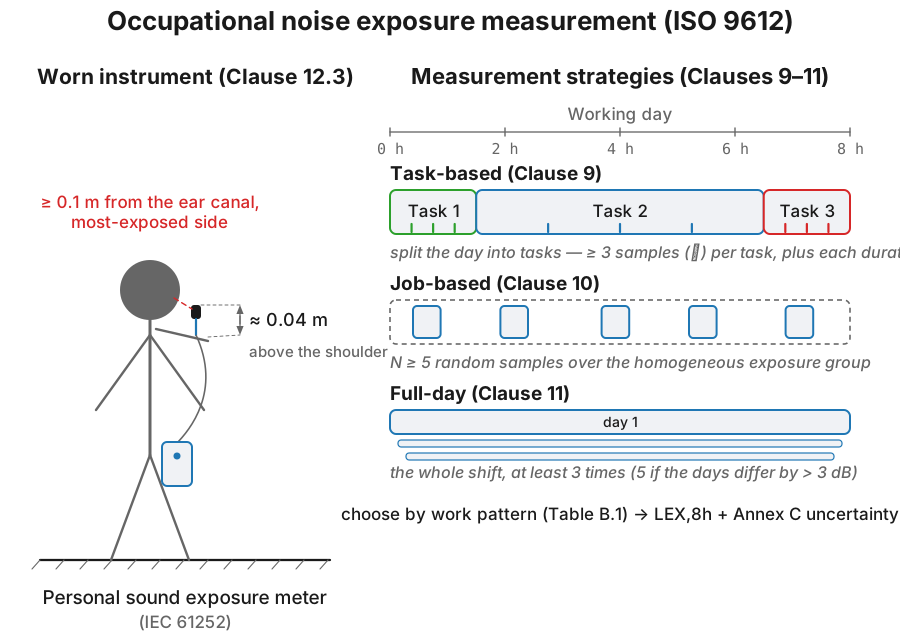
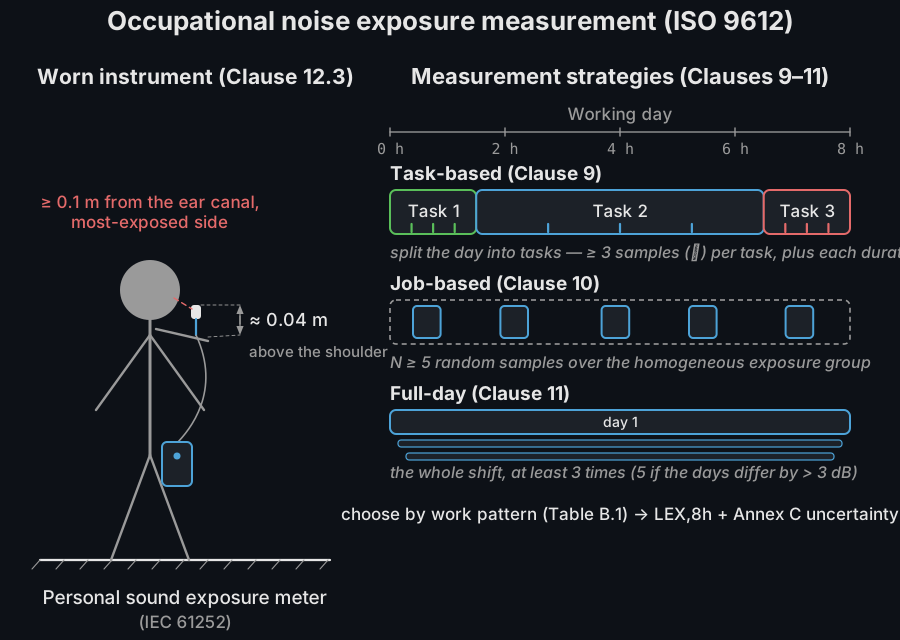
Section titled “1. The three measurement strategies (Clauses 9-11)”The task-based strategy (Clause 9) splits the nominal day into tasks, takes samples per task, and energy-sums the task contributions
so a loud but short task contributes little. The job-based (Clause 10) and full-day (Clause 11) strategies instead take random samples over a homogeneous exposure group ( samples for the job-based strategy, at least three whole shifts for the full-day one), energy-average them, and normalise that average to the nominal eight-hour day with the effective working-day duration in the same term. The daily level is the same either way; the strategies differ in how the uncertainty is built.
Choosing a strategy. ISO 9612 Table B.1 picks the strategy from the work pattern, not from convenience, and the trade-off is coverage against effort. The task-based strategy is the recommended default when the day decomposes into a small number of well-defined tasks: because it measures each task separately, it explains where the dose comes from (the per-task breakdown above) and lets a short, loud task be sampled properly without dragging out the whole survey, but it needs a reliable work analysis, and its uncertainty grows if the task durations are themselves uncertain. The job-based strategy suits a mobile worker with an unpredictable pattern or a homogeneous group doing “the same job”: random samples across the group average over the variability instead of resolving it, which is robust when the day cannot be cleanly cut into tasks but blind to which activity dominates. The full-day strategy (a worn dosimeter capturing the entire shift, repeated on several days) needs the least analysis and captures everything including the unexpected, at the cost of the most wearer-days and the weakest diagnostic value (one number per day, no breakdown, and false contributions like knocks on the microphone are hard to spot). As a rule: resolve the dose with task-based when you can, fall back to job-based for irregular work, and use full-day when the pattern defies description or an independent whole-shift check is wanted.
1.1 Taking the samples
Section titled “1.1 Taking the samples”Everything below this line happens before a single number reaches a Task, and
the three commonest ways of invalidating a survey all live here.
How long each sample runs (Clause 9.3). A task measurement shall last at least 5 min; if the task itself is shorter than 5 min, the measurement lasts as long as the task. It may be shortened only when the level is found to be constant or repeatable, or when the task is a minor contributor to the total exposure. Cyclic noise is sampled over at least three well-defined cycles, still at least 5 min, and always over a whole number of cycles. A partial cycle biases the task level by whatever part of the cycle it over-samples. Randomly fluctuating noise is sampled long enough to be representative, which is a judgement the report has to record.
How many, and taken when (Clause 9.3). At least three measurements per task, and the standard recommends taking them at different times during the task or on different workers in the group, so that the scatter feeding is real variability rather than one lucky minute. The Annex D day in the snippet below is exactly this rule in action: welding keeps its three samples, while cutting/grinding has six, because the first three spanned more than 3 dB. Note what that buys: Eq. C.6 divides the scatter by , so it is the sample count, not the sample length, that shrinks the sampling term.
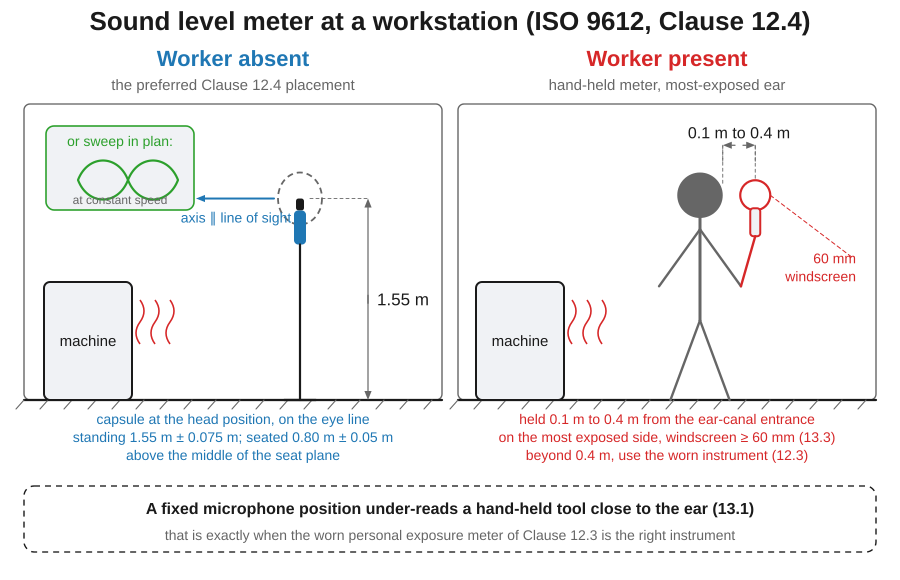
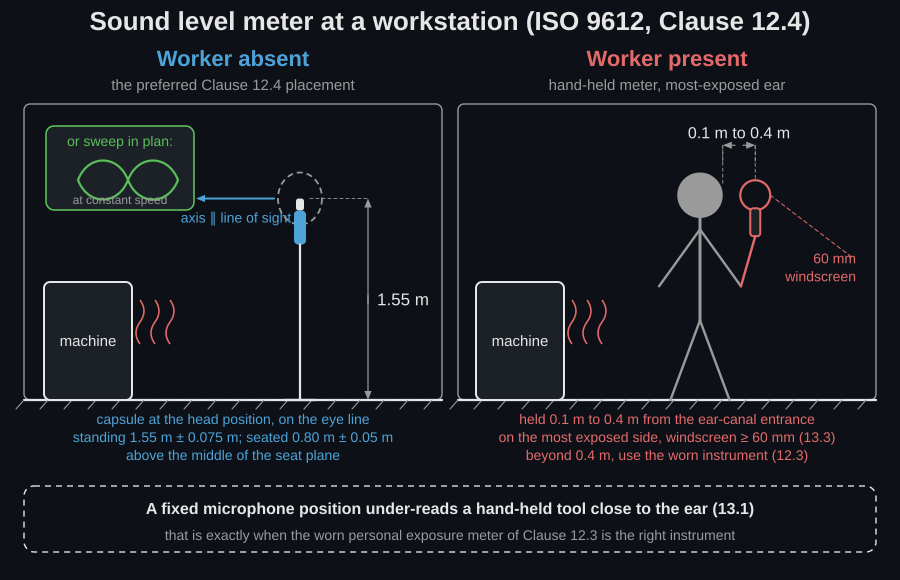
Where the microphone goes. Two configurations, and the guide’s opening diagram draws only the first:
- Worn instrument (Clause 12.3). On the top of the shoulder, at least 0.1 m from the entrance of the external ear canal on the most exposed side, approximately 0.04 m above the shoulder, with microphone and cable fastened so that clothing cannot cover them or rub against them. The body screening and reflections this introduces are exactly what the dB term of the Annex C budget pays for; where the ear is close to a small source, NOTE 1 suggests measuring on both sides of the head to find which ear really is the most exposed.
- Sound level meter (Clause 12.4). With the worker absent, the microphone goes at the location of the worker’s head, preferably in the centre plane of the head, on a line with the eyes and with its axis parallel to the worker’s line of sight; where the head position is not well defined, 1.55 m ± 0.075 m above the floor for a standing worker and 0.80 m ± 0.05 m above the middle of the seat plane for a seated one. The workstation average may instead be swept at constant speed along a path shaped like an infinity sign. With the worker present, the microphone is held between 0.1 m and 0.4 m from the ear-canal entrance on the most exposed side, and if the work makes 0.4 m impossible the standard recommends the worn instrument instead.
The two checks that decide whether the data survive. A field calibration with adjustment before each series and at the start of each daily series, and a field calibration without adjustment at the end of each; if the two readings differ by more than 0.5 dB at any frequency, the results of that series shall be discarded (Clause 12.2). This is what the example fiche’s “field checks within 0.3 dB” is claiming. Then, before trusting the day, compare the level-versus-time log against the observation notes: a dosimeter records a knock or a rub on the microphone as a genuine high-level event (Clause 13.2), and one such artefact can move the day’s ; any unexplained peak shall be investigated and the measurement repeated if the result is significantly affected, and with a non-logging instrument, repeated outright.
And the rest of the rejection rules. Avoid high airflow, and fit hand-held meters with a windscreen of at least 60 mm diameter (Clause 13.3; a 60 mm windscreen keeps flow up to about 10 m/s from significantly affecting an 80 dB level). Observe the worker, or reconstruct the activities from interviews and work records and report that you did (Clause 9.3). Radio, speech and alarm noise count as relevant if the work analysis says they are part of normal working conditions; excluding them is allowed but is a reportable decision, not a silent edit, and non-typical behaviour during the measurement has to be evaluated and, if it matters, re-measured (Clause 13.4).
from phonometry import hearing
# ISO 9612 Annex D — a welder's day split into three tasks. Each task level is# the energy average of its Lp,A,eqT samples; durations carry a measured range.tasks = [    hearing.Task(samples=(70.0,), duration_hours=1.5, label="planning/breaks"),    hearing.Task(samples=(80.1, 82.2, 79.6), duration_hours=5.0,         duration_range=(4.0, 6.0), label="welding"),    hearing.Task(samples=(86.5, 92.4, 89.3, 93.2, 87.8, 86.2), duration_hours=1.5,         duration_range=(1.0, 2.0), label="cutting/grinding"),]res = hearing.task_based_exposure(tasks, include_duration_uncertainty=False, warn=False)print(f"LEX,8h = {res.lex_8h:.1f} dB   U = {res.expanded_uncertainty:.1f} dB")# LEX,8h = 84.3 dB   U = 2.7 dBprint(f"one-sided 95 % upper limit LEX,8h + U = {res.upper_limit:.1f} dB")   # 87.0 dBfor t in res.tasks:    print(f"  {t.label:<16} Lp,A,eqT = {t.lp_aeqt:5.1f}   contributes {t.lex_8h_contribution:5.1f} dB")#   planning/breaks  Lp,A,eqT =  70.0   contributes  62.7 dB#   welding          Lp,A,eqT =  80.8   contributes  78.7 dB#   cutting/grinding Lp,A,eqT =  90.1   contributes  82.8 dB
# The same shift measured job-based (Annex E) and full-day (Annex F): both use# the Eq C.9 / Table C.4 sampling budget with k = 1.65 (one-sided 95 %).job = hearing.job_based_exposure([88.1, 86.1, 89.7, 86.5, 91.1, 86.7], effective_duration_hours=7.5)full = hearing.full_day_exposure([88.0, 91.9, 87.6, 90.4, 89.0, 88.4], effective_duration_hours=9.25)print(f"job      LEX,8h = {job.lex_8h:.1f} dB   U = {job.expanded_uncertainty:.1f} dB")# job      LEX,8h = 88.2 dB   U = 3.8 dBprint(f"full-day LEX,8h = {full.lex_8h:.1f} dB   U = {full.expanded_uncertainty:.1f} dB")# full-day LEX,8h = 90.1 dB   U = 3.4 dB
res.plot()   # the figure below: task contributions with LEX,8h and LEX,8h + U
Reading the job and full-day numbers. The task-based case gets its per-task breakdown; the other two deserve the same walk-through, because in both of them the answer is moved by a term that is not a measured level at all. is the effective duration of the working day established by the work analysis: the time the worker is actually exposed, breaks away from the noise excluded, breaks spent in it included. The six job samples energy-average to 88.4 dB, and with h the normalisation subtracts 0.3 dB, so = 88.2 dB, which is below the sampled average. The six full-day samples energy-average to 89.5 dB, but that shift lasts 9.25 h, so the same term adds = 0.6 dB and = 90.1 dB, which is higher than four of the six individual samples. That is not an error: normalising a long shift to a nominal eight-hour day is supposed to penalise it. Get wrong by a factor and the whole result moves by of it, which is why the task-based strategy carries a separate duration-uncertainty term for exactly this quantity.
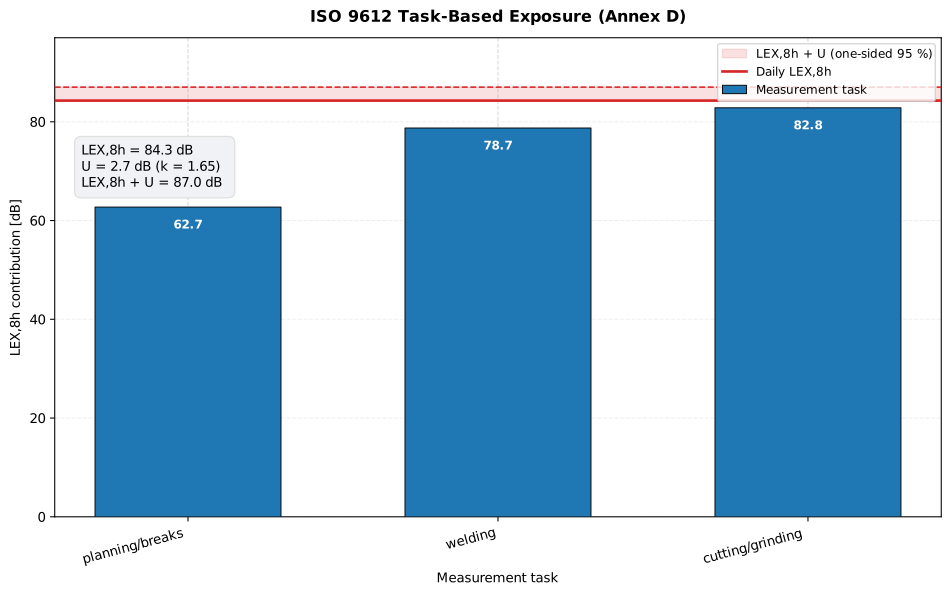
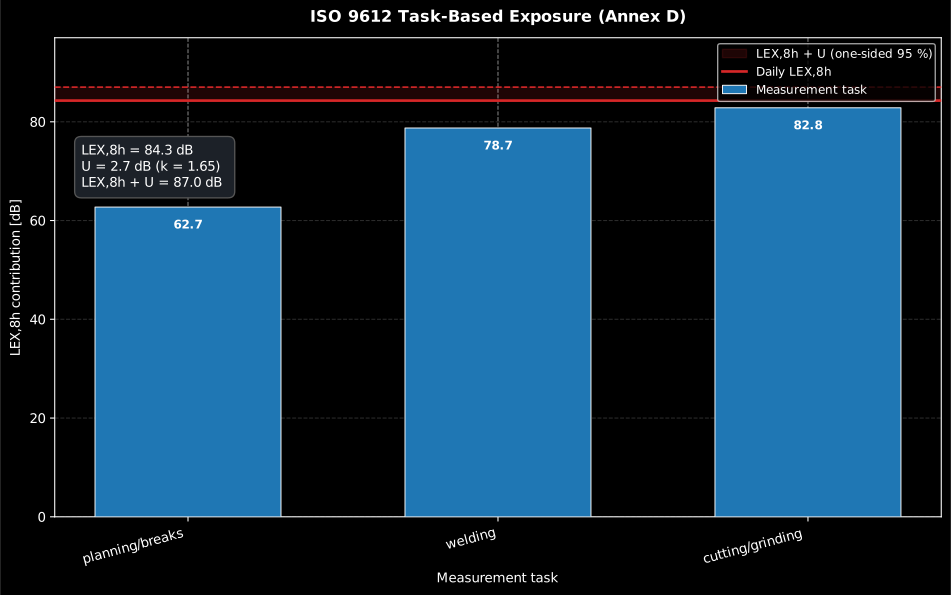
Show the code for this figure
import matplotlib.pyplot as pltfrom phonometry import hearing
# The ISO 9612 Annex D welder's day of the previous snippet.tasks = [    hearing.Task(samples=(70.0,), duration_hours=1.5, label="planning/breaks"),    hearing.Task(samples=(80.1, 82.2, 79.6), duration_hours=5.0,         duration_range=(4.0, 6.0), label="welding"),    hearing.Task(samples=(86.5, 92.4, 89.3, 93.2, 87.8, 86.2), duration_hours=1.5,         duration_range=(1.0, 2.0), label="cutting/grinding"),]res = hearing.task_based_exposure(tasks, include_duration_uncertainty=False, warn=False)
# One line: task contribution bars plus the LEX,8h and LEX,8h + U lines.res.plot()plt.show()
1.2 Planning the survey
Section titled “1.2 Planning the survey”ISO 9612 is a planning standard as much as a computation standard, and the two
questions a hygienist asks before going on site are each one call away. How
many hours must the survey cover for a group of this size? Table 1 fixes the
minimum cumulative measurement duration for a homogeneous exposure group as a
function of its size, and minimum_cumulative_duration_hours reads it:
for n in (4, 10, 25, 50): print(n, hearing.minimum_cumulative_duration_hours(n))# 4 5.0# 10 7.5# 25 12.5# 50 17.0Three regimes and a ceiling: 5 h up to five workers, then half an hour per
extra worker to fifteen, then a quarter of an hour per worker to forty, then a
flat 17 h. Beyond forty, the standard’s advice is to split the group rather
than measure longer. Pass the planned figures as n_workers= and
sample_duration_hours= to job_based_exposure and the result raises the
advisory when the coverage falls short.
The second question is how many samples the sampling term needs.
table_c4_contribution(n_samples, u1) interpolates Table C.4, so the answer can
be chosen against a target instead of discovered afterwards:
print([round(hearing.table_c4_contribution(n, 3.0), 1) for n in (3, 5, 10, 20, 30)])# [11.5, 3.3, 1.5, 0.9, 0.7]For a 3 dB sample scatter, the contribution collapses from 11.5 dB at three samples to 3.3 dB at five and 1.5 dB at ten, and then flattens: going from five to ten samples buys 1.8 dB, going from twenty to thirty buys 0.2 dB. That is where the Clause 10.4 advisory threshold of 3.5 dB sits. A job-based survey of a group with 3 dB of scatter crosses it below five samples. This is the quantitative form of the “more samples, not a better meter” rule of §2. Note that the and rows of Table C.4 apply to full-day measurements only (Table C.4, NOTE 1).
2. The Annex C uncertainty budget
Section titled “2. The Annex C uncertainty budget”Two subtleties are worth spelling out. First, the coverage factor is
for a one-sided 95 % interval (Clause 14), because a hygienist
cares only about the upper bound: res.upper_limit = is the
value 95 % of measurements fall below, the number compared against an action
limit. Second, the task and job methods weight the same spread of samples
differently. The task sampling uncertainty (Eq. C.6) divides the summed
squared deviations by (the standard error of the mean, smaller by a
factor ), whereas the job/full-day sampling uncertainty (Eq. C.12)
is the plain sample standard deviation with denominator , whose contribution
is then read from Table C.4 as a function of . The same
raw scatter therefore inflates the job estimate more, which is the standard’s
built-in penalty for coarser, fewer samples. (The printed job is
dB where Annex E reports : the standard rounds the effective-day
level to before the duration normalisation; the library keeps it
unrounded.)
What dominates the budget. Annex C combines four sources in quadrature (Table C.1): the sampling uncertainty (/), the duration uncertainty (, task-based only), the instrument (, Table C.5) and the microphone position (, Clause C.6). The last two are small and roughly fixed ( dB for a class 1 sound level meter, 1.5 dB for a class 2 meter or a personal exposimeter, and dB by default), which makes them a floor no survey design gets under: with a personal exposimeter, dB even if every sample came out identical. Everything above that floor is the sampling and duration terms, which are also the only two the surveyor controls.
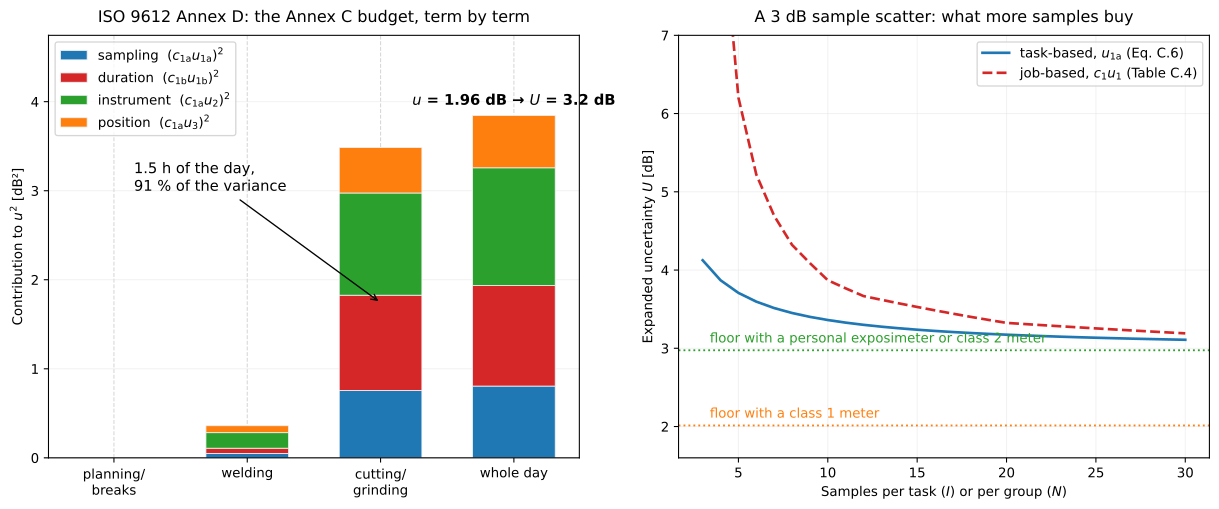
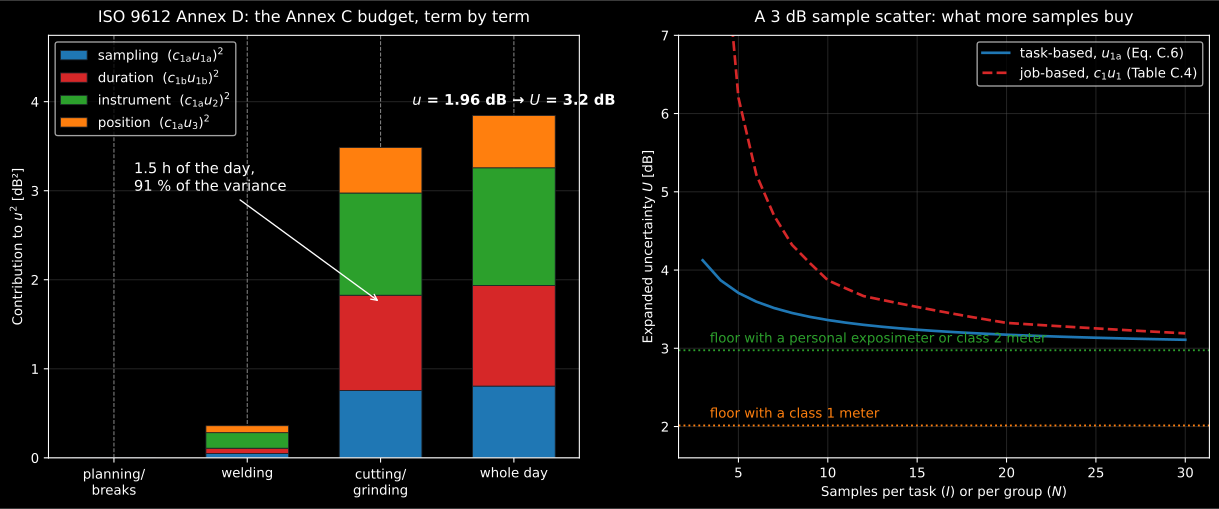
Two things the figure says that the formulae do not. First, every term is weighted by , the task’s share of the daily energy, so the budget follows the dose rather than the clock: cutting and grinding is 1.5 h of the eight and carries 91 % of the variance, welding’s five hours carry 9 %, and the quiet planning task carries nothing measurable. Second, “the sampling term dominates” is a rule of thumb, not an identity. With the default personal exposimeter the task sampling term overtakes the instrument term only once the sample standard deviation exceeds (about 3.7 dB at six samples), and in this Annex D day it does not: cutting and grinding scatters by 3.0 dB over six samples, so dB against dB. The largest single segment here is in fact the duration of that short, loud task, because grows as the task shortens, so a h uncertainty on a 1.5 h task costs more than either the sampling or the instrument term.
Show the code for this figure
import matplotlib.pyplot as pltimport numpy as np
# `hearing` and `res` (the Annex D day, with duration uncertainty) come from# the snippets above; here it is rebuilt with the duration term included.res_d = hearing.task_based_exposure(tasks, warn=False)for t in res_d.tasks:    print(f"{t.label:<16} sampling {(t.c1a * t.u1a) ** 2:5.3f}  "          f"duration {(t.c1b * t.u1b) ** 2:5.3f}  "          f"instrument {(t.c1a * t.u2) ** 2:5.3f}  "          f"position {(t.c1a * t.u3) ** 2:5.3f}")
counts = np.arange(3, 31)u2, u3, scatter = 1.5, 1.0, 3.0expanded = lambda term: 1.65 * np.sqrt(np.asarray(term) ** 2 + u2**2 + u3**2)fig, ax = plt.subplots()ax.plot(counts, expanded(scatter / np.sqrt(counts)), label="task-based")ax.plot(counts, expanded([hearing.table_c4_contribution(int(n), scatter)                          for n in counts]), "--", label="job-based")ax.axhline(expanded(0.0))            # the instrument + position floorax.legend()plt.show()
The practical consequence still holds, and the right panel gives it a shape: a quadrature budget is set by its largest term, so tightening the instrument grade buys nothing while the sampling term sits above the floor, and the productive move is more samples, with returns that fall off fast. At a 3 dB scatter the task-based goes 4.1 dB at three samples, 3.4 dB at ten, 3.1 dB at thirty, while the job-based strategy pays a far steeper penalty for a small (19.2 dB at three, 6.2 dB at five, 3.9 dB at ten) because Table C.4 does not simply divide by . That gap is the standard’s built-in penalty for coarser, fewer samples, and it is what the Clause 9.3 / 10.4 advisories push against. Because peak carries no Annex C sampling model (Table C.5, Note 1), it is reported without an uncertainty, not with a zero one.
When a task’s samples span 3 dB or more (Clause 9.3), or the job contribution
exceeds 3.5 dB (Clause 10.4), or too few workers are covered
(Table 1 cumulative-duration), the result sets sampling_advisory=True and, with
warn=True, emits an OccupationalExposureWarning recommending more
measurements. The
three Annex D/E/F worked examples above are reproduced to the standard’s printed
precision (Annex E’s final rounding is disclosed above), and the theory is
derived on the Theory page.
task_based_exposure() / job_based_exposure() / full_day_exposure() parameters
Section titled “task_based_exposure() / job_based_exposure() / full_day_exposure() parameters”| Parameter | Applies to | Type | Units | Range / default | Notes |
|---|---|---|---|---|---|
tasks | task | list of Task | — | Each Task has samples, duration_hours, optional duration_range/duration_samples, label, instrument | |
samples | job / full-day | sequence | dB | ( / advised) | Random samples |
effective_duration_hours | job / full-day | float | h | Effective working-day duration | |
instrument | all | str | — | 'class1', 'class2', 'personal_exposimeter' (default) | Selects (Table C.5) |
u3 | all | float | dB | default 1.0 | Microphone-position uncertainty (Clause C.6) |
include_duration_uncertainty | task | bool | — | default True | False omits the term (Annex D case a) |
n_workers / sample_duration_hours | job | int / float | — / h | default None | Table 1 cumulative-duration check |
warn | all | bool | — | default True | Emit OccupationalExposureWarning for the sampling advisories |
All three return an ExposureResult with lex_8h, combined_standard_uncertainty
, expanded_uncertainty , upper_limit = ,
sampling_advisory, and (task-based) the per-task tasks breakdown; the
result’s .plot() draws the per-task contribution bars with the
and upper-limit lines (task-based results only, since the other strategies
carry no per-task breakdown).
3. The measurement report (Clause 15)
Section titled “3. The measurement report (Clause 15)”An exposure determination ends as a document: ISO 9612 Clause 15 lists what
the measurement report shall state, from the strategy that was applied and the
work analysis down to the requirement that the noise exposure level and the
measurement uncertainty be reported as separate values, each rounded to one
decimal place. ExposureResult.report() writes that report as a one-page PDF
fiche laid out like a prevention-service measurement sheet: the standard-basis
line naming the applied strategy, a header grid (company, worker(s)/job,
workplace, and the Clause 15 c instrumentation and calibration traceability),
the work analysis (the per-task table of durations, levels
and contributions for a task-based result with its contribution
chart, or the sampling summary with the Formula C.9 budget for a job-based or
full-day result) and the boxed with , and the one-sided
95 % upper limit.
Because the number exists to be compared with the law, the fiche then assesses
the result against Directive 2003/10/EC (Article 3): the lower and upper
exposure action values (80 and 85 dB(A)) and the exposure limit value
(87 dB(A)), each marked exceeded / not exceeded on the value exactly as
displayed, with a PASS/FAIL verdict against the limit value. A printed note
records that the limit value applies to the effective exposure, with the
attenuation of the worn hearing protectors taken into account, which the
measured does not include. verbose=True adds the per-task
Annex C uncertainty columns (, , ), and language="es"
renders the Spanish fiche (the vocabulary of the Spanish transposition,
RD 286/2006: nivel de exposición diario equivalente, valor límite de
exposición, with comma decimals).
from phonometry import ReportMetadata, hearing
# The Annex D welders' day from section 1, with duration uncertainty.res = hearing.task_based_exposure(tasks, warn=False)
res.report(    "lex8h.pdf",    metadata=ReportMetadata(        client="Example fabrication works",        specimen="Welders (homogeneous exposure group, 4 workers)",        test_room="Steel assembly hall, line 2",        instrumentation="Personal sound exposure meter (IEC 61252), s/n 0042",        calibration="Calibrator IEC 60942 class 1; field checks within 0.3 dB",        test_date="2026-07-20",        laboratory="Phonometry reference example",        report_id="EXAMPLE-9612",    ),)   # LEX,8h = 84.3 dB, U = 3.2 dB -> lower action value exceeded, limit PASS
The example fiche is regenerated with make reports and kept rendered in the
repository; click the preview to open the PDF.
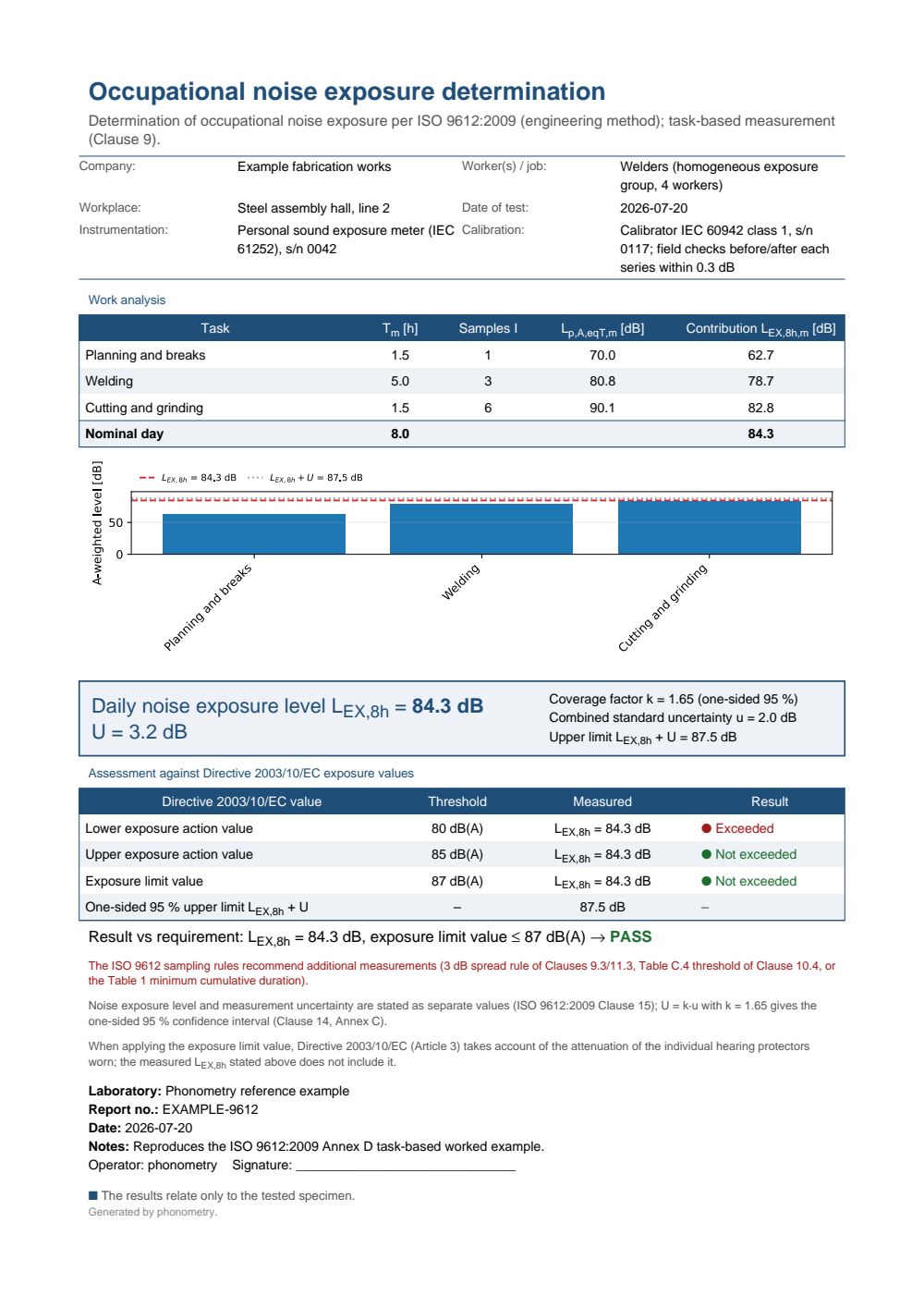
One-page ISO 9612 occupational noise-exposure fiche: a header with the company, the welders exposure group, the workplace and the instrumentation and calibration traceability, the task-based work-analysis table (planning/breaks, welding, cutting/grinding with durations, sample counts, task levels and LEX,8h contributions closed by the nominal-day totals row), the per-task contribution chart, the boxed LEX,8h = 84.3 dB with U = 3.2 dB, k = 1.65 and the 87.5 dB upper limit, and the Directive 2003/10/EC assessment table where the 80 dB(A) lower action value is exceeded, the 85 dB(A) upper action value and the 87 dB(A) limit value are not, ending in a PASS verdict.
What this guide covers
Section titled “What this guide covers”Covered
The three measurement strategies of ISO 9612:2009 Clauses 9-11,
task_based_exposure,job_based_exposureandfull_day_exposure, with the Clause 9.3 sampling rules and the Clause 12.3 / 12.4 microphone geometry stated here as the procedure that produces their inputs; the Annex C uncertainty budget (Formulae C.6, C.9 and C.12 with Tables C.4 and C.5, and from Clause C.6); the one-sided coverage factor of Clause 14; the Clause 9.3 / 10.4 / Table 1 advisories, reachable before the survey throughminimum_cumulative_duration_hoursandtable_c4_contribution; and the Clause 15 measurement report throughExposureResult.report(), with the Directive 2003/10/EC assessment on top of it. The three worked examples of Annexes D, E and F are reproduced.Not covered
The work analysis of Clause 7 and the microphone placement of Clause 12.3 / 12.4 are procedures, not calculations: they stay with the surveyor, and this guide documents them so the numbers fed to a
Taskmean something. Table B.1 is reproduced as guidance and the caller picks the strategy; nothing here applies it. Hearing-protector attenuation (the ISO 4869 series) is not applied, so the computed here (and the limit-value comparison the fiche prints on it) is the unprotected exposure, which is also what the ISO 1999 hearing-loss model wants. And Annex C offers no uncertainty model for (Table C.5, Note 1), which is why the peak is reported without one rather than with a zero one.
References
Section titled “References”- European Parliament and Council. (2003). Directive 2003/10/EC on the minimum health and safety requirements regarding the exposure of workers to the risks arising from physical agents (noise) (Directive 2003/10/EC). Official Journal of the European Union. The EU exposure action values (80/85 dB) and limit value (87 dB) that the LEX,8h and its upper limit are assessed against.
- International Organization for Standardization. (2009). Acoustics — Determination of occupational noise exposure — Engineering method (ISO 9612:2009). The implemented method: the task-based (Clause 9), job-based (Clause 10) and full-day (Clause 11) strategies, the microphone placement of Clause 12.3, the Annex C uncertainty budget (Formulae C.6, C.9 and C.12, Tables C.4/C.5) and the one-sided coverage factor k = 1.65 (Clause 14), validated against the worked examples of Annexes D, E and F; the Clause 15 measurement report is written by ExposureResult.report().
- National Institute for Occupational Safety and Health. (1998). Criteria for a recommended standard: Occupational noise exposure — Revised criteria 1998 (DHHS/NIOSH Publication No. 98-126). https://doi.org/10.26616/NIOSHPUB98126The freely available criteria document (the linked PDF is the free download) behind the 85 dB(A) recommended exposure limit and the hearing-conservation rationale for measuring the daily dose.