Suspended Ceilings: the EN 16487 Test Code
Standards: EN 16487EN ISO 354EN 13964ISO 11654
EN ISO 354 measures the sound absorption of a specimen in a reverberation room, and leaves a good deal to the laboratory: how large the specimen is, how it is mounted, how much air is behind it. For most materials those choices move the answer by less than the measurement uncertainty. For a suspended ceiling they do not. A ceiling tile absorbs partly by itself and partly through the plenum behind it, so a laboratory that hangs it 400 mm below the ceiling gets a different product from one that hangs it at 150 mm.
EN 16487 closes those choices. It is a test code: it adds no measurement of its own, it fixes the arrangement so that the one EN ISO 354 describes gives the same answer in Bregenz as in Bilbao.
1. The specimen is a fixed size
Section titled “1. The specimen is a fixed size”4.1.1.1.1 asks for a specimen area as close to 10,80 m² as the product allows, built from test objects of 0,6 m by 0,6 m butted together with no seal in the joints. The exposed face sits level with the top of the mounting fixture, the joint between the two is taped, and the edges of the specimen are set at an angle of at least 10° to the nearest room wall, so that the specimen and the room do not share a direction.
from phonometry import materials
check = materials.check_ceiling_specimen(area_m2=10.8, mounting="E", depth_mm=200.0)print(check.satisfied)            # Trueprint(check.ce_marking_depth)     # Trueprint(check.area_error_m2)        # 0.0
The area is a target and not a tolerance: the clause says “as close to 10,80 m² as possible”, so the check reports how far off you are and leaves the judgement to the laboratory. A 9,6 m² specimen comes back satisfied, with the 1,2 m² shortfall reported as a number rather than as a refusal.
2. The mounting is the product
Section titled “2. The mounting is the product”Four mountings of EN ISO 354 Annex B are used here, and a ceiling normally uses the third of them.
print(materials.mounting_type("A"))# attached directly against a hard surface, with no air spaceprint(materials.mounting_type("E"))# suspended from a hard surface with an air space behind itFor that type E mounting, 4.1.1.2.3.1 fixes the overall depth of construction at 200 mm, and says in as many words that this is the depth the data for CE marking is compiled at. Another depth may be measured and reported, but the result is then a measurement of that arrangement rather than the one the marking rests on. The check passes it and its one warning says only that: the depth is not the one CE marking data is compiled from, which is not the same as leaving the test code.
import warnings
with warnings.catch_warnings(record=True) as raised:    warnings.simplefilter("always")    deep = materials.check_ceiling_specimen(area_m2=10.8, mounting="E", depth_mm=400.0)print(deep.satisfied)           # Trueprint(deep.ce_marking_depth)    # Falseprint(len(raised))              # 1
The rest of the arrangement carries numbers too: a substructure no more than
30 mm wide and 50 mm deep on a pitch of about 0,6 m, support units under it no
larger than 50 mm by 50 mm in cross-section at centre distances of at least
1,2 m, a mounting fixture of solid material at 20 kg/m² or more, and a specimen
that deflects no more than 5 mm anywhere. Every one of those limits that a
dimension of the arrangement as built can be held to is judged: the substructure
section, the support section and centre distance, the fixture density and the
deflection. Leaving one makes satisfied false and raises a
SuspendedCeilingWarning that says which.
with warnings.catch_warnings(record=True) as raised: warnings.simplefilter("always") hung = materials.check_ceiling_specimen( area_m2=10.8, mounting="E", depth_mm=200.0, substructure_width_mm=24.0, substructure_height_mm=38.0, support_width_mm=60.0, support_height_mm=40.0, support_centre_distance_m=1.0, )print(hung.substructure_ok) # Trueprint(hung.supports_ok) # Falseprint(hung.satisfied) # FalseA substructure and supports are what the clause allows rather than requires, so
their dimensions default to none at all and the centre distance is judged only
when it is given. Three printed figures are not judged, because the clause does
not make them limits: the 0,6 m test object, which “should” be that size and
otherwise the closest in the product range; the 10° edge angle, which “should be
aimed at”; and the substructure pitch of “approx. 0,6 m”. They are published as
TEST_OBJECT_SIZE_M, MIN_ROOM_EDGE_ANGLE_DEG and SUBSTRUCTURE_SPACING_M to
build to.
How the measurement goes
Section titled “How the measurement goes”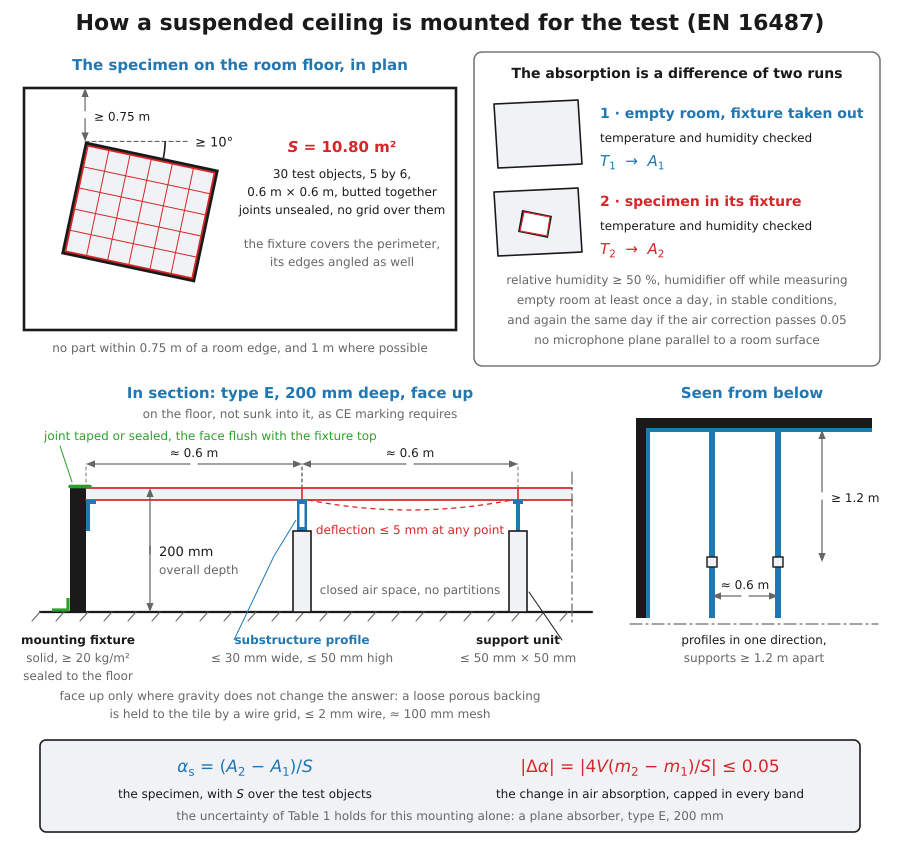
Build the specimen to 10,80 m² out of whole test objects, butted together, with the joints unsealed and the perimeter covered by the mounting fixture. Mount it at 200 mm overall depth if the result is to support CE marking, on a substructure inside the 30 mm by 50 mm section, carried by supports inside 50 mm by 50 mm and at least 1,2 m apart, and check the deflection at the worst point. Set the specimen edges at an angle to the room walls. Measure the empty room first and then the room with the specimen in it, as EN ISO 354 prescribes, holding the temperature and the humidity steady between the two runs and the humidity at 50 % or more in each: the correction below is the difference between them, and it is a difference of days rather than of ceilings.
3. The air in the room is part of the answer
Section titled “3. The air in the room is part of the answer”The reverberation time of an empty room depends on the air in it, and at 4 kHz in a dry room the air absorbs a great deal. Since the absorption coefficient is obtained from two reverberation times measured on two occasions, a change in temperature or humidity between them shows up as absorption that the specimen never had.
4.2.1 caps the whole effect. The correction is
and the test conditions “shall be so chosen” that it does not exceed 0,05 at any frequency. 4.2.2 adds the practical half of that: at least 50 % relative humidity in the room, which 4.2.3 asks to be checked for each measurement. The specimen check takes one humidity per measurement and judges the driest:
with warnings.catch_warnings(record=True) as raised: warnings.simplefilter("always") dry = materials.check_ceiling_specimen( area_m2=10.8, mounting="E", depth_mm=200.0, relative_humidity_percent=[41.0, 44.0], # empty room, then with the specimen )print(dry.humidity_ok) # Falseprint(dry.satisfied) # FalseLeave the humidity out and humidity_ok is None: the verdict then covers the
specimen and says nothing about the room.
correction = materials.air_absorption_correction( volume_m3=200.0, specimen_area_m2=10.8, attenuation_with=[0.0011, 0.0013, 0.0018, 0.0028, 0.0055, 0.0170], attenuation_empty=[0.0010, 0.0012, 0.0016, 0.0025, 0.0050, 0.0160],)print(correction.round(3)) # [0.007 0.007 0.015 0.022 0.037 0.074]That last band is over the cap, and the library says so rather than returning it quietly: the answer is a second measurement of the empty room, which is what 5.2 asks for.
4. What the whole thing buys
Section titled “4. What the whole thing buys”Table 1 is the point of the exercise. It is the reproducibility between European laboratories, from the round robin reported in Annex A: the spread you should expect when the same ceiling is measured in two places that both follow this code.
print(materials.reproducibility_uncertainty().round(2))# [0.23 0.23 0.11 0.1 0.1 0.13]print(materials.WEIGHTED_UNCERTAINTY) # 0.08print(materials.EN16487_COVERAGE_FACTOR) # 2.8Two things are worth reading twice. The figures are an expanded uncertainty: ISO 5725-6 gives a reproducibility standard deviation, and the note under the table multiplies it by 2,8 rather than by the usual 2, so the standard deviation at 1 kHz is 0,036 rather than 0,10. And 6.2 says plainly that the figures hold for a plane absorber with the type E mounting at 200 mm overall depth, and that nothing has been investigated for any other absorber or mounting. A baffle, a raft or a free-hanging unit is outside them.
What this guide covers
Section titled “What this guide covers”Covered
- EN 16487:2014: the specimen geometry of 4.1.1.1, the four mountings of 4.1.1.2 with the type E depth of 4.1.1.2.3.1, the substructure, deflection and support unit limits of 4.1.1.2.3.4 to 4.1.1.2.3.6, the mounting fixture of 4.1.1.1.6, the air-absorption correction and cap of 4.2.1, the humidity of 4.2.2 judged for each measurement, and Table 1 with its coverage factor.
Not covered
- The measurement itself, which is EN ISO 354 and lives in Measuring Sound Absorption.
- Discrete absorbers, baffles and rafts measured as objects rather than as a plane, which the code covers in outline and the reproducibility of Table 1 does not cover at all.
- The product requirements of EN 13964 beyond the definitions and the CE marking depth this code refers to.
References
Section titled “References”- European Committee for Standardization. (2003). Acoustics — Measurement of sound absorption in a reverberation room (EN ISO 354:2003). The measurement this code constrains, and the source of the mounting letters A, B, E and J of Annex B and of the air-absorption correction of Formulae (8) and (9).
- European Committee for Standardization. (2014). Acoustics — Test code for suspended ceilings — Sound absorption (EN 16487:2014). The test code: the specimen geometry of 4.1.1, the mountings of 4.1.1.2, the air-absorption cap of 4.2.1 and the humidity of 4.2.2, and Table 1, the reproducibility of the round robin of Annex A. Read from BS EN 16487:2014.
- European Committee for Standardization. (2014). Suspended ceilings — Requirements and test methods (EN 13964:2014). The product standard the definitions come from, and the CE marking the 200 mm depth is fixed for.
- International Organization for Standardization. (1997). Acoustics — Sound absorbers for use in buildings — Rating of sound absorption (ISO 11654:1997). The weighted rating the reproducibility of 0,08 applies to.