Humid air
Standards: IEC 61094
A reciprocity calibration needs the air it is done in to five or six figures, which is why the standard that defines that calibration also carries the most carefully stated model of humid air in the acoustic literature. Annex F is that model, and this page is what the library does with it.
The shortest useful call
Section titled “The shortest useful call”from phonometry import fluids
f = fluids.air( temperature_c=23.0, static_pressure_pa=101325.0, relative_humidity_percent=50.0,)print(f.density) # 1.1860847889882964 kg/m3print(f.speed_of_sound) # 345.86651725321 m/sprint(f.characteristic_impedance) # 410.2270151343906 Pa.s/mThose are the conditions of the first row of Table F.1, and the numbers are the ones the annex prints. Every one of the ten figures it tabulates comes back inside the rounding of its last printed digit.
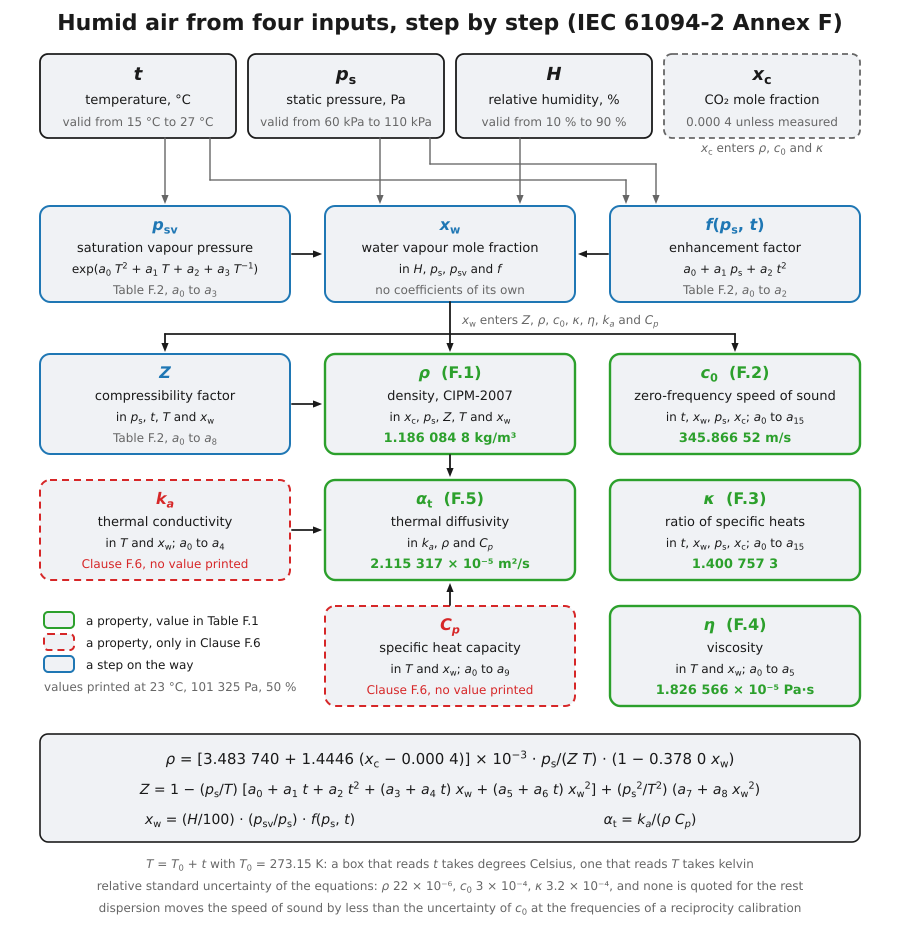
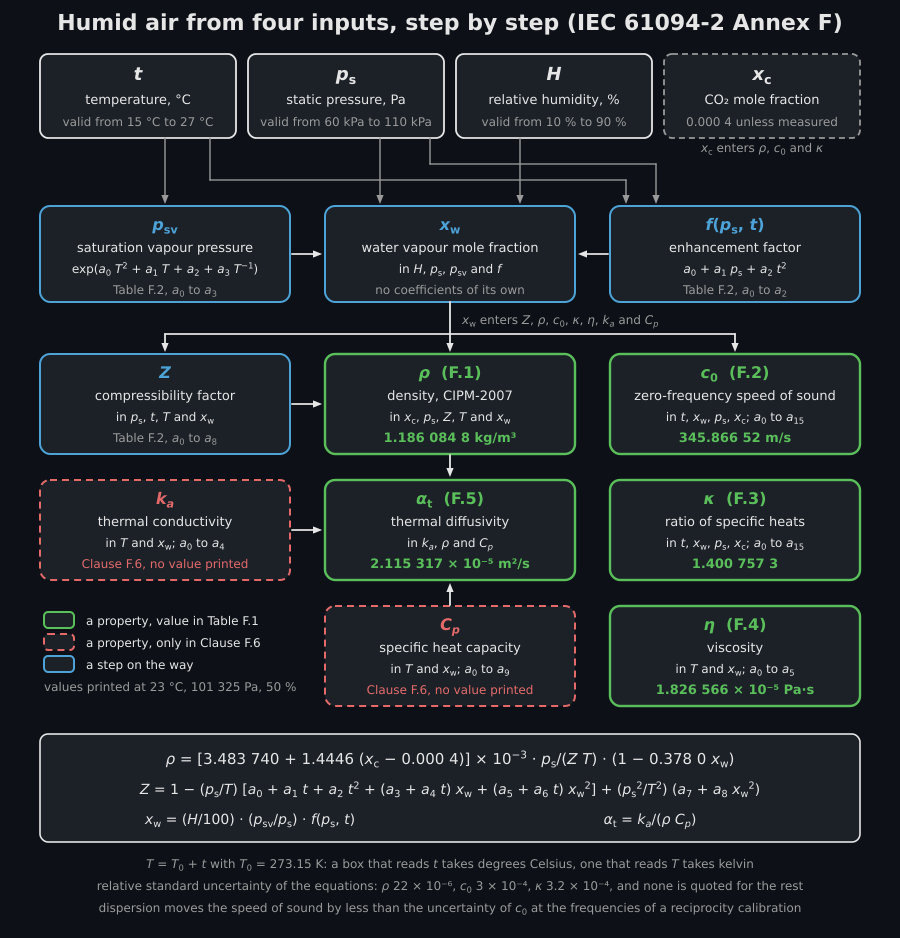
The chain the call above runs: the water vapour comes first and every quantity after it depends on it, and the five with a printed value carry the one Table F.1 gives for those conditions.
The three conditions are not equally important
Section titled “The three conditions are not equally important”The library asks for the temperature and assumes the other two. That is not laziness in one direction and rigour in the other; it follows from how much each is worth. Sweeping each condition across its plausible range, with the annex’s own equations:
| Condition | Swept over | Moves the density by |
|---|---|---|
| Static pressure | 80 to 105 kPa | 25 % |
| Temperature | 15 to 27 °C | 4,5 % |
| Relative humidity | 0 to 100 % | 1,05 % |
The pressure dominates, and it is also the one people believe they already know. A test site 1000 metres up sits at roughly 90 kPa. That is 11 % below the standard atmosphere the library would otherwise assume, and it puts the density about 13 % high, which is half a decibel on a sound power level with nothing on the page to say so.
Humidity is the opposite case. It moves the density least, and almost nobody knows theirs without measuring it.
So both are assumed and both are announced, once, in the same warning:
import warnings
from phonometry import fluids
with warnings.catch_warnings(record=True) as caught:    warnings.simplefilter("always")    fluids.air(temperature_c=20.0)
print(caught[0].category.__name__)              # FluidAssumptionWarningprint(str(caught[0].message))# air() assumed 101325 Pa and 50 % relative humidity. The pressure is the one# worth measuring: a site 1000 m up sits near 90 kPa, and taking it for one# standard atmosphere puts the density about 13 % high. The whole span of# humidity, 0 % to 100 %, is worth about 1 % of the density. Pass the# conditions to silence this.
One warning, not two, because a caller who supplied neither has one thing to fix rather than two.
Supplying both is silent, which is the property somebody who measured their
air should get. Python shows the warning once per call site, so exploring at a
prompt is not drowned in it, and it derives from PhonometryWarning, so one
rule escalates it to an error for anyone who wants their runs to fail rather
than warn:
import warnings
from phonometry import PhonometryWarning
warnings.filterwarnings("error", category=PhonometryWarning)
The temperature has no default at all. It is the one condition a caller has actually measured, and there is no value that would be defensible to invent for it.
The carbon dioxide fraction defaults quietly, to 0,000 4. That is not a guess about the caller’s air: Clause F.2 names it as the value to use for laboratory conditions in the absence of a measurement, so the library is quoting the annex rather than filling a hole.
What the model fixes, and what it will not invent
Section titled “What the model fixes, and what it will not invent”Table F.1 prints five quantities. Clause F.6 gives expressions for two more, and three follow by identity from the ones above:
f.density # printed by Table F.1f.speed_of_sound # printed, at zero frequencyf.heat_capacity_ratio # printedf.viscosity # printedf.thermal_diffusivity # printedf.thermal_conductivity # Clause F.6 expressionf.specific_heat_capacity # Clause F.6 expressionf.characteristic_impedance # rho cf.prandtl_number # eta / (rho alpha_t)f.kinematic_viscosity # eta / rhoA quantity this model did not determine raises rather than returning a number nobody printed. The error names the model, what it does determine, and the two ways out:
from phonometry.fluids import Fluid, FluidPropertyUnavailable
measured = Fluid(    temperature_c=10.0,    static_pressure_pa=1.1e6,    composition={"salinity_psu": 35.0},    model="a density and a sound speed, measured",    validity="",    properties={"density": 1027.0, "speed_of_sound": 1491.0},)try:    measured.heat_capacity_ratioexcept FluidPropertyUnavailable as exc:    print(exc)# 'a density and a sound speed, measured' does not determine# 'heat_capacity_ratio'; it determines density, speed_of_sound. Supply the# quantity yourself, or use a model that prints it.
That looks like pedantry with one fluid in the library, and stops looking like
it with two: sea water has no ratio of specific heats to give, and a
Fluid that invented one would be handing a caller a number with the shape of
a measurement and none of the substance.
Three attributes are not quantities and never raise. They are the record of where the numbers came from:
f.properties # exactly what this model determinedf.model # 'IEC 61094-2:2009 Annex F (CIPM-2007)'f.composition # the humidity and CO2 it was computed withThe printed domain, and the difference between a fit and a fact
Section titled “The printed domain, and the difference between a fit and a fact”Annex F states, on its own page, where its equations were validated: 15 °C to 27 °C, 60 kPa to 110 kPa, 10 % to 90 % relative humidity. It states no range for the carbon dioxide fraction.
Outside that box the library warns and still answers:
import warnings
from phonometry import fluids
with warnings.catch_warnings(record=True) as caught:    warnings.simplefilter("always")    hot = fluids.air(temperature_c=60.0, static_pressure_pa=101325.0,                     relative_humidity_percent=50.0)
print(caught[0].category.__name__)                    # FluidWarningprint("temperature 60 degC (stated 15 to 27)" in str(caught[0].message))  # Trueprint(round(hot.speed_of_sound, 2))                   # 371.52
The distinction matters and it is the rule the whole library follows. Air at
60 °C in a duct exists; a fit past its validated range is still arithmetic, and
refusing it would refuse a real measurement. What is refused is a state that
cannot be, and that is the whole list: a temperature at or below absolute zero,
a pressure that is not positive, a relative humidity outside 0 % to 100 %, a
carbon dioxide mole fraction outside 0 to 1, and a non-finite value for any of
the four. Each raises ValueError naming the argument.
How the numbers are pinned
Section titled “How the numbers are pinned”The oracle is Table F.1: five quantities at two condition sets, ten figures in
all. The tolerance is not chosen. A value is stated to within half a unit of
the last place it was printed to, so that is what reproducing it means, and the
test derives that bound from the printed string rather than carrying a constant
somebody picked. It is the last place that sets the bound, not a count of
significant figures: 1,186 084 8 carries eight of them and 2,115 317 x 10^-5
seven, and the same rule reads both:
The tolerance, derived from the print
from decimal import Decimal
def half_of_the_last_printed_figure(printed: str) -> float:    """Half a unit in the last place the annex printed."""    exponent = int(Decimal(printed).as_tuple().exponent)    return float(Decimal(5) * Decimal(10) ** (exponent - 1))
half_of_the_last_printed_figure("1.1860848")    # 5e-08half_of_the_last_printed_figure("2.115317e-5")  # 5e-12
Nobody can loosen it by accident, and a future edition quoting more figures tightens it by itself.
Three conformance rows record how much of that allowance each set uses: 55 % for the first, 96 % for the second, and none at all for the identity that ties the thermal conductivity and the specific heat capacity to the diffusivity printed between them. The 96 % is the density of the second set, and it is the annex’s own rounding rather than any slack of the library’s. Reporting it as a percentage means that if a change ever pushes it out, it is visible coming.
Where this air is, and is not, used
Section titled “Where this air is, and is not, used”Passing a Fluid to a measurement function is the subject of the packages
that consume it, and it comes with a rule worth stating here: where a standard
fixes the air of its own procedure, using better air is a departure from the
standard, and the library says so rather than letting a measurement quietly
stop reproducing the document it cites.
That is why the simplified air formulas of ISO 10534-2, ASTM E2611 and ISO 17497-1 stay in their own modules with their own clauses, and why the Johnson-Champoux-Allard Prandtl number of 0,71 stays frozen at 0,71 even though the air at that state has 0,728.
Two states of that air are published as constants, because a caller has no
business writing them out twice. materials.ANNEX_A_AIR is the reference state
ISO 9053-2:2020 Annex A.3 fixes for an airflow-resistance measurement, 23 °C
and 50 % relative humidity at one standard atmosphere, evaluated through the
same CIPM-2007 model as any other air. simulation.SIMULATION_AIR is the
solver’s default medium, and it is deliberately not that: 343 m/s and
1,2 kg/m³ flat, the round pair a finite-difference grid is set up with, carried
as a Fluid so that a run says which air it was made in rather than leaving
two floats standing side by side in a call.
References
Section titled “References”- International Electrotechnical Commission. (2009). Electroacoustics — Measurement microphones — Part 2: Primary method for pressure calibration of laboratory standard microphones by the reciprocity technique (IEC 61094-2:2009). Annex F carries the humid-air model implemented here, its coefficients in Table F.2 and the two worked condition sets of Table F.1 that pin it. The edition read is its European adoption BS EN 61094-2:2009.