Source: https://jmrplens.github.io/phonometry/reference/theory/environment-transport/
This page collects the theory behind outdoor and environmental noise: the whole-day rating descriptors and the impulsive-sound adjustment, atmospheric absorption, the general outdoor propagation method, occupational noise exposure with its uncertainty budget, and the sound power determination methods. It is part of the [theory reference](/phonometry/reference/theory/).
## Environmental descriptors (ISO 1996-1)
The **day-evening-night level** $L_{den}$ (ISO 1996-1:2016, 3.6.4) is an energy average over the 24 h day with penalty weightings of **+5 dB for the evening** and **+10 dB for the night**:
$$
L_{den} = 10 \log_{10}\left\lbrace\frac{1}{24}\left[ t_d\ 10^{0.1 L_{day}} + t_e\ 10^{0.1 (L_{evening} + 5)} + t_n\ 10^{0.1 (L_{night} + 10)} \right]\right\rbrace
$$
with default period durations $(t_d, t_e, t_n) = (12, 4, 8)$ h; countries may define the periods differently (3.6.4 Note 1). The **day-night level** $L_{dn}$ (3.6.5) drops the evening period:
$$
L_{dn} = 10 \log_{10}\left\lbrace\frac{1}{24}\left[ t_d\ 10^{0.1 L_{day}} + t_n\ 10^{0.1 (L_{night} + 10)} \right]\right\rbrace, \qquad (t_d, t_n) = (15, 9)\ \text{h}
$$
Both are special cases of the **composite whole-day rating level** (6.5, generalizing Formulae 5–6), where each period $i$ contributes its rating level $L_i$ plus an adjustment $K_i$, weighted by its share of the day:
$$
L_R = 10 \log_{10}\left[ \sum_i \frac{h_i}{24}\ 10^{0.1 (L_i + K_i)} \right], \qquad \sum_i h_i = 24\ \text{h}
$$
The adjustments $K_i$ cover time-of-day penalties (ISO 1996-1 Table A.1: evening 5 dB, night 10 dB) as well as source-character adjustments (e.g. tonal penalties), which the ECMA-418-1 TNR/PR assessments can justify objectively.
See the [Levels guide](/phonometry/guides/levels/) for usage.
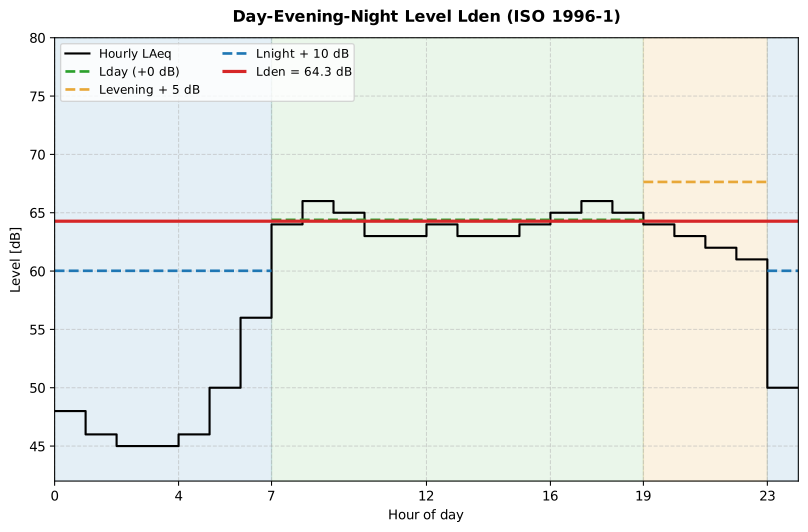
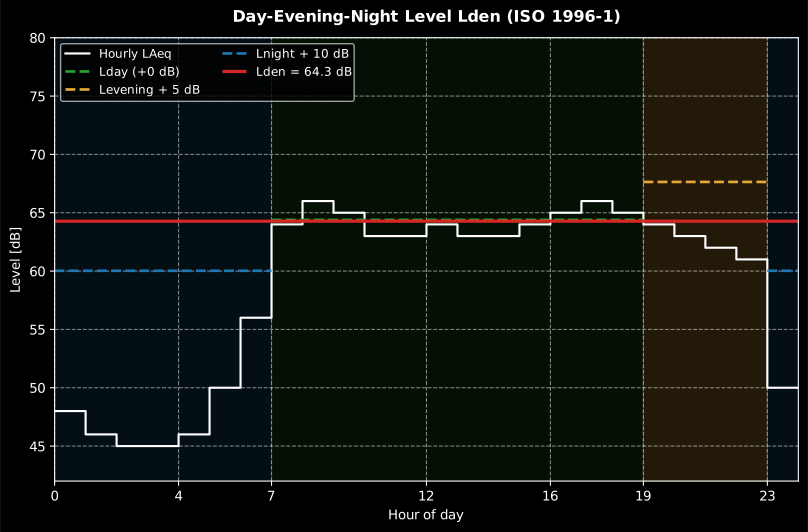 *A 24-hour LAeq profile split into day, evening and night, the +5/+10 dB penalties and the resulting Lden.*
## Impulsive-sound prominence (NT ACOU 112)
An impulse annoys beyond its energy, so environmental surveys after ISO 1996-2 penalize periods containing prominent impulsive sounds; NT ACOU 112:2002 makes that penalty objective. From the A-weighted, time-weighting-F level history of a single event, the onset rate (dB/s) and the level difference (dB) of the onset (which qualifies when steeper than 10 dB/s, clauses 4.5–4.7) predict the perceived prominence (clause 7, Formula 1):
$$
P = 3 \lg(\text{onset rate}) + 2 \lg(\text{level difference}),
$$
designed to peak around 15 for very sudden, loud impulses. The adjustment to the measurement-period level takes the governing (highest-$P$) impulse (clause 8, Formula 2):
$$
K_I = 1.8\ (P - 5)\ \text{dB} \quad (P > 5;\ \text{else } K_I = 0),
$$
and the whole-day rating level combines the adjusted periods energetically (clause 8, Note 1):
$$
L_{Ar,T} = 10 \lg\Big[ \frac{1}{T} \sum_N \Delta t_N\ 10^{(L_{Aeq,N} + K_{I,N})/10} \Big].
$$
$K_I$ is exactly the kind of source-character adjustment that enters the ISO 1996-1 composite rating level above. The anchors $P(1000\ \text{dB/s}, 30\ \text{dB}) = 9 + 2\lg 30 = 11.95$ and $K_I(P{=}10) = 9.0$ dB are reproduced exactly.
See the [Impulse Prominence guide](/phonometry/guides/impulse-prominence/) for usage.
## Outdoor propagation and occupational exposure (ISO 9613-1/2, ISO 9612)
### Atmospheric absorption (ISO 9613-1)
Air is a lossy medium: a propagating tone loses energy to shear viscosity and
heat conduction (classical and rotational losses, growing as $f^2$) and to the
**vibrational relaxation** of the oxygen and nitrogen molecules, each an energy
reservoir that resonates near a humidity- and temperature-dependent relaxation
frequency. ISO 9613-1:1993, Eq. (5) gives the pure-tone attenuation coefficient
$\alpha$ in decibels per metre:
$$
\alpha = 8.686\ f^2 \Big[ 1.84\times10^{-11} \big(p_a/p_r\big)^{-1} \big(T/T_0\big)^{1/2}
+ \big(T/T_0\big)^{-5/2} \big( 0.01275\ \tfrac{e^{-2239.1/T}}{f_{rO} + f^2/f_{rO}}
+ 0.1068\ \tfrac{e^{-3352.0/T}}{f_{rN} + f^2/f_{rN}} \big) \Big],
$$
with the oxygen and nitrogen relaxation frequencies $f_{rO}$, $f_{rN}$ of
Eq. (3)/(4), the reference conditions $T_0 = 293.15$ K, $p_r = 101.325$ kPa
(Clause 4.2) and the molar water-vapour concentration $h$ from the relative
humidity (Annex B). At low frequency $\alpha \propto f^2$; near each relaxation
frequency the corresponding term peaks and rolls off, which is why $\alpha$ rises
by two decades from 50 Hz to 10 kHz and why raising the humidity sweeps a peak
across the band. The library reproduces Table 1 to under 0.4 % (the standard's
own printed precision), well inside its stated $\pm 10$ %; passing
`exact_midband=True` snaps each frequency onto the exact midbands
$f_m = 1000 \cdot 10^{k/10}$ (Note 5) used to compute that table. The same
$\alpha$ is the only route to the ISO 354 power attenuation coefficient
$m = \alpha/(10 \lg e)$, exposed as `air_attenuation_m`.
*A 24-hour LAeq profile split into day, evening and night, the +5/+10 dB penalties and the resulting Lden.*
## Impulsive-sound prominence (NT ACOU 112)
An impulse annoys beyond its energy, so environmental surveys after ISO 1996-2 penalize periods containing prominent impulsive sounds; NT ACOU 112:2002 makes that penalty objective. From the A-weighted, time-weighting-F level history of a single event, the onset rate (dB/s) and the level difference (dB) of the onset (which qualifies when steeper than 10 dB/s, clauses 4.5–4.7) predict the perceived prominence (clause 7, Formula 1):
$$
P = 3 \lg(\text{onset rate}) + 2 \lg(\text{level difference}),
$$
designed to peak around 15 for very sudden, loud impulses. The adjustment to the measurement-period level takes the governing (highest-$P$) impulse (clause 8, Formula 2):
$$
K_I = 1.8\ (P - 5)\ \text{dB} \quad (P > 5;\ \text{else } K_I = 0),
$$
and the whole-day rating level combines the adjusted periods energetically (clause 8, Note 1):
$$
L_{Ar,T} = 10 \lg\Big[ \frac{1}{T} \sum_N \Delta t_N\ 10^{(L_{Aeq,N} + K_{I,N})/10} \Big].
$$
$K_I$ is exactly the kind of source-character adjustment that enters the ISO 1996-1 composite rating level above. The anchors $P(1000\ \text{dB/s}, 30\ \text{dB}) = 9 + 2\lg 30 = 11.95$ and $K_I(P{=}10) = 9.0$ dB are reproduced exactly.
See the [Impulse Prominence guide](/phonometry/guides/impulse-prominence/) for usage.
## Outdoor propagation and occupational exposure (ISO 9613-1/2, ISO 9612)
### Atmospheric absorption (ISO 9613-1)
Air is a lossy medium: a propagating tone loses energy to shear viscosity and
heat conduction (classical and rotational losses, growing as $f^2$) and to the
**vibrational relaxation** of the oxygen and nitrogen molecules, each an energy
reservoir that resonates near a humidity- and temperature-dependent relaxation
frequency. ISO 9613-1:1993, Eq. (5) gives the pure-tone attenuation coefficient
$\alpha$ in decibels per metre:
$$
\alpha = 8.686\ f^2 \Big[ 1.84\times10^{-11} \big(p_a/p_r\big)^{-1} \big(T/T_0\big)^{1/2}
+ \big(T/T_0\big)^{-5/2} \big( 0.01275\ \tfrac{e^{-2239.1/T}}{f_{rO} + f^2/f_{rO}}
+ 0.1068\ \tfrac{e^{-3352.0/T}}{f_{rN} + f^2/f_{rN}} \big) \Big],
$$
with the oxygen and nitrogen relaxation frequencies $f_{rO}$, $f_{rN}$ of
Eq. (3)/(4), the reference conditions $T_0 = 293.15$ K, $p_r = 101.325$ kPa
(Clause 4.2) and the molar water-vapour concentration $h$ from the relative
humidity (Annex B). At low frequency $\alpha \propto f^2$; near each relaxation
frequency the corresponding term peaks and rolls off, which is why $\alpha$ rises
by two decades from 50 Hz to 10 kHz and why raising the humidity sweeps a peak
across the band. The library reproduces Table 1 to under 0.4 % (the standard's
own printed precision), well inside its stated $\pm 10$ %; passing
`exact_midband=True` snaps each frequency onto the exact midbands
$f_m = 1000 \cdot 10^{k/10}$ (Note 5) used to compute that table. The same
$\alpha$ is the only route to the ISO 354 power attenuation coefficient
$m = \alpha/(10 \lg e)$, exposed as `air_attenuation_m`.
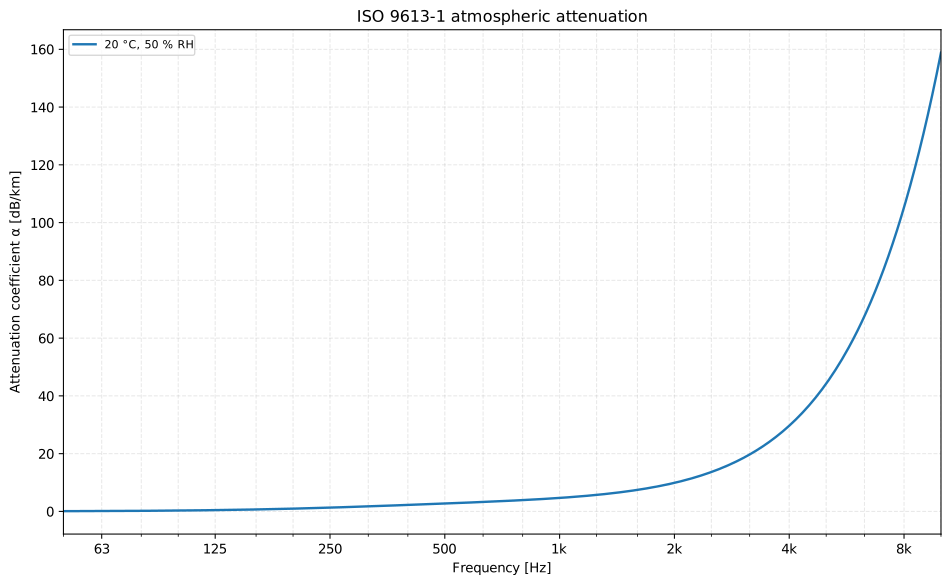
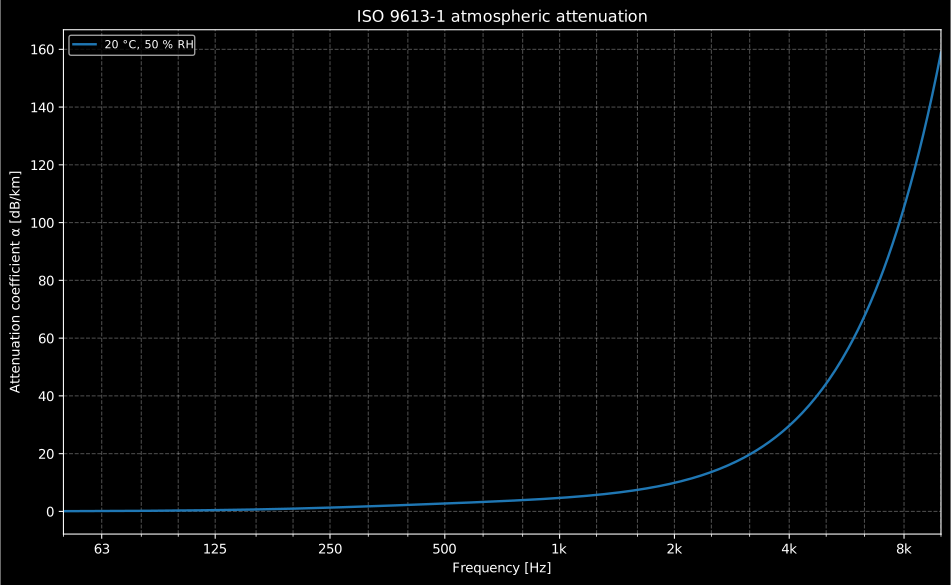 *The ISO 9613-1 coefficient for the 20 °C, 50 % relative-humidity reference atmosphere: the f² rise spans two decades from 50 Hz to 10 kHz.*
### Outdoor propagation, general method (ISO 9613-2)
ISO 9613-2:1996 predicts the octave-band level at a receiver **downwind** of a
point source (or the equivalent moderate temperature inversion) as
$L_{fT}(DW) = L_W + D_c - A$ (Eq. (3)), where $D_c$ is the directivity correction
and $A$ is the octave-band attenuation, a sum of independent physical mechanisms
(Eq. (4)):
$$
A = A_{div} + A_{atm} + A_{gr} + A_{bar} + A_{misc}.
$$
The library implements the four general terms of Clause 7; the informative
$A_{misc}$ (foliage, industrial sites, housing) and reflections are left to the
caller. **Geometrical divergence** is spherical spreading from a point source,
$A_{div} = 20 \log_{10}(d/d_0) + 11$ dB with $d_0 = 1$ m (Eq. (7)): exactly
51 dB at 100 m, +6 dB per distance doubling. **Atmospheric absorption** is
$A_{atm} = \alpha\ d$ (Eq. (8)) with $\alpha$ the ISO 9613-1 coefficient above.
**Ground effect** $A_{gr} = A_s + A_r + A_m$ (Eq. (9)) sums a source, receiver and
middle region, each evaluated from the Table 3 functions $a'/b'/c'/d'$ and its
ground factor $G$ (0 hard, 1 porous); a negative $A_{gr}$ denotes a net gain from
the ground reflection. An alternative A-weighted-only form
$A_{gr} = 4.8 - (2 h_m/d)[17 + 300/d] \ge 0$ (Eq. (10)) is offered for porous
ground when only the A-weighted level matters, paired with the solid-angle index
$D_\Omega$ (Eq. (11)). **Screening** by a barrier is the diffraction insertion
loss
$$
D_z = 10 \log_{10}\big[ 3 + (C_2/\lambda)\ C_3\ z\ K_{met} \big] \quad\text{dB},
$$
(Eq. (14)) with $C_2 = 20$ (or 40 when ground reflections are handled by image
sources), $C_3 = 1$ for a single edge or Eq. (15) for a double edge, the
path-length difference $z = d_{ss} + d_{sr} - d$ (Eq. (16)/(17)), wavelength
$\lambda = 340/f$ and the meteorological factor $K_{met}$ (Eq. (18)); $D_z$ is
capped at 20 dB (single) or 25 dB (double). For a top-edge barrier the ground
effect of the screened path is folded into the screening term,
$A_{bar} = D_z - A_{gr} \ge 0$ (Eq. (12), Note 13); for a lateral (vertical-edge)
barrier $A_{bar} = D_z$ and the ground term is kept (Eq. (13)). The long-term
average level subtracts the meteorological correction $C_{met}$ (Eq. (6),
(21)/(22)). The method's stated accuracy is $\pm 1$ to $\pm 3$ dB for broadband
noise up to 1000 m (Table 5).
### Occupational noise exposure and uncertainty (ISO 9612)
ISO 9612:2009 is the engineering method (accuracy grade 2) for a worker's daily
noise exposure level $L_{EX,8h}$, normalised to a nominal 8 h day. Three
**measurement strategies** trade effort for representativeness. The *task-based*
method (Clause 9) splits the day into tasks, energy-averages $I \ge 3$ samples
per task (Eq. 7) and sums the task contributions
$L_{EX,8h,m} = L_{p,A,eqT,m} + 10 \log_{10}(T_m/T_0)$ energetically (Eq. 9/10).
The *job-based* method (Clause 10) energy-averages $N \ge 5$ random samples over a
homogeneous exposure group (Eq. 11) and normalises the effective-day duration
(Eq. 12); the *full-day* method (Clause 11) does the same arithmetic on whole-day
measurements (Eq. 13).
The **Annex C** uncertainty budget is normative. The combined standard
uncertainty is $u^2 = \sum c_i^2 u_i^2$ (C.1) and the expanded uncertainty is
$U = k\ u$ with $k = 1.65$ for a **one-sided** 95 % interval (Clause 14), so the
reported upper limit is $L_{EX,8h} + U$. The task and job methods differ in an
instructive way: the task noise-sampling uncertainty $u_{1a}$ divides the summed
squared deviations by $I(I-1)$ (the standard error of the mean, Eq. C.6)
whereas the job/full-day sampling uncertainty $u_1$ is the plain sample standard
deviation with denominator $N-1$ (Eq. C.12), so the same spread contributes more
in the job method (fewer, coarser samples). The task budget (Eq. C.3) adds the
sensitivity coefficients $c_{1a}$ (Eq. C.4) and $c_{1b}$ (Eq. C.5) and an optional
task-duration uncertainty $u_{1b}$ (Eq. C.7); the job/full-day budget (Eq. C.9)
reads $c_1 u_1$ from Table C.4 as a function of $(N, u_1)$ and adds the instrument
uncertainty $u_2$ (Table C.5) and microphone-position uncertainty $u_3 = 1.0$ dB
in quadrature. Peak levels $L_{p,Cpeak}$ are reported without an uncertainty:
Annex C provides no method for them (Table C.5, Note 1). The three worked
examples of Annexes D (task, $L_{EX,8h} = 84.3$ dB, $U = 2.7$ dB), E (job,
$88.1$ dB, $3.8$ dB) and F (full-day, $90.1$ dB, $3.4$ dB) are reproduced to
the standard's printed precision: every intermediate of Annex E is digit-exact,
and its final level differs only by the standard's own pre-rounding of the
effective-day level (see the [Occupational Noise Exposure guide](/phonometry/guides/occupational-exposure/)).
See the [Outdoor Propagation guide](/phonometry/guides/outdoor-propagation/) and the
[Occupational Noise Exposure guide](/phonometry/guides/occupational-exposure/) for usage.
## Sound power determination (ISO 3744/3745/3746, ISO 3741, ISO 9614-2/3)
The sound power level $L_W = 10 \log_{10}(P/P_0)$ ($P_0 = 1$ pW) is an
*emission* quantity: unlike a pressure level it does not depend on the receiver
distance or the room. Three families of methods recover it.
*The ISO 9613-1 coefficient for the 20 °C, 50 % relative-humidity reference atmosphere: the f² rise spans two decades from 50 Hz to 10 kHz.*
### Outdoor propagation, general method (ISO 9613-2)
ISO 9613-2:1996 predicts the octave-band level at a receiver **downwind** of a
point source (or the equivalent moderate temperature inversion) as
$L_{fT}(DW) = L_W + D_c - A$ (Eq. (3)), where $D_c$ is the directivity correction
and $A$ is the octave-band attenuation, a sum of independent physical mechanisms
(Eq. (4)):
$$
A = A_{div} + A_{atm} + A_{gr} + A_{bar} + A_{misc}.
$$
The library implements the four general terms of Clause 7; the informative
$A_{misc}$ (foliage, industrial sites, housing) and reflections are left to the
caller. **Geometrical divergence** is spherical spreading from a point source,
$A_{div} = 20 \log_{10}(d/d_0) + 11$ dB with $d_0 = 1$ m (Eq. (7)): exactly
51 dB at 100 m, +6 dB per distance doubling. **Atmospheric absorption** is
$A_{atm} = \alpha\ d$ (Eq. (8)) with $\alpha$ the ISO 9613-1 coefficient above.
**Ground effect** $A_{gr} = A_s + A_r + A_m$ (Eq. (9)) sums a source, receiver and
middle region, each evaluated from the Table 3 functions $a'/b'/c'/d'$ and its
ground factor $G$ (0 hard, 1 porous); a negative $A_{gr}$ denotes a net gain from
the ground reflection. An alternative A-weighted-only form
$A_{gr} = 4.8 - (2 h_m/d)[17 + 300/d] \ge 0$ (Eq. (10)) is offered for porous
ground when only the A-weighted level matters, paired with the solid-angle index
$D_\Omega$ (Eq. (11)). **Screening** by a barrier is the diffraction insertion
loss
$$
D_z = 10 \log_{10}\big[ 3 + (C_2/\lambda)\ C_3\ z\ K_{met} \big] \quad\text{dB},
$$
(Eq. (14)) with $C_2 = 20$ (or 40 when ground reflections are handled by image
sources), $C_3 = 1$ for a single edge or Eq. (15) for a double edge, the
path-length difference $z = d_{ss} + d_{sr} - d$ (Eq. (16)/(17)), wavelength
$\lambda = 340/f$ and the meteorological factor $K_{met}$ (Eq. (18)); $D_z$ is
capped at 20 dB (single) or 25 dB (double). For a top-edge barrier the ground
effect of the screened path is folded into the screening term,
$A_{bar} = D_z - A_{gr} \ge 0$ (Eq. (12), Note 13); for a lateral (vertical-edge)
barrier $A_{bar} = D_z$ and the ground term is kept (Eq. (13)). The long-term
average level subtracts the meteorological correction $C_{met}$ (Eq. (6),
(21)/(22)). The method's stated accuracy is $\pm 1$ to $\pm 3$ dB for broadband
noise up to 1000 m (Table 5).
### Occupational noise exposure and uncertainty (ISO 9612)
ISO 9612:2009 is the engineering method (accuracy grade 2) for a worker's daily
noise exposure level $L_{EX,8h}$, normalised to a nominal 8 h day. Three
**measurement strategies** trade effort for representativeness. The *task-based*
method (Clause 9) splits the day into tasks, energy-averages $I \ge 3$ samples
per task (Eq. 7) and sums the task contributions
$L_{EX,8h,m} = L_{p,A,eqT,m} + 10 \log_{10}(T_m/T_0)$ energetically (Eq. 9/10).
The *job-based* method (Clause 10) energy-averages $N \ge 5$ random samples over a
homogeneous exposure group (Eq. 11) and normalises the effective-day duration
(Eq. 12); the *full-day* method (Clause 11) does the same arithmetic on whole-day
measurements (Eq. 13).
The **Annex C** uncertainty budget is normative. The combined standard
uncertainty is $u^2 = \sum c_i^2 u_i^2$ (C.1) and the expanded uncertainty is
$U = k\ u$ with $k = 1.65$ for a **one-sided** 95 % interval (Clause 14), so the
reported upper limit is $L_{EX,8h} + U$. The task and job methods differ in an
instructive way: the task noise-sampling uncertainty $u_{1a}$ divides the summed
squared deviations by $I(I-1)$ (the standard error of the mean, Eq. C.6)
whereas the job/full-day sampling uncertainty $u_1$ is the plain sample standard
deviation with denominator $N-1$ (Eq. C.12), so the same spread contributes more
in the job method (fewer, coarser samples). The task budget (Eq. C.3) adds the
sensitivity coefficients $c_{1a}$ (Eq. C.4) and $c_{1b}$ (Eq. C.5) and an optional
task-duration uncertainty $u_{1b}$ (Eq. C.7); the job/full-day budget (Eq. C.9)
reads $c_1 u_1$ from Table C.4 as a function of $(N, u_1)$ and adds the instrument
uncertainty $u_2$ (Table C.5) and microphone-position uncertainty $u_3 = 1.0$ dB
in quadrature. Peak levels $L_{p,Cpeak}$ are reported without an uncertainty:
Annex C provides no method for them (Table C.5, Note 1). The three worked
examples of Annexes D (task, $L_{EX,8h} = 84.3$ dB, $U = 2.7$ dB), E (job,
$88.1$ dB, $3.8$ dB) and F (full-day, $90.1$ dB, $3.4$ dB) are reproduced to
the standard's printed precision: every intermediate of Annex E is digit-exact,
and its final level differs only by the standard's own pre-rounding of the
effective-day level (see the [Occupational Noise Exposure guide](/phonometry/guides/occupational-exposure/)).
See the [Outdoor Propagation guide](/phonometry/guides/outdoor-propagation/) and the
[Occupational Noise Exposure guide](/phonometry/guides/occupational-exposure/) for usage.
## Sound power determination (ISO 3744/3745/3746, ISO 3741, ISO 9614-2/3)
The sound power level $L_W = 10 \log_{10}(P/P_0)$ ($P_0 = 1$ pW) is an
*emission* quantity: unlike a pressure level it does not depend on the receiver
distance or the room. Three families of methods recover it.
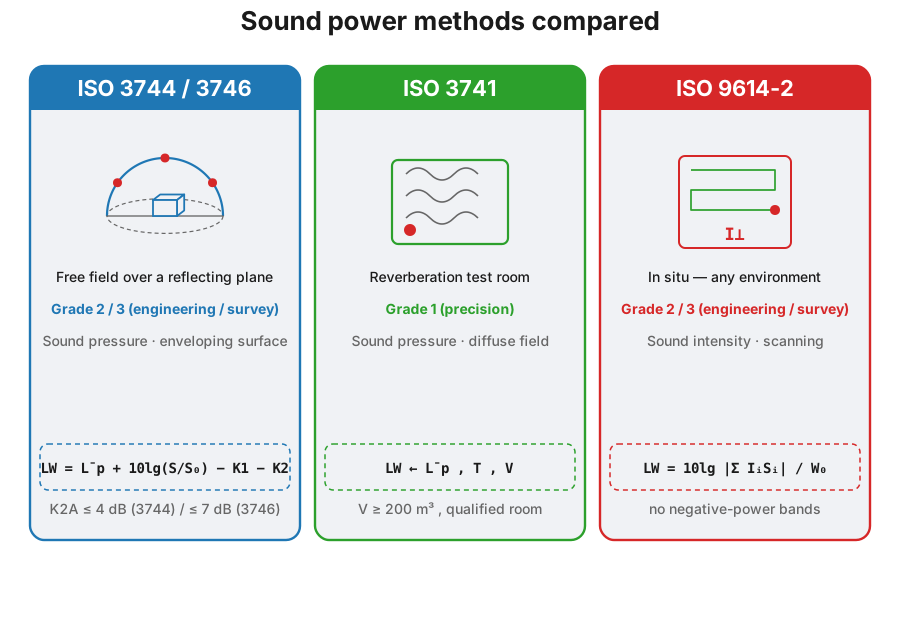
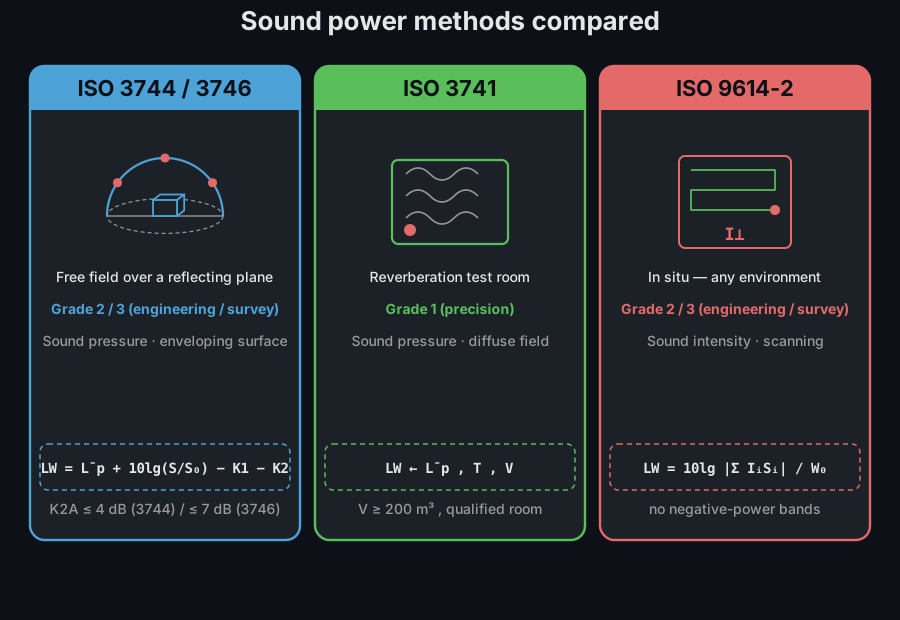 *The three routes to LW: enveloping pressure surface, reverberation room and intensity scan.*
### Enveloping-surface pressure (ISO 3744/3746)
Over a reflecting plane the free-field relation is simply
$L_W = \bar{L}_p + 10 \log_{10}(S/S_0)$: the mean-square pressure averaged over
an enveloping surface of area $S$, multiplied by $S$, is the radiated power.
Two corrections restore that idealisation. Uncorrelated **background noise**
adds its mean square to the source's, so with the margin
$\Delta L_p = L_{ST} - L_{bg}$ the source-only level is recovered by subtracting
$K_1 = -10 \log_{10}(1 - 10^{-\Delta L_p/10})$ (from $p_{src}^2 = p_{ST}^2 (1 - 10^{-\Delta L_p/10})$).
The **reverberant field** of a non-anechoic room adds a near-uniform energy
density $4P/(A c)$ to the direct $P/(S c)$, so the surface level exceeds the
free-field value by their ratio, $K_2 = 10 \log_{10}(1 + 4 S/A)$, with $A$ the
room's equivalent absorption area. The surface area is the closed form of the
geometry: a hemisphere $S = 2 \pi r^2$ over one reflecting plane (halved and
quartered for two and three planes), a one-plane box $S = 4(ab + bc + ca)$ with
$a = 0.5\ l_1 + d$, $b = 0.5\ l_2 + d$, $c = l_3 + d$. ISO 3746 (survey) shares
the maths with looser criteria. The expanded uncertainty is
$U = 2 \sqrt{\sigma_{R0}^2 + \sigma_{omc}^2}$.
### Precision grade in anechoic rooms (ISO 3745)
ISO 3745:2012 is the grade-1 (precision) sibling: a qualified anechoic or
hemi-anechoic room removes the reverberant field, so there is no $K_2$ term and
the corrections become meteorological. The power level is
$L_W = \bar{L}_p + 10 \lg(S/S_0) + C_1 + C_2 + C_3$ (Eq. 14/15) over a full
sphere $S = 4 \pi r^2$ or hemisphere $S = 2 \pi r^2$, with the background
correction $K_{1i} = -10 \lg(1 - 10^{-0.1 \Delta L_{pi}})$ applied per
microphone position *before* the energy average (Eq. 11); no correction is
needed above a 15 dB margin, and below 10 dB (250 Hz – 5 kHz) or 6 dB (edge
bands) the correction is clamped and the result flagged as an upper bound
(clause 9.4.2). The meteorological terms are
$C_1 = -10 \lg(p_s/p_{s0}) + 5 \lg[(273 + \theta)/\theta_0]$ and
$C_2 = -10 \lg(p_s/p_{s0}) + 15 \lg[(273 + \theta)/\theta_1]$ with
$\theta_0 = 314$ K, $\theta_1 = 296$ K: at the 23 °C / 101.325 kPa reference
$C_2 = 0$ exactly and $C_1 = -0.128$ dB; and
$C_3 = A_0 (1.0053 - 0.0012 A_0)^{1.6}$ with $A_0 = a(f)\ r$ restores the
ISO 9613-1 air absorption over the measurement radius. The Annex D/E
microphone arrays are built in as digit-exact coordinate tables (40 equal-area
positions; the mirror set 21–40 is added when the band-SPL spread exceeds
$N_M/2$, clause 9.3.2), and the same positions yield the directivity index
$DI_i = L_{pi} - \bar{L}_p$ (Eq. 21). The clause 10.5 uncertainty example,
$U = 2\sqrt{0.5^2 + 2.0^2} = 4.12$ dB, is reproduced, along with the Table 2/3
per-band $\sigma_{R0}$ values.
### Reverberation room (ISO 3741)
In a qualified diffuse field the steady energy density $w = 4P/(A c)$ ties the
power to the room absorption, giving $L_W = \bar{L}_p + 10 \log_{10}(A/A_0) - 6$
plus higher-order corrections, with $A = (55.26/c)(V/T_{60})$ and
$c = 20.05 \sqrt{273 + \theta}$. The **Waterhouse correction**
$10 \log_{10}(1 + S c/(8 V f))$ compensates the extra energy stored in the
boundary layer that interior microphones miss ($S c/(8 V f) = S \lambda/(8 V)$,
so it fades as frequency rises); the $4.34\ A/S$ term is the mean-free-path air
correction, and $C_1$, $C_2$ carry the result to the reference meteorological
conditions (23 °C, 101.325 kPa). The **comparison method** subtracts a
reference source of known power measured in the same room,
$L_W = L_{W(\text{RSS})} + (\bar{L}_p - \bar{L}_{p,\text{RSS}} + C_2)$, so the
absorption-area, Waterhouse and $C_1$ terms cancel and the room need not be
characterised.
### Intensity scanning (ISO 9614-2)
Sound intensity is the net energy flux $\vec{I} = \overline{p\ \vec{u}}$, so by
the divergence theorem the power through a closed surface is
$P = \sum_i \langle I_{n,i} \rangle\ S_i$. A steady source *outside* the surface
contributes zero net flux (its energy enters and leaves), which is why
intensity rejects stationary background noise, but it can still drive a band's
$P$ negative, in which case that band is not determinable. Two normative field
indicators gate validity: the surface pressure-intensity indicator
$F_{pI} = [L_p] - L_W + 10 \log_{10}(S/S_0)$ (reactivity) and the
negative-partial-power indicator
$F_{+/-} = 10 \log_{10}(\sum_i \lvert P_i \rvert / \lvert \sum_i P_i \rvert)$
(recirculation), together with the probe's dynamic capability
$L_d = \delta_{pI0} - K$ ($K = 10$ dB grade 2, 7 dB grade 3), which must exceed
$F_{pI}$. A band earns the engineering grade when $L_d > F_{pI}$, $F_{+/-} \le 3$ dB
and the two repeated sweeps agree within the Table 2 limit.
### Precision intensity scanning (ISO 9614-3)
ISO 9614-3:2002 upgrades the scanning method to precision grade with a tighter
indicator machinery. The partial powers $P_i = I_{n,i} S_i$ (Eq. 5) sum as
before, but validity now rests on the signed and unsigned pressure-intensity
indicators $F_{pIn} = \bar{L}_p - L_{In}$ (Eqs. B.3/B.6, the F2/F3 of
ISO 9614-1) and the normalized intensity non-uniformity $F_S$ (Eq. B.8),
through five acceptance criteria (Annex C): scan repeatability
$|L_{In}(1) - L_{In}(2)| \le s/2$ (C.1), dynamic capability
$L_d = \delta_{pI0} - K \ge F_{pIn}(\text{signed})$ with the precision
bias-error factor $K = 10$ dB (C.2),
$F_{pIn}(\text{signed}) - F_{pIn}(\text{unsigned}) \le 3$ dB (C.3),
$F_S \le 2$ (C.4) and the scan-density convergence
$0.83 \le F_S(1)/F_S(2) \le 1.2$ (C.5). Eq. 10 normalizes the result to the
reference meteorological conditions,
$L_{W0} = L_W - 15 \lg[(B/101325) \cdot 296.15/(273.15 + \theta)]$. Bands whose
net power is negative are not determinable (clause 9.2) and are flagged. A
uniform normal intensity recovers the power exactly (100 µW over 3.75 m² →
80.0 dB re 1 pW), independent of how the surface is segmented.
See the [Sound Power guide](/phonometry/guides/sound-power/) for usage.
*The three routes to LW: enveloping pressure surface, reverberation room and intensity scan.*
### Enveloping-surface pressure (ISO 3744/3746)
Over a reflecting plane the free-field relation is simply
$L_W = \bar{L}_p + 10 \log_{10}(S/S_0)$: the mean-square pressure averaged over
an enveloping surface of area $S$, multiplied by $S$, is the radiated power.
Two corrections restore that idealisation. Uncorrelated **background noise**
adds its mean square to the source's, so with the margin
$\Delta L_p = L_{ST} - L_{bg}$ the source-only level is recovered by subtracting
$K_1 = -10 \log_{10}(1 - 10^{-\Delta L_p/10})$ (from $p_{src}^2 = p_{ST}^2 (1 - 10^{-\Delta L_p/10})$).
The **reverberant field** of a non-anechoic room adds a near-uniform energy
density $4P/(A c)$ to the direct $P/(S c)$, so the surface level exceeds the
free-field value by their ratio, $K_2 = 10 \log_{10}(1 + 4 S/A)$, with $A$ the
room's equivalent absorption area. The surface area is the closed form of the
geometry: a hemisphere $S = 2 \pi r^2$ over one reflecting plane (halved and
quartered for two and three planes), a one-plane box $S = 4(ab + bc + ca)$ with
$a = 0.5\ l_1 + d$, $b = 0.5\ l_2 + d$, $c = l_3 + d$. ISO 3746 (survey) shares
the maths with looser criteria. The expanded uncertainty is
$U = 2 \sqrt{\sigma_{R0}^2 + \sigma_{omc}^2}$.
### Precision grade in anechoic rooms (ISO 3745)
ISO 3745:2012 is the grade-1 (precision) sibling: a qualified anechoic or
hemi-anechoic room removes the reverberant field, so there is no $K_2$ term and
the corrections become meteorological. The power level is
$L_W = \bar{L}_p + 10 \lg(S/S_0) + C_1 + C_2 + C_3$ (Eq. 14/15) over a full
sphere $S = 4 \pi r^2$ or hemisphere $S = 2 \pi r^2$, with the background
correction $K_{1i} = -10 \lg(1 - 10^{-0.1 \Delta L_{pi}})$ applied per
microphone position *before* the energy average (Eq. 11); no correction is
needed above a 15 dB margin, and below 10 dB (250 Hz – 5 kHz) or 6 dB (edge
bands) the correction is clamped and the result flagged as an upper bound
(clause 9.4.2). The meteorological terms are
$C_1 = -10 \lg(p_s/p_{s0}) + 5 \lg[(273 + \theta)/\theta_0]$ and
$C_2 = -10 \lg(p_s/p_{s0}) + 15 \lg[(273 + \theta)/\theta_1]$ with
$\theta_0 = 314$ K, $\theta_1 = 296$ K: at the 23 °C / 101.325 kPa reference
$C_2 = 0$ exactly and $C_1 = -0.128$ dB; and
$C_3 = A_0 (1.0053 - 0.0012 A_0)^{1.6}$ with $A_0 = a(f)\ r$ restores the
ISO 9613-1 air absorption over the measurement radius. The Annex D/E
microphone arrays are built in as digit-exact coordinate tables (40 equal-area
positions; the mirror set 21–40 is added when the band-SPL spread exceeds
$N_M/2$, clause 9.3.2), and the same positions yield the directivity index
$DI_i = L_{pi} - \bar{L}_p$ (Eq. 21). The clause 10.5 uncertainty example,
$U = 2\sqrt{0.5^2 + 2.0^2} = 4.12$ dB, is reproduced, along with the Table 2/3
per-band $\sigma_{R0}$ values.
### Reverberation room (ISO 3741)
In a qualified diffuse field the steady energy density $w = 4P/(A c)$ ties the
power to the room absorption, giving $L_W = \bar{L}_p + 10 \log_{10}(A/A_0) - 6$
plus higher-order corrections, with $A = (55.26/c)(V/T_{60})$ and
$c = 20.05 \sqrt{273 + \theta}$. The **Waterhouse correction**
$10 \log_{10}(1 + S c/(8 V f))$ compensates the extra energy stored in the
boundary layer that interior microphones miss ($S c/(8 V f) = S \lambda/(8 V)$,
so it fades as frequency rises); the $4.34\ A/S$ term is the mean-free-path air
correction, and $C_1$, $C_2$ carry the result to the reference meteorological
conditions (23 °C, 101.325 kPa). The **comparison method** subtracts a
reference source of known power measured in the same room,
$L_W = L_{W(\text{RSS})} + (\bar{L}_p - \bar{L}_{p,\text{RSS}} + C_2)$, so the
absorption-area, Waterhouse and $C_1$ terms cancel and the room need not be
characterised.
### Intensity scanning (ISO 9614-2)
Sound intensity is the net energy flux $\vec{I} = \overline{p\ \vec{u}}$, so by
the divergence theorem the power through a closed surface is
$P = \sum_i \langle I_{n,i} \rangle\ S_i$. A steady source *outside* the surface
contributes zero net flux (its energy enters and leaves), which is why
intensity rejects stationary background noise, but it can still drive a band's
$P$ negative, in which case that band is not determinable. Two normative field
indicators gate validity: the surface pressure-intensity indicator
$F_{pI} = [L_p] - L_W + 10 \log_{10}(S/S_0)$ (reactivity) and the
negative-partial-power indicator
$F_{+/-} = 10 \log_{10}(\sum_i \lvert P_i \rvert / \lvert \sum_i P_i \rvert)$
(recirculation), together with the probe's dynamic capability
$L_d = \delta_{pI0} - K$ ($K = 10$ dB grade 2, 7 dB grade 3), which must exceed
$F_{pI}$. A band earns the engineering grade when $L_d > F_{pI}$, $F_{+/-} \le 3$ dB
and the two repeated sweeps agree within the Table 2 limit.
### Precision intensity scanning (ISO 9614-3)
ISO 9614-3:2002 upgrades the scanning method to precision grade with a tighter
indicator machinery. The partial powers $P_i = I_{n,i} S_i$ (Eq. 5) sum as
before, but validity now rests on the signed and unsigned pressure-intensity
indicators $F_{pIn} = \bar{L}_p - L_{In}$ (Eqs. B.3/B.6, the F2/F3 of
ISO 9614-1) and the normalized intensity non-uniformity $F_S$ (Eq. B.8),
through five acceptance criteria (Annex C): scan repeatability
$|L_{In}(1) - L_{In}(2)| \le s/2$ (C.1), dynamic capability
$L_d = \delta_{pI0} - K \ge F_{pIn}(\text{signed})$ with the precision
bias-error factor $K = 10$ dB (C.2),
$F_{pIn}(\text{signed}) - F_{pIn}(\text{unsigned}) \le 3$ dB (C.3),
$F_S \le 2$ (C.4) and the scan-density convergence
$0.83 \le F_S(1)/F_S(2) \le 1.2$ (C.5). Eq. 10 normalizes the result to the
reference meteorological conditions,
$L_{W0} = L_W - 15 \lg[(B/101325) \cdot 296.15/(273.15 + \theta)]$. Bands whose
net power is negative are not determinable (clause 9.2) and are flagged. A
uniform normal intensity recovers the power exactly (100 µW over 3.75 m² →
80.0 dB re 1 pW), independent of how the surface is segmented.
See the [Sound Power guide](/phonometry/guides/sound-power/) for usage.