Source: https://jmrplens.github.io/phonometry/guides/room-noise/
# Room-noise criteria (NC / RC Mark II)
Steady background noise in an occupied room (from ventilation, diffusers or
distant traffic) is rated against a family of **octave-band criterion curves**.
**ANSI/ASA S12.2-2019**, *Criteria for Evaluating Room Noise*, defines two
spectrum-in ratings that phonometry implements: the **Noise Criteria (NC)**
rating (the NC-(SIL) designation of clause 5.2.2, with the tangency method
when the spectrum exceeds it), and the **Room Criteria Mark II (RC)** rating
with its rumble/hiss spectral tag. Both work on octave-band sound pressure
levels over the ten bands from 16 Hz to 8000 Hz.
## 1. Noise Criteria: SIL designation and tangency
The **NC curves** (ANSI/ASA S12.2-2019 Table 1) are a family of octave-band
limits, each designated by its value at 1000 Hz (NC-15 up to NC-70). Clause
5.2.2 rates a spectrum in **two steps**. First the **speech interference
level** `SIL` (clause 3.2, the average of the 500/1000/2000/4000 Hz levels)
selects the NC-(SIL) curve: if no octave band exceeds it, the spectrum is
simply designated **NC-(SIL)**. Only when the spectrum pokes above that curve
does the **tangency method** (clause 5.2.3) take over: for each octave band,
the NC index whose curve passes through the measured level is found, and the
rating is the maximum across bands. The band where that maximum occurs, the
one that pushes the spectrum up against the curves, is reported as the
**governing band**.
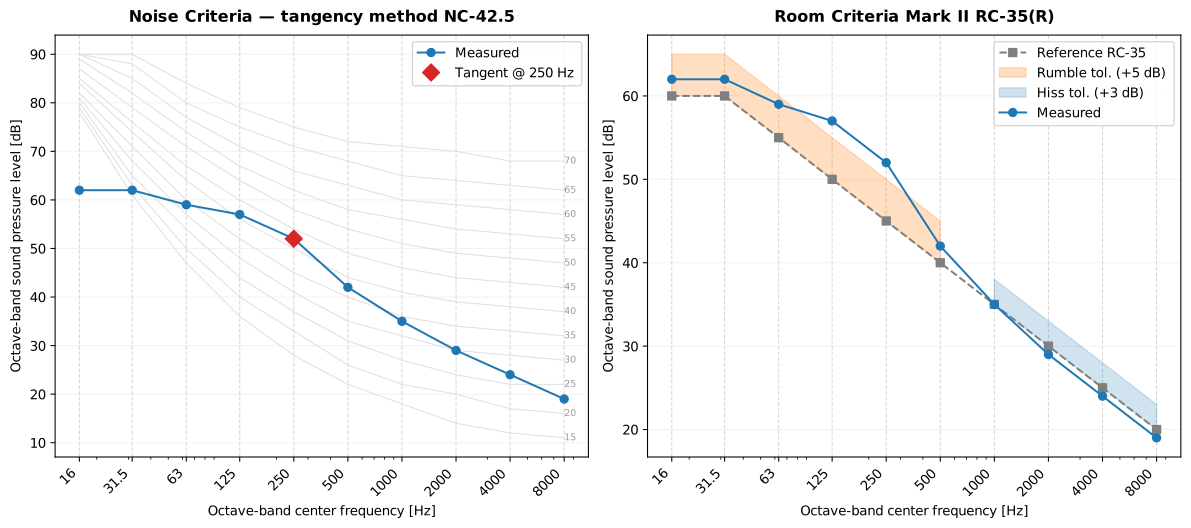
```python
import numpy as np
from phonometry import room
# Octave-band SPL, 16 Hz - 8000 Hz (a ventilation-dominated room).
spl = np.array([62.0, 62.0, 59.0, 57.0, 52.0, 42.0, 35.0, 29.0, 24.0, 19.0])
nc = room.noise_criterion(spl)
print(round(nc.sil, 1)) # 32.5 (clause 3.2)
print(nc.method) # 'tangency' (the NC-32 curve is exceeded)
print(round(nc.rating, 1)) # 42.5
print(nc.governing_frequency) # 250.0 (the tangent band)
print(nc.label) # 'NC-42.5 (250 Hz)'
nc.plot() # the spectrum over the NC curve family (left panel below)
```
Because a tangency rating interpolates between the tabulated curves it is a
continuous number: an NC rating of `42.5` sits half-way between NC-40 and
NC-45 (a SIL designation is always an integer). The tangency rating is kept
on `tangency_rating` even when the SIL designation applies. A subset of the
octave bands may be supplied together with their centre frequencies
(`room.noise_criterion(levels, frequencies)`); without the four SIL bands the
tangency rating alone sets the designation.
The Table 1 family ends at NC-70 and NC-15, and the standard defines no
rating beyond it. A spectrum above the NC-70 curve (or entirely below the
NC-15 curve) therefore gets `rating = nan` and an `out_of_range` flag of
`"above"` / `"below"`, with `nc.label` reading `'>NC-70 (63 Hz)'` (the band
with the largest exceedance over NC-70 governs) or `'Show the code for this figure
```python
import numpy as np
import matplotlib.pyplot as plt
from phonometry import room
spl = np.array([62.0, 62.0, 59.0, 57.0, 52.0, 42.0, 35.0, 29.0, 24.0, 19.0])
# One line each:
room.noise_criterion(spl).plot()
room.room_criterion(spl).plot()
plt.show()
# By hand, mirroring what NCResult.plot() / RCResult.plot() draw:
from phonometry.room.room_noise import NC_CURVES, NC_INDICES, OCTAVE_BANDS
nc, rc = room.noise_criterion(spl), room.room_criterion(spl)
fig, (ax1, ax2) = plt.subplots(1, 2, figsize=(12, 5))
for row, idx in zip(NC_CURVES, NC_INDICES):
ax1.plot(OCTAVE_BANDS, row, color="#bbbbbb", lw=0.8)
ax1.plot(OCTAVE_BANDS, spl, "o-", label="Measured")
gov = spl[OCTAVE_BANDS == nc.governing_frequency][0]
ax1.plot([nc.governing_frequency], [gov], "D", color="#d62728")
ax1.set_xscale("log"); ax1.set_title(f"NC-{nc.rating:g}")
ref = rc.reference_curve
low, high = OCTAVE_BANDS <= 500, OCTAVE_BANDS >= 1000
ax2.plot(OCTAVE_BANDS, ref, "s--", color="#7f7f7f", label=f"Reference RC-{rc.rating}")
ax2.fill_between(OCTAVE_BANDS[low], ref[low], ref[low] + 5, color="#ffbb78", alpha=0.35)
ax2.fill_between(OCTAVE_BANDS[high], ref[high], ref[high] + 3, color="#aec7e8", alpha=0.45)
ax2.plot(OCTAVE_BANDS, spl, "o-", label="Measured")
ax2.set_xscale("log"); ax2.set_title(rc.label)
plt.show()
```
The `NCResult` carries the `rating`, the `sil`, the `tangency_rating`, the
`method` (`'SIL'` or `'tangency'`), the `governing_frequency`, the
`out_of_range` flag and the measured `levels`, plus a convenience `label`
(`'NC-44'`, `'NC-51 (125 Hz)'`, `'>NC-70 (63 Hz)'`); the `RCResult` carries
the `rating`, the `lmf`, the `classification`, the `reference_curve`, an
`out_of_family` flag (Table D.1 tabulates RC-25 through RC-50 only) and a
convenience `label` in the `RC-NN(A)` form. Clause D.3.5 admits the tags
`N`, `R`, `H` or `RV`; when both the rumble and hiss deviations fire, the
library reports the combined `RH` as a diagnostic extension. Each result
exposes a `.plot()` that renders its panel above. Clause D.4 expects at
least the 31.5 Hz to 4000 Hz octave bands: a spectrum missing any of them
still rates, but emits a `UserWarning` because the absent bands are skipped
by the tag deviation tests.
The balanced noise criteria (NCB), the room noise criterion for fluctuating
low-frequency noise (RNC, which needs a time series rather than a single
spectrum), the vibration/rattle tag (`RV`, which needs the Table 6 test) and
the numeric quality-assessment index (QAI, which the standard defers to
external references) are not part of this module.
## 3. Choosing a criterion: NC, RC Mark II or NR
The two ratings answer different questions, and a third family exists that
this module deliberately does not implement:
- **NC** answers *"does the room meet its limit, and which band breaks
it?"*. It is the compliance rating of North-American practice
(specifications, codes, equipment schedules). The clause 5.2.2 SIL step
anchors the designation to speech interference, but the moment any band
exceeds the NC-(SIL) curve the tangency method takes over and is driven
entirely by the single governing band. That is also its blind spot: two
NC-40 rooms can sound completely different, one rumbly and one hissy,
because tangency says nothing about spectral balance. Use NC when a
specification cites it, and always report the governing band with a
tangency rating, since it names the octave any fix must attack first.
- **RC Mark II** answers *"how does the room sound, and what should be
fixed?"*. Its rating tracks speech interference through the
mid-frequency average, and its reference slope of −5 dB per octave is
the spectrum occupants describe as neutral, a bland ventilation
background that is neither boomy nor sharp. The spectral tag then points
at the offending frequency range. Reach for RC Mark II at HVAC design
time, or to diagnose an installation that fails its NC limit.
- **NR (Noise Rating)**, the curve family of Kosten & van Os (1962), is
the European counterpart of NC: the same tangency logic over a
slightly different curve family (more permissive
at low frequency, stricter at high), common in European and
international equipment and building specifications. phonometry does not
implement NR; when a specification cites NR, rate against the NR curves
themselves rather than substituting NC, because the two families diverge
by several decibels away from the mid frequencies.
**Reading the tag.** The RC Mark II tag is a repair hint, not just a label.
A rumble tag (`R`, more than 5 dB over the reference at or below 500 Hz)
points at the air-handling plant: an oversized or starved fan, duct
rumble, or structure-borne vibration re-radiated by walls, and it is the
low-frequency energy that rattles lightweight construction and fatigues
occupants. A hiss tag (`H`, more than 3 dB over at or above 1000 Hz)
points at the terminal end: diffuser and grille face velocities or a
throttled damper close to the outlet, and it is the range that masks
speech. A neutral tag (`N`) means the level can still be wrong, but the
character is right: reduce the whole spectrum rather than reshape it.
## 4. Room-noise reports (`.report()`)
Both ratings render a one-page PDF room-noise assessment fiche. `NCResult.report(path)`
and `RCResult.report(path)` share the same layout: a standard-basis line, an
optional metadata header block, the measured octave-band levels beside the
measured spectrum plotted against the NC/RC curve family (the result's own
`.plot()`), the boxed rating, an optional verdict row and a footer with the
fixed disclaimer. The NC box shows the `NC-nn` designation with the SIL and,
for a tangency rating, its governing band (`>NC-70` / `