Source: https://jmrplens.github.io/phonometry/devices/emission/sound-power/
# Sound Power
Sound *pressure* depends on where you stand and on the room you stand in;
sound **power** does not. The sound power level $L_W$ is the total acoustic
energy per second a source radiates, referenced to $P_0 = 1\ \text{pW}$, and it is
the device-independent **emission** descriptor that goes on a datasheet,
feeds a room prediction (EN 12354) or is checked against a noise-emission
limit. phonometry implements five standardised routes to it, split across
three method guides: an enveloping *pressure* surface in the field
(ISO 3744/3746) and the precision grade in an *anechoic room* (ISO 3745),
covered in [Sound Power by Pressure Methods](https://jmrplens.github.io/phonometry/devices/emission/sound-power-pressure/); the
diffuse field of a *reverberation room* (ISO 3741), covered in
[Sound Power in the Reverberation Room](https://jmrplens.github.io/phonometry/devices/emission/sound-power-reverberation/); and
*intensity* scanning over a surface (ISO 9614-2), with its precision
counterpart (ISO 9614-3), covered in
[Sound Power by Intensity Scanning](https://jmrplens.github.io/phonometry/devices/emission/sound-power-intensity/). This page is
the front door: how to choose among them, what the accuracy grades actually
promise, and how a measured $L_W$ becomes the ISO 4871 noise-emission
declaration a datasheet prints.
[Watch the high-resolution video (WebM)](https://raw.githubusercontent.com/jmrplens/phonometry/main/.github/images/anim_power_two_rooms.webm)
## Choosing a method
All deliver the same quantity, a per-band $L_W$ and an A-weighted total
$L_{W\mathrm{A}}$, but under different environments, accuracy grades and practical
constraints.
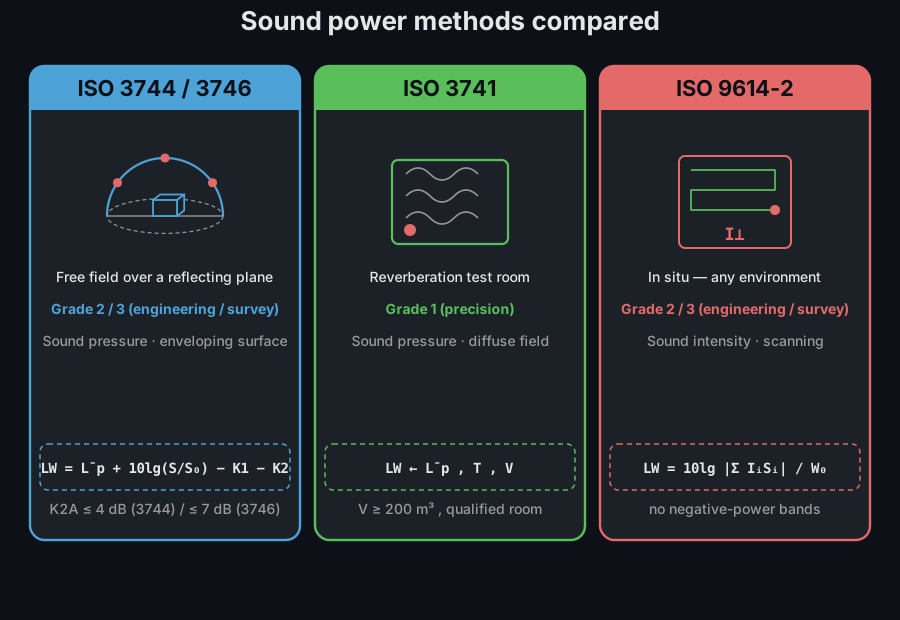
| Method | Standard | Measured quantity | Environment | Accuracy grade | Use when |
| :--- | :--- | :--- | :--- | :--- | :--- |
| Enveloping surface | **ISO 3744** (engineering) / **ISO 3746** (survey) | Sound pressure on a hemisphere or box | Essentially free field over one or more reflecting planes | Grade 2 ($\sigma_{\mathrm{R}0} \approx 1.5\ \text{dB}$) / grade 3 ($\approx 3.0\ \text{dB}$) | In situ or a large room; no special test facility available |
| Reverberation room | **ISO 3741** | Sound pressure in the diffuse field | Qualified hard-walled reverberation room | Grade 1 (precision) | Highest accuracy for steady, broadband sources in a lab |
| Intensity scanning | **ISO 9614-2** | Normal sound intensity scanned over a surface | Almost any, tolerant of steady extraneous noise | Grade 2 / 3 (from per-band field indicators) | On-site with background noise, or one machine among many |
| Anechoic room | **ISO 3745** | Sound pressure on a fixed microphone array | Qualified anechoic or hemi-anechoic room | Grade 1 (precision) | Reference-grade emission in a free-field laboratory |
| Precision intensity scanning | **ISO 9614-3** | Scanned normal intensity, tighter criteria | Almost any, tolerant of steady extraneous noise | Grade 1 (precision) | Precision on-site, with the ISO 9614-3 field-indicator checks |
The pressure methods correct the surface level for the room ($K_2$) and for
background noise ($K_1$); the reverberation method needs a *qualified* room
but reaches precision grade; intensity rejects steady background energy at
the cost of a two-microphone probe and a per-band validity check. Each
method guide walks its routes in turn.
Show the code for this figure
```python
import matplotlib.pyplot as plt
import numpy as np
from phonometry import emission
# One steady source (octave-band LW below) determined by three routes.
freqs = np.array([125.0, 250.0, 500.0, 1000.0, 2000.0, 4000.0])
lw_true = np.array([85.0, 88.0, 90.0, 89.0, 86.0, 82.0])
# ISO 3744: SPL at 10 positions on a hemisphere, r = 2 m (10 lg(S/S0) = 14 dB).
pres = emission.sound_power_pressure(np.tile(lw_true - 14.0, (10, 1)),
"hemisphere", radius=2.0,
frequencies=freqs)
# ISO 9614-2: uniform normal intensity scanned over six 0.5 m2 segments.
i_n = np.tile(10.0 ** (lw_true / 10.0) * 1e-12 / 3.0, (6, 1))
inten = emission.sound_power_intensity(i_n, np.full(6, 0.5),
frequencies=freqs, band_type="octave")
# ISO 3741: comparison against a reference source of known LW = 84 dB per band.
comp = emission.sound_power_comparison(lw_true - 20.0, np.full(6, 64.0),
np.full(6, 84.0), frequencies=freqs)
fig, ax = plt.subplots()
for res, style, ms, label in ((pres, "-o", 11, "pressure (ISO 3744)"),
(inten, "--s", 8, "intensity (ISO 9614-2)"),
(comp, ":^", 5, "reference source (ISO 3741)")):
ax.semilogx(freqs, res.sound_power_level, style, markersize=ms,
label=f"{label}: LWA = {res.sound_power_level_a:.1f} dB")
ax.set(xlabel="Frequency [Hz]", ylabel="Sound power level LW [dB]")
ax.legend()
plt.show()
```
### A decision path
The table compresses into a short sequence of questions (ISO 3740 dedicates
its Table 3 and Annex D to exactly this decision). Work through them in
order; the first match names the standard.
1. **What is the number for?** A datasheet declaration or a limit check
normally asks for engineering grade (grade 2, the preferred grade for
noise declarations); a reference source, a product ranking or a dispute
calls for precision (grade 1); a first walk-through of a noisy plant
tolerates survey grade (grade 3). Grade 1 exists only in a qualified
laboratory room (ISO 3741, ISO 3745) or via the precision intensity
methods (ISO 9614-1 at discrete points, ISO 9614-3 by scanning).
2. **Can the source travel to a laboratory?** ISO 3741 wants the source
small next to the room (volume no more than about 2 % of the room volume)
and its noise steady; ISO 3745 wants it inside a qualified anechoic or
hemi-anechoic room with a characteristic dimension below half the
measurement radius, and it is the route that also yields directivity. A
machine bolted to its foundation rules both out and leaves the in-situ
methods.
3. **How quiet and how dry is the site?** ISO 3744 needs the background at
least 6 dB below the source (preferably more than 15 dB) and
$K_2 \le 4\ \text{dB}$. If only a
3 dB margin or $K_2 \le 7\ \text{dB}$ can be met, the same microphones and formulae
degrade gracefully to ISO 3746 at survey grade.
4. **Is the background the problem?** When neighbouring machines cannot be
switched off, or the margin is outright negative, the pressure methods
are out. Intensity scanning (ISO 9614-2, or ISO 9614-3 for grade 1)
tolerates steady extraneous noise even some 10 dB *above* the source,
because only the net energy flux through the surface counts; the
per-band field indicators then decide the grade actually achieved.
### What the accuracy grades mean
The grade is a claim about **reproducibility**: $\sigma_{\mathrm{R}0}$ is the standard
deviation you would see if different laboratories measured the same source,
each following the standard correctly. Typical A-weighted values are
$\sigma_{\mathrm{R}0} \approx 0.5\ \text{dB}$ for grade 1 (ISO 3741), 1.5 dB for grade 2 (ISO 3744,
ISO 9614-2) and 3 dB or more for grade 3 (larger still when $K_2$ is
large or the spectrum is tonal). Per-band values are larger at the
spectrum edges. The `uncertainty` field of the pressure-method results
(enveloping surface and anechoic) is the expanded uncertainty
$U = 2\sigma_\text{tot}$ (95 % coverage), where
$\sigma_\text{tot} = \sqrt{\sigma_{\mathrm{R}0}^2 + \sigma_\text{omc}^2}$ also folds
in the operating/mounting instability
$\sigma_\text{omc}$ that you estimate and pass in; the grade only bounds the method's
share of the budget.
In practice: a grade-2 $L_{W\mathrm{A}}$ of 92.4 dB carries $U \approx 3\ \text{dB}$, so two grade-2
results 2 dB apart are statistically indistinguishable, and checking that
same source against a 93 dB limit is a coin flip. Choose the grade from the
decision the number has to support, not from the facility that happens to
be free.
## Declaring the noise emission (ISO 4871)
A measured sound power level is not yet a *declaration*. ISO 4871:1996 is the
standard for the noise-emission declaration a manufacturer prints in technical
documents: which quantities are stated, in which form, and how a declared value
is verified. The preferred quantity is the A-weighted sound power level
$L_{W\mathrm{A}}$, optionally accompanied by the A-weighted emission sound pressure level
$L_{p\mathrm{A}}$ at a work station.
A declaration takes one of two alternative forms (clause 4):
- the **dual-number** form (clause 3.16): the measured value $L_{W\mathrm{A}}$ and its
uncertainty $K_{W\mathrm{A}}$ stated together but separately; and
- the **single-number** form (clause 3.15): the derived declared value
$L_{W\mathrm{Ad}} = L_{W\mathrm{A}} + K_{W\mathrm{A}}$, an upper limit that repeated measurements are unlikely
to exceed at the stated confidence level.
$K_{W\mathrm{A}}$ combines the measurement (reproducibility) and, for a batch, the
production spread; for a single machine $K = 1.645\,\sigma_\mathrm{R}$ (Annex A.2.2). A
`NoiseEmissionDeclaration` holds one or more per-operating-mode declarations
and renders the ISO 4871 fiche through `.report()`. The quickest route is to
`declare()` straight from a measured sound power:
```python
import numpy as np
import phonometry as ph
from phonometry import ReportMetadata
# ... a measured LWA from ISO 3744 ...
result = ph.sound_power_pressure(levels, "hemisphere", radius=1.0,
frequencies=freqs)
declaration = result.declare(
uncertainty=2.0, # K_WA in dB (defaults to the expanded U)
machine="Type 990, Model 11-TC",
operating_conditions="50 Hz, 230 V, rated load",
basic_standards="ISO 3744",
verification_level=result.sound_power_level_a, # L_1 for clause 6.2
)
declaration.report(
"iso4871.pdf",
metadata=ReportMetadata(measurement_standard="ISO 3744"),
) # -> L_WAd = L_WA + K_WA, verified when L_1 <= L_WAd
```
Or build the declaration directly, reproducing the ISO 4871 Annex B example
(two operating modes, $L_{W\mathrm{A}} = 88$ and 95 dB with $K_{W\mathrm{A}} = 2$ dB, giving
declared $L_{W\mathrm{Ad}} = 90$ and 97 dB):
```python
mode1 = ph.OperatingModeDeclaration(
"Operating mode 1", sound_power_level=88.0, sound_power_uncertainty=2.0,
emission_pressure_level=78.0, emission_pressure_uncertainty=2.0,
verification_level=89.0, # passes: 89 <= 90
)
mode2 = ph.OperatingModeDeclaration(
"Operating mode 2", sound_power_level=95.0, sound_power_uncertainty=2.0,
emission_pressure_level=86.0, emission_pressure_uncertainty=2.0,
verification_level=98.0, # fails: 98 > 97
)
ph.NoiseEmissionDeclaration(
(mode1, mode2), machine="Type 990, Model 11-TC",
basic_standards=("ISO 3744", "ISO 11202"), form="dual-number",
).report("iso4871.pdf")
```
The example fiche, regenerated with `make reports`, is kept rendered in the
repository. Click the preview to open the PDF:
[](https://raw.githubusercontent.com/jmrplens/phonometry/main/.github/reports/iso4871_declaration_example.pdf)
*Noise emission declaration fiche (`NoiseEmissionDeclaration.report`), the
ISO 4871 Annex B dual-number table with the declared $L_{W\mathrm{Ad}} = L_{W\mathrm{A}} + K_{W\mathrm{A}}$ and
the clause 6.2 verification verdict.*
## See also
- [Sound Power by Pressure Methods (ISO 3744 / ISO 3746 / ISO 3745)](https://jmrplens.github.io/phonometry/devices/emission/sound-power-pressure/):
the enveloping surface with its $K_1$/$K_2$ corrections, and the precision
anechoic array.
- [Sound Power in the Reverberation Room (ISO 3741)](https://jmrplens.github.io/phonometry/devices/emission/sound-power-reverberation/):
the precision diffuse-field method with the Waterhouse and meteorological
corrections.
- [Sound Power by Intensity Scanning (ISO 9614-2 / ISO 9614-3)](https://jmrplens.github.io/phonometry/devices/emission/sound-power-intensity/):
the routes that tolerate steady background noise, qualified by their field
indicators.
- [Sound Intensity (p-p)](https://jmrplens.github.io/phonometry/devices/emission/intensity/): the two-microphone probe behind the
scanning methods.
- [Room Acoustics](https://jmrplens.github.io/phonometry/buildings/rooms/room-acoustics/): the reverberation time and equivalent
absorption area that feed the room corrections.
- [Levels](https://jmrplens.github.io/phonometry/signals/levels/levels/): energy averaging and the A-weighting behind $L_{W\mathrm{A}}$.
- [Theory](https://jmrplens.github.io/phonometry/reference/theory/environment-transport/): the Waterhouse, $K_1$/$K_2$ and $C_1$/$C_2$ derivations.
- API reference: [`emission.sound_power`](https://jmrplens.github.io/phonometry/reference/api/power/sound-power/), [`emission.sound_power_reverberation`](https://jmrplens.github.io/phonometry/reference/api/power/sound-power-reverberation/) and [`emission.sound_power_intensity`](https://jmrplens.github.io/phonometry/reference/api/power/sound-power-intensity/).
## Quick answers
### What is the difference between sound power and sound pressure?
Sound pressure depends on where you stand and on the room; sound power does
not. The sound power level $L_W$ is the total acoustic energy per second a
source radiates, referenced to $P_0 = 1\ \text{pW}$, and it is the device-independent
emission descriptor that goes on a datasheet or is checked against a
noise-emission limit; ISO 3744, ISO 3741, ISO 9614-2, ISO 3745 and
ISO 9614-3 all determine it.
### What do the accuracy grades in sound power measurement mean?
The grade is a claim about reproducibility: $\sigma_{\mathrm{R}0}$ is the standard deviation
you would see if different laboratories measured the same source, each
following the standard correctly. Typical A-weighted values are
$\sigma_{\mathrm{R}0} \approx 0.5\ \text{dB}$ for grade 1 (ISO 3741), 1.5 dB for grade 2 (ISO 3744,
ISO 9614-2) and 3 dB or more for grade 3. A grade-2 $L_{W\mathrm{A}}$ carries
$U \approx 3\ \text{dB}$, so two grade-2 results 2 dB apart are statistically
indistinguishable.
### How do I measure sound power when background noise cannot be switched off?
Use intensity scanning: ISO 9614-2 (grade 2 or 3) or ISO 9614-3 (grade 1,
precision). Because sound intensity is the net energy flux through the
measurement surface, steady extraneous noise even some 10 dB above the
source is tolerated, whereas the ISO 3744 pressure method needs the
background at least 6 dB below the source. The per-band field indicators
then decide the grade actually achieved.
## References
- Beranek, L. L., & Mellow, T. J. (2012). *Acoustics: Sound fields and
transducers*. Academic Press. ISBN 978-0-12-391421-7.
[doi:10.1016/C2011-0-05897-0](https://doi.org/10.1016/C2011-0-05897-0).
Radiation and sound fields: the free-field and diffuse-field relations
between pressure and power that the whole method family rests on.
- International Organization for Standardization. (2019). *Acoustics —
Determination of sound power levels of noise sources — Guidelines for the
use of basic standards* (ISO 3740:2019).
[iso.org catalogue](https://www.iso.org/standard/45107.html).
The selection guide behind "Choosing a method": grades, environments,
source-size and background criteria for the whole family.
- International Organization for Standardization. (1996). *Acoustics —
Declaration and verification of noise emission values of machinery and
equipment* (ISO 4871:1996).
[iso.org catalogue](https://www.iso.org/standard/10868.html).
The declaration section: the dual/single-number forms,
$L_{W\mathrm{Ad}} = L_{W\mathrm{A}} + K_{W\mathrm{A}}$ (clause 3.15) and the clause 6.2 verification.
## Standards
ISO 3740:2019, *Acoustics — Determination of sound power levels of noise
sources — Guidelines for the use of basic standards*: the Table 3 / Annex D
selection guidance condensed into the decision path of this page.
ISO 4871:1996, *Acoustics — Declaration and verification of noise emission
values of machinery and equipment*: the dual-number and single-number
declaration forms, the declared value $L_{W\mathrm{Ad}} = L_{W\mathrm{A}} + K_{W\mathrm{A}}$ and the
clause 6.2 verification. The basic determination standards (ISO 3744/3746,
ISO 3741, ISO 3745, ISO 9614-2/-3) are covered in their method guides.
**Not covered.** Three members of the ISO 3740 family are not implemented at
all — ISO 3743-1, ISO 3743-2 and ISO 3747 — and neither is the sound *energy*
level $L_J$ of a single event. ISO 9614-1's own discrete-point power summation
is absent as well; only its field indicators exist, in
[Sound Intensity (p-p)](https://jmrplens.github.io/phonometry/devices/emission/intensity/). The emission sound pressure level
$L_{p\mathrm{A}}$ that stands beside $L_{W\mathrm{A}}$ in a declaration is consumed here, never
determined: ISO 11201, ISO 11202 and ISO 11204 are outside the library. Of
ISO 4871, only the clause 6.2 single-machine verification is evaluated; the
batch criteria of clause 6.3 are not, and the batch statistics beyond the
single-machine $K = 1{,}645\,\sigma_\mathrm{R}$ case of Annex A.2.2 are stated rather
than derived.